
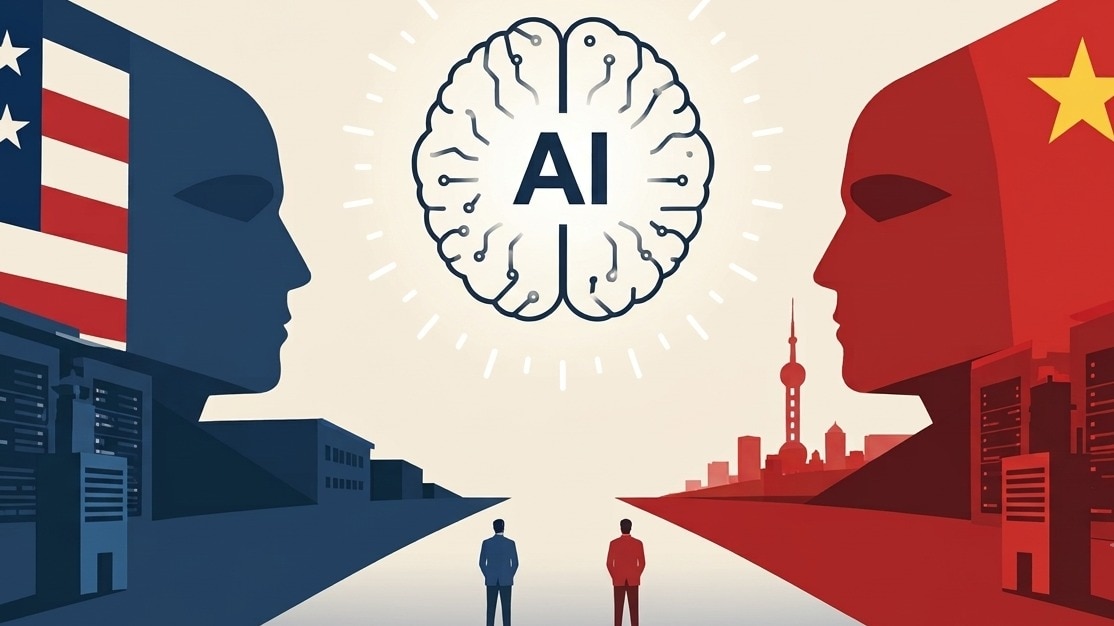
China is strengthening its position in the global AI talent race, while the US continues to attract researchers from across the world. India, meanwhile, is struggling to retain its AI research talent, the Carnegie report finds.China overtakes US in AI talent, India misses out on global research race: Report (AI-generated image)New Delhi,Nov 23, 2026 11:15 ISTChina has emerged as the world's biggest hub for elite artificial intelligence (AI) research talent, overtaking the US as the leading destination for researchers. According to a report titled Who's Ahead in the Global AI Talent Race?, published by the Carnegie Endowment for International Peace, China accounted for 41% of elite AI researchers by current workplace in 2025, compared with 34% for the US.The study examined the education and employment histories of 10,280 researchers whose papers were accepted at NeurIPS 2025, one of the world's leading machine-learning research conferences. It compared the researchers' undergraduate education, graduate training, and current workplaces with the corresponding 2022 cohort.CHINA OVERTAKES US IN AI TALENT RACEChina's rise is particularly visible in the origins of elite AI researchers. The share of researchers who completed their undergraduate education in China increased from 46% in 2022 to 57% in 2025. The corresponding US share fell to 13%. China leads as an AI research destination (AI-generated chart) China is also retaining a larger proportion of its homegrown researchers. The share of Chinese-origin researchers working in China increased from 57% in 2022 to 69% in 2025. The report attributes this shift partly to China's expanding AI industry, which is creating more employment opportunities, and tighter US visa restrictions that have made it harder for some Chinese graduates to move to America.US REMAINS A MAGNET FOR GLOBAL AI TALENTDespite China's growing dominance, the US continues to attract researchers from across the world, particularly those educated in China. Among researchers working in the US, the share of Chinese-origin talent increased by four percentage points between 2022 and 2025. The US recorded a net gain of 2,145 elite researchers in 2025, while China registered a net loss of 1,729.The talent movement between the two countries, however, remains heavily tilted towards America. In 2025, there were 30 Chinese-origin researchers working in the US for every US-origin researcher working in China.INDIA STRUGGLES TO RETAIN ITS AI RESEARCH TALENTIndia's position presents a contrasting picture. Its share of global elite AI talent declined by two percentage points between 2022 and 2025. The share of Indian-origin researchers working in the US also fell during the period. China dominates AI talent origins (AI-generated chart) More concerningly, no Indian institution featured among the top 30 institutions producing elite AI talent in either the 2022 or 2025 cohort.The contrast is particularly visible across Asia. South Korea recorded a talent retention rate of 77%, while China retained 69% of its undergraduate-educated researchers. India's position in the study's comparison was significantly weaker.FIVE FINDINGS THAT EXPLAIN THE GLOBAL AI TALENT RACEKey findingReport's numbersChina's share of elite AI talent by origin57%China's share by current workplace41%US share by current workplace34%US net gain of elite researchers+2,145India's change in global talent share-2 percentage pointsSource: Carnegie Endowment for International Peace, Who's Ahead in the Global AI Talent Race?The changing institutional landscape offers another indication of the shift. Peking University ranked first among the top 30 institutions producing elite AI talent in 2025, replacing Google, which held the position in 2022. South Korea's KAIST climbed 12 places to third, while Singapore's National University of Singapore and Nanyang Technological University entered the top 20.For India, the findings point to a challenge that goes beyond attracting AI investment. Building a stronger research ecosystem, developing advanced research talent, and creating opportunities for researchers to work within the country will be crucial to improving its position in the global AI race.The study uses authors of accepted NeurIPS papers as a proxy for elite AI research talent. It does not represent the entire global AI workforce. Researchers' countries of origin are determined by where they completed their undergraduate education.- Ends
India's place in the AI world is shrinking as China and the US move ahead: Report
Full Article
Original Source
Read the full article at Indiatoday →KhanList aggregates and links to publicly available news content. We do not host full articles from third-party sources. Always verify important information with original sources.