
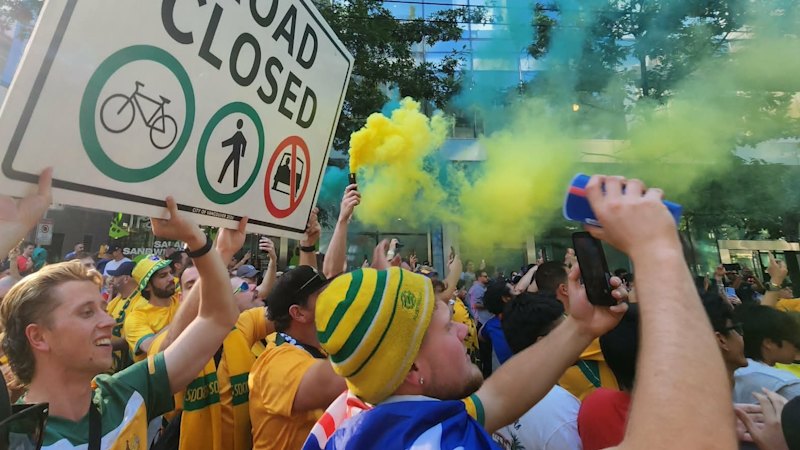
September 1, 2026 — 5:00amOne of the experts tasked with delivering transport at this year’s FIFA World Cup – the world’s biggest-ever sporting event – says the lesson Brisbane 2032 could take was not about buses, trains or crowd control.Socceroos fans on their way to BC Place in Vancouver for the Australia v Turkiye FIFA World Cup match on June 14.Cameron AtfieldRather, Los Angeles-based transport strategist Ramin Massoumi said, it came down to one thing.“Communication, communication, communication.“The volume of communication that the organising entities and the local authorities had with the public [for FIFA] was enormous.”Massoumi, the global transportation lead for design and consultancy firm Arcadis, said Brisbane 2032 organisers would have to focus on keeping residents as well as visitors informed as events unfold.Visiting the 2032 Olympic host city last week, Massoumi said providing real-time information about transport, security arrangements and venue access would be critical.“It’s the collection of information and giving it back to you as the person attending the events or the fan zones in real time,” Massoumi said.“That’s part of the user experience.”Massoumi said host cities faced the challenge of accommodating hundreds of thousands of visitors while maintaining normal services for residents.“You can’t shut down a city to throw a big event,” he said.“You need to be able to service not only the existing community and their needs, but then you’re going to have this massive influx of visitors and newcomers who might not be as familiar with the area.”Arcadis global transportation lead Ramin Massoumi and Asia-Pacific tranport executive Renaye Peters in Brisbane last week.Cameron AtfieldOne lesson from the FIFA World Cup came through way-finding systems designed to help unfamiliar visitors navigate host cities.Massoumi said planners in Toronto had redesigned signage and visitor information to make it easier for spectators to use public transport and reach venues.“The more you can communicate, either verbally, visually, whatever method you can use, the better,” he said.“You can not over-communicate.”Arcadis Asia-Pacific sector transport executive Renaye Peters said Queensland authorities were already studying lessons from recent major events, including the World Cup, and preparations for the Los Angeles Olympics.“They’re not rushing to final decisions, or final thinking, because they’re wanting to learn from those most recent events,” she said.Peters said the challenge would be meeting rapidly changing public expectations about transport information, recalling how she recently overheard young Brisbane commuters question why they could not simply ask their phone when the next train would arrive and receive an immediate answer.“Actually, why can’t you do that?” she said.“That should be the expectation.”The stadium at Victoria Park will be the centrepiece of the Games. Queensland governmentMassoumi said technology would increasingly help tie different transport modes together, allowing visitors to move between trains, buses, venues and fan zones with minimal confusion.“As a user, I am not going to care whose network I’m riding on,” he said.“I am here at point A, I’ve got to get to point B. How reliably and at as low a cost as possible can I get to my destination?“The beauty of this technology is you don’t need years to roll out this technology – and the technology is evolving rapidly – so this is stuff that could be rolled out fairly quickly.“Sure, you need the actual infrastructure too, of course, but this technology is what’s going to be the string that holds it all together – all these different pieces together to a unified transport network.”Importantly, Massoumi said Olympic investments should be assessed on the benefits they left behind, rather than their usefulness during a few weeks of competition.“I wouldn’t look at it as a 2032 set of projects or programs,” he said.“I would look at it as 2040, 2042, 2046, 2047 – what future are you trying to build?”Start the day with a summary of the day’s most important and interesting stories, analysis and insights. Sign up for our Morning Edition newsletter.More:Brisbane 2032 OlympicsFor subscribersPublic TransportFIFA World CupOlympicsPublic transportPlanningInfrastructureBrisbane developmentFrom our partners
Transport success at Brisbane 2032 won’t hinge on buses or trains: FIFA planner
Full Article
Original Source
Read the full article at Smh →KhanList aggregates and links to publicly available news content. We do not host full articles from third-party sources. Always verify important information with original sources.