
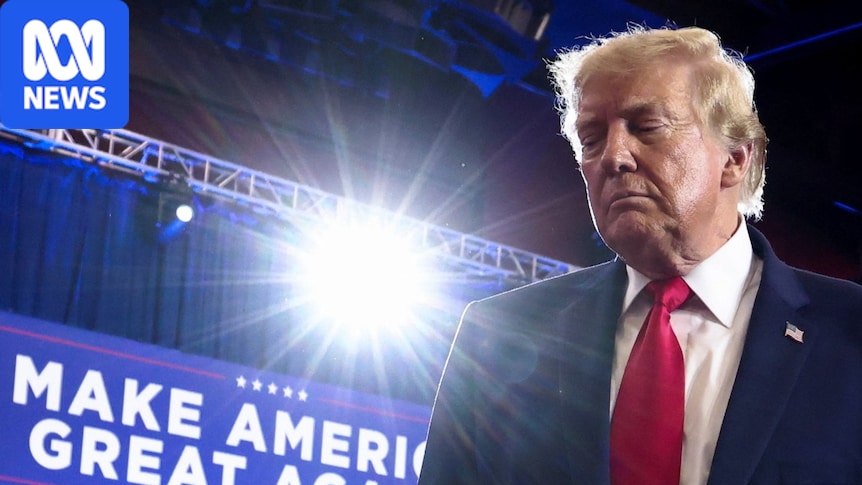
Two years ago, Donald Trump was crisscrossing the United States, spending time in swing states as he stormed back into the White House amid an electoral earthquake.His travel itinerary looks a little different these days, and for good reason.Ahead of the US midterm elections, which take place on Tuesday, local time, President Trump has prioritised his in-person appearances in regions he has typically been able to count on for strong support over the past decade.Experts say this is an unpopular leader playing defence.Mr Trump's approval ratings have plummeted over the past two years.Instead of attempting to entice new voters to back his Republican Party, the president is trying to energise his base to avoid losing control of Congress.We are about to find out whether it has worked.Mr Trump has made 28 interstate trips to campaign since October 1, and much of his itinerary appears to be linked to Senate contests.In all but two of the states he has visited, the Republicans hold the Senate seat which is up for election. Many of them are considered traditional Trump strongholds.His stops have included Texas, Mississippi, Ohio, South Carolina and Kansas, where opinion polls rate the Senate contests a toss-up or closer than the GOP would like.Many analysts believe the Democrats will dominate house races on Tuesday, which could explain why Mr Trump has spent so much time focusing on Senate contests which are seen as more competitive.While presidents campaigning in their party's traditional strongholds is not unprecedented at midterm elections, analysts argue Mr Trump's itinerary offers clues as to the GOP's concerns."What Trump and the Republicans are trying desperately to do is drive voter turnout," said James D Boys, a long-time political academic and the author of multiple books on US presidents."That is why Trump is trekking around the country, going frankly to states he shouldn't need to."He's visiting red states that he won by double figures only two years ago, so that's an indication of the concern that's gripping the White House at this point."Donald Trump stumps with US Senate candidate Ken Paxton in Texas last week. (Reuters: Kevin Lamarque)For example, Mr Trump has been to Texas multiple times to support GOP Senate candidate Ken Paxton.The Democrats have not won a Senate seat in the state for 33 years, but many polls suggest the party has a narrow lead in the contest.Mr Trump also chose Texas as the destination for the Republican midterms convention in September.Kansas, meanwhile, has not elected a Democratic senator for almost a century, but the Senate race there is on a knife edge, according to sampling.Mr Trump has made two trips to the state to campaign, most recently on Sunday."It really reflects, not just the tilt toward Democrats, but also the lack of enthusiasm among Republican voters for this election," Don Haider-Markel, a political science professor at the University of Kansas, told the LA Times.Sitting presidents have historically faced a ballot box backlash at the midterms, although losing control of both the House and Senate (something widely considered a possibility for the Republicans on Tuesday) is much less common.That's happened only four times in the past 80 years.Mr Trump told a rally in Florida on Friday evening his campaign schedule had been extended to include extra stops in Kansas and Iowa on Sunday."I thought this was going to be my last one," he told the crowd in Daytona Beach."I thought this was it. I thought I could relax. Twenty-eight days of this crap is a lot."On top of in-person appearances, the president has also done dozens of virtual rallies, where he is beamed into an event to support a candidate.
Tracking Trump's rallies, amid predictions deep red states could turn blue
Full Article
Original Source
Read the full article at Abc →KhanList aggregates and links to publicly available news content. We do not host full articles from third-party sources. Always verify important information with original sources.