
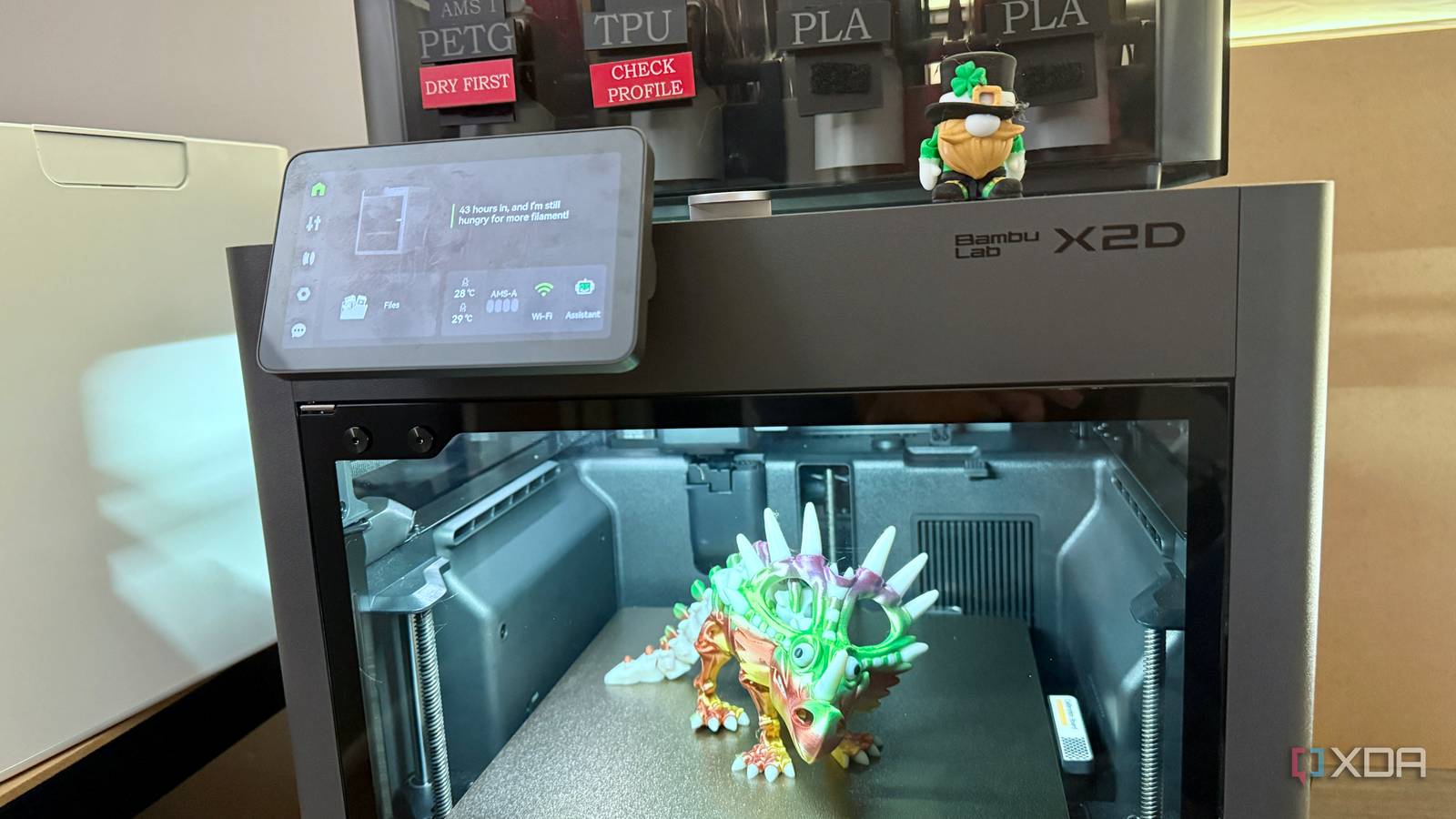
Published Aug 20, 2026, 11:01 AM EDT Jeff's been involved in the IT industry since before the Internet and spent more than 20 years working in technical support, system administration, network administration, and consulting roles. He holds an undergraduate degree in English, a Master's degree in English with a focus on professional writing and editing, and another Master's degree in Computing & Information Systems. After teaching university English and computer science for a few years, Jeff launched his writing career. He's written for Macworld, Tom's Hardware, groovyPost, The Mac Observer, and more before beginning here at XDA. For a long time, TPU was the filament I owned without much reason to use it. PLA handled almost everything I printed regularly, while PETG handled the jobs where I wanted something tougher or a little more heat-resistant. TPU mostly sat there because flexible prints sounded useful in theory, but I wasn’t running into many projects that actually demanded them. That changed once I stopped looking for “TPU projects” and started noticing the little household annoyances that rigid plastic kept solving poorly. TPU finally gave my desk accessories some grip Rigid plastic feet kept sliding when they shouldn't move One of the least exciting TPU prints ended up doing the most to change my mind about the material. I had lightweight desk accessories that were perfectly usable until I touched them, at which point they'd scoot across the desk instead of staying put. Printing feet or pads from PLA didn't really solve the problem because they were still hard plastic on a smooth surface. TPU gave me the same basic shape, but with enough grip to keep the object from moving every time I plugged something in or pulled something out. That sounds almost too minor to bother firing up a 3D printer for, but those are exactly the kinds of problems that get annoying through repetition. I don't think much about something sliding once. I absolutely notice it after I've nudged it back into place for the twentieth time. A small TPU pad fixed the actual problem instead of just giving the object a nicer-looking base. The other nice part was that I didn't have to design around whatever adhesive rubber feet I happened to find online or in a drawer. I could make the pads the size and thickness I wanted, then fit them to the part instead of fitting the part to them. There's nothing particularly clever about a little TPU rectangle, and I probably wouldn't have considered it an interesting print before. It turned out to be exactly the kind of print that made me start keeping TPU in mind. Flexible strain relief made one annoying cable behave A little flexibility worked better than another cable holder I've printed plenty of rigid cable clips and guides, and most of them do what they're supposed to do. The trouble starts when I need to hold the cable somewhere without forcing it into a single fixed position. A PLA clip can keep a cable neat while still creating a hard bend right where I don't want one. At that point, I've technically organized the cable, but I’ve made the actual routing worse. TPU worked much better for a small strain-relief piece because the printed part could flex with the cable rather than fight it. It still kept the cable where I wanted it, but there wasn't a rigid edge to act as the new bend point whenever the cable shifted. I could support the cable without pinning it down completely. That distinction didn't seem important until I tried it and realized the flexible part was doing a different job than all the hard clips I'd printed before. That was probably the point where TPU stopped feeling like "soft PLA" to me. I had been approaching it with the same kinds of designs I'd use for rigid filament, which doesn't make much sense once you think about it. TPU is far more interesting when the part is supposed to bend, compress, stretch slightly, or give way under pressure. Once I started thinking in terms of sleeves, strain reliefs, retainers, and flexible contact points, the material suddenly had a much longer list of potential jobs. A flexible bumper stopped one irritating cabinet noise Sometimes the useful print is barely noticeable afterward The third fix was a cabinet door that closed harder and louder than I wanted. I could have printed a rigid spacer, but that would have changed where the door stopped without doing much about the impact itself. A TPU bumper could compress slightly when the door made contact. That was the property I needed, not simply another chunk of plastic between two surfaces. I also wasn't limited to a generic round adhesive bumper with whatever thickness was in the package. I could widen the contact area, adjust the thickness, and shape it to the spot where I wanted it. That's a small advantage, but I run into it constantly with useful 3D prints. Store-bought parts are usually designed to fit hundreds of situations reasonably well, while I only need the part to fit one situation properly. The best thing about that repair is that I stopped thinking about it once it was installed. Nobody is going to notice a small TPU bumper and ask where I got the model, and it's certainly not the kind of print I'd put on display. The cabinet just stopped making the noise that had been irritating me. I've grown much more fond of prints where the final result is that I forget there used to be a problem. TPU still asks more from the printer Flexible filament isn't nearly as carefree as ordinary PLA There's still a reason TPU spent so much time in my filament drawer. PLA has become ridiculously easy to use for everyday printing, and I rarely have to think much about the material itself. TPU is flexible before it reaches the nozzle, which is precisely what makes it useful afterward but can also make handling it less straightforward. I don't reach for it when PLA will do the job because there's usually no reason to make an easy print more complicated. The important part is that TPU gives my printer access to a category of repairs that PLA and PETG don't cover very well. Flexibility also isn't automatically useful. I've caught myself looking at a part and wondering whether TPU might somehow make it "better," when what I really needed was something stiff enough to hold its shape. A storage bin doesn't need to flex, nor does most mounting hardware. Many clips work better when they're rigid enough to snap firmly into position rather than deform when you push on them. Don’t assume ordinary TPU will work through an AMS or other automatic material system. Soft filament can buckle when the feeder tries to push it through a long filament path, and manufacturers such as Prusa still recommend bypassing their multi-material system for standard TPU. Some newer filaments are specifically formulated for automatic feeders, including Bambu Lab’s TPU for AMS, so check both the filament and feeder compatibility before loading it. So TPU hasn't replaced anything in my normal filament rotation. I still use rigid materials for the overwhelming majority of household prints because most of those parts need to stay exactly where I put them. Enclosures, organizers, mounts, brackets, and containers generally aren't crying out for flexibility. TPU is useful specifically for the smaller group of jobs where rigidity is the problem. That inconvenience is exactly why TPU earns its place The right material matters more than an easy print The difference now is that I know when extra effort is worth it. If a part needs grip, compression, controlled movement, or a little impact absorption, I no longer automatically design around PLA. That's what I had been doing without really noticing it: choosing the filament first because it was familiar, then trying to make the design compensate for the material. TPU works better when I reverse that decision and ask what the part needs to do before deciding what to print it from. That's also why I think TPU gets overlooked. The obvious demonstrations of flexible filament tend to focus on parts that bend dramatically because that's an easy way to show what the material can do. My useful TPU prints haven't been dramatic at all. They've been tiny pieces that take advantage of just enough flexibility to fix what rigid plastic wasn't fixing properly. Before reaching for TPU, ask whether the part actually benefits from grip, compression, flex, or impact absorption. If none of those properties matter, a rigid filament will probably be easier to print and better suited to the job. Once I'd made a few of those, I started noticing the same material properties all over the house. Rubber feet, soft bumpers, flexible tabs, sleeves, straps, strain reliefs, and little pads suddenly looked less like things I had to buy and more like parts I might be able to print. I'm not interested in reproducing every rubber component I see, and some aren't worth the effort. The important part is that TPU gives my printer access to a category of repairs that PLA and PETG don't cover very well. TPU deserves more than occasional novelty projects The three prints that changed my mind about TPU are almost embarrassingly ordinary: grippy feet for desk accessories, a strain-relief piece for a cable, and a cabinet bumper. None of them used much filament, and none produced a particularly impressive object when the printer finished. They were more useful. Each one fixed a recurring annoyance because I finally used a material suited to the job instead of reaching for rigid filament out of habit. PLA will still account for most of what comes off my printers, and TPU may continue to sit untouched for weeks at a time. I no longer see that spool as specialty filament. When a problem involves friction, movement, compression, or impact, TPU is now one of the first materials I consider, not one of the last. That's a much better reason to keep it in the drawer than waiting around for another novelty flexible print. Bambu Lab X2D Build Volume 256 x 256 x 256 mm Printing Speed 1000 mm/s Materials Used PLA, PETG, ABS, ASA, TPU, Support for PLA, Support for PLA/PETG, Support for ABS, Support for PA/PET, PET, PA, PC, PVA; Carbon/Glass Fiber Reinforced PLA, PETG, ABS, ASA, PA6, PAHT, PPA, PET Brand Bambu Lab Extruder Quantity 2 Extruder Direct Drive (Primary), Bowden (Auxiliary) The X2D can even handle TPU in its AMS unit, but you will need a specific TPU hardness and possibly an updated motor for the unit.
TPU finally made sense when I stopped looking for TPU projects and started noticing what rigid plastic does poorly
Full Article
Original Source
Read the full article at Xda-developers →KhanList aggregates and links to publicly available news content. We do not host full articles from third-party sources. Always verify important information with original sources.