
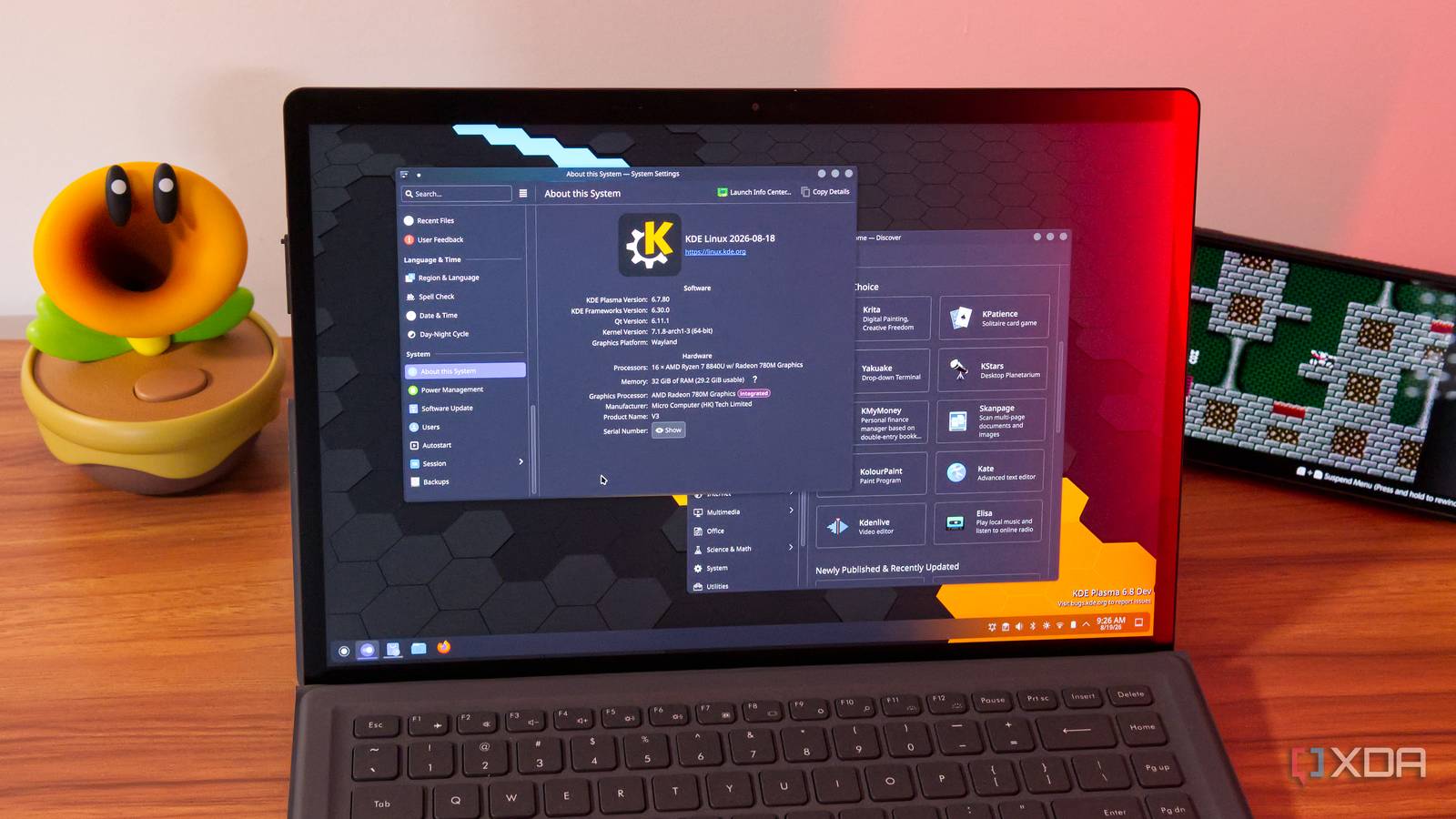
Published Aug 21, 2026, 1:30 PM EDT João has been covering the tech world for over 7 years, with a heavy focus on laptops and the Windows ecosystem. I also love all things tech and videogames, especially Nintendo, which he's always happy to talk about. Prior to joining XDA in 2021, he worked at Neowin: https://www.neowin.net/news/poster/jo%C3%A3o-carrasqueira/ KDE Plasma has been one of the most popular desktop environments for Linux for quite a while now, and speaking personally, it's also been one of my favorites since I started using Linux. There's just a ton of features built into it, and a lot of Linux distros have adopted it as a result, whether it's Fedora, Kubuntu, or SteamOS. But there hasn't been an "official" implementation of Plasma... until recently, that is. The team behind the desktop environment is now making its own distro, simply called KDE Linux, and it's looking pretty good. What is KDE Linux? All the KDE features in one place The idea behind KDE Linux is to create an operating system that's easily usable by anyone, with a stable and reliable foundation, while also offering the best of KDE's features. While many desktops implement KDE Plasma as the default desktop environment, this often doesn't include all the packages developed by KDE, replacing them with alternatives for one reason or another. KDE Linux ships pretty much exclusively with software made by KDE, aside from cases where such software doesn't exist, like the browser, which is still Firefox. Otherwise, you're getting apps like Discover, Gwenview for viewing images, Haruna for the media player, KWrite for a basic text editor, and a few other things. Interestingly, the distro still doesn't include KDE's own office suite, Calligra, which I would have liked to see, at least to help increase awareness of its existence. KDE Linux is still in early testing, though, with frequent builds being released and no proper "stable" version yet. The goal is to be geared to more casual users at some point, but right now, it's best if you're more knowledgeable about solving problems and you're okay with potentially losing some data in more extreme scenarios. You can also expect this to be one of the first distros to get new updates for KDE software. Typically, your best bet would probably be Arch, where these packages are often released before any other distro, but this distro could give you that bleeding-edge feel with far fewer risks. The current testing version already ships with in-development versions of Plasma (currently version 6.8). Stable and resilient Based on Arch, made immutable One of the notable aspects of KDE Linux is that it's also immutable and designed to be easy to use and maintain. This distro doesn't ship with a command-line package manager, and you can't ordinarily install apps this way. Instead, the Discover store is where you're expected to find your favorite apps. Discover uses Flatpak as its backbone, and there are plenty of apps already available on the platform, so a lot of users should be completely fine with this limitation. What this also enables is a more stable and secure system. There's a degree of containerization that Flatpaks have that prevents them from making changes to the system files, which helps prevent crashes and other bugs. Immutability also means that system updates are less of a risk. Whenever you update your system, your previous system image is backed up and you can always boot back into it if the new update causes any problems. You can easily roll back and boot the previous version and just keep using your system as you were before. System updates are also delivered through Discover, but your apps and system files are always separate. Only your system files are backed up before an upgrade, and your personal apps aren't touched during an update or after rolling it back. There's potential here But it may not be for everyone The developers of KDE Linux describe it as a general-purpose distro, and given the very lightweight set of packages included, that certainly seems to be the case. It's not the first immutable distro based on Arch Linux (SteamOS is a great example of another one), but it does include the smallest number of packages I've seen. Only a few necessities are packed in here, giving you the freedom to set things up to your liking without unnecessary tools. However, this distro won't be for everyone, and a lot of that has to do with the heavy reliance on Flatpak and Discover for apps and updates. A lot of Linux apps are available on Flathub, and some others use the AppImage format, which also allows them to run here without much trouble. But there are still a few apps that aren't available in these formats, and the lack of a typical package manager makes it harder to get them. Or, in some cases, they may be harder to run or more limited when installed using these formats. The lack of options may make KDE Linux too restrictive for some users. On the flip side, this kind of approach could push more developers to make their apps available through Flatpak, which can only be a good thing. Do we need another Linux distro? It's a fine idea, but... I'm not fully convinced yet that KDE Linux has proven its need to exist amid the endless ocean of Linux distros, but I do like the idea of a distro fully focused on shipping the best of KDE. This team makes a ton of software that's great, but it can get overlooked in other distros that bundle different alternatives. Here, you'll get the latest updates as fast as possible, and a bigger percentage of KDE users should also mean more contributions to making it even better. That's partly why I also why Calligra would be included, as that office suite could use all the help it can get to be a good LibreOffice competitor. For now, I don't think there's much of a reason for most people to try this out, and it doesn't help with the sense of distro fatigue that affects the Linux world. KDE Linux isn't doing a lot that's different from other immutable distros shipping with KDE Plasma aside from potentially getting updates more quickly. Still, much like how Pop! OS is a great showcase for the COSMIC desktop, there's a some value in having a flagship distro carrying the "optimal" implementation of a desktop environment. And since KDE is a trusted name, it may earn more attention than other options using KDE Plasma. We'll have to see if the team does anything more interesting with it to make it stand out from the large array of alternatives. KDE Linux
After years of fragmented Plasma implementations, the team is finally building the ideal KDE distro
Full Article
Original Source
Read the full article at Xda-developers →KhanList aggregates and links to publicly available news content. We do not host full articles from third-party sources. Always verify important information with original sources.