
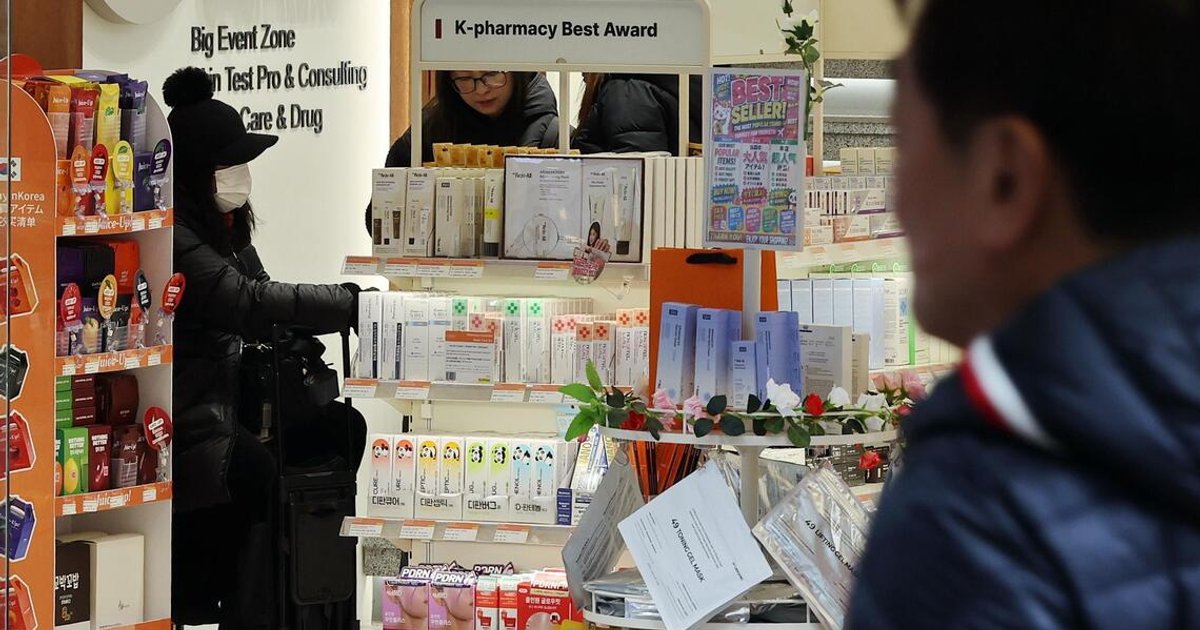
SEOUL – At a busy branch of South Korean beauty emporium Olive Young in downtown Seoul, foreign tourists are piling K-beauty products into their baskets, part of a record surge of shoppers from overseas that is helping offset lacklustre domestic consumption.South Korea has seen tourist arrivals bounce back post-pandemic, hitting an all-time high of over 17 million people for the first nine months of 2026. The country’s main Incheon airport was the world’s busiest airport for international passenger traffic in the January-June period, according to preliminary Airports Council International data.As his partner shopped at Olive Young, Florian Le Roux, a 34-year-old from France, was playing mobile chess in a corner of the store. “She’s just buying everything she can, as much as she can bring back,” he said.Such shopping sprees by international customers accounted for 33% of Olive Young’s offline sales in August, up over 30 percentage points from 2022.Seoul’s tourism boom offers a bright spot in the country’s uneven growth story. While semiconductor exports have sent AI-linked corporate profits into the stratosphere and boosted exports to record highs, the gains have yet to translate into a broad-based pick-up in domestic demand. Private consumption unexpectedly contracted 0.2% in the third quarter.Tourist spending – which is tallied as a service export in official statistics – is becoming increasingly important for South Korea. Inbound tourism is on track to contribute about 0.2 percentage point to economic growth in 2026, according to Jiuk Choi, Asia Pacific macro strategist at State Street Bank.That is up from an average annual contribution of 0.15 percentage point between 2022 and 2025, according to an analysis by the country’s central bank. “Stronger inbound tourism provides some support to sectors that do not directly benefit from the chip boom,” Choi said. “Without the increase in foreign tourists this year, accommodation and food-service output would likely have contracted from a year earlier, given that they grew by only 1.9% in the first half.”The distinction matters for South Korea’s growth outlook. While semiconductor exports are concentrated among a handful of large manufacturers, spending by foreign visitors flows more directly into businesses ranging from hotels and restaurants to retailers and medical service providers, potentially supporting employment and incomes in sectors that have lagged the technology-led expansion.Still, the tourism boom has not been enough to reverse weakness across the broader services economy. Wholesale, retail, accommodation and food-service output grew 1.5% from a year earlier in the third quarter, slowing from 4% growth in the first half, while arts, entertainment and other services contracted 2.3%.But as South Koreans tighten their belts, international tourists are willing to shell out more. A similar trend is clear in neighbouring Japan.“We wouldn’t go out shopping like this in Australia,” said Jill Hummel, a 69-year-old from Sydney. Besides visiting Olive Young, Hummel said she had bought handbags at the popular Namdaemun Market and was planning to have hair and facial treatments to round off her trip. In the first nine months of 2026, credit-card spending by overseas tourists in Seoul topped 8.8 trillion won (S$8.3 billion), rising nearly 60% from 2025, according to the City of Seoul. Average purchases have become smaller, but spending per head has gone up, showing how the range of consumption has widened in terms of products, price points and venues, rather than shifting toward lower-priced goods, noted Ji Youn-jeong, an associate professor of tourism at Hanyang University. The outlays are propping up brick-and-mortar businesses across the board from department stores to traditional markets. Sales to foreign visitors at the Shinsegae department store’s main branch in tourist-choked Myeongdong roughly tripled from 2025. At Gwangjang Market, South Korea’s oldest year-round traditional market, credit-card spending by foreign tourists more than doubled in the year through September. “We get a lot of tourists from South-east Asia, and more recently, from Europe,” said Lee Byeong-whan, who runs a ginseng store at Gwangjang Market, adding he was too busy selling foreign visitors boxes of red ginseng and stone laver to eat lunch. While around 70% of the spending occurs in Seoul, some tourists are also venturing beyond the capital to smaller cities and the countryside.Susanne Pereira, 58, and Drew Markham, 70, cycled from Incheon in the country’s north to coastal Busan, all the way at the bottom of the peninsula, staying at hotels across the country and browsing and shopping for everything from local ceramics and art to Samsung phones. The pair said they were spending freely on their trip. “We don’t have a budget,” said Markham, a retiree from Calgary. BLOOMBERG
Tourist outlays lift South Korea retail as domestic consumption slows
Full Article
Original Source
Read the full article at Straitstimes →KhanList aggregates and links to publicly available news content. We do not host full articles from third-party sources. Always verify important information with original sources.