
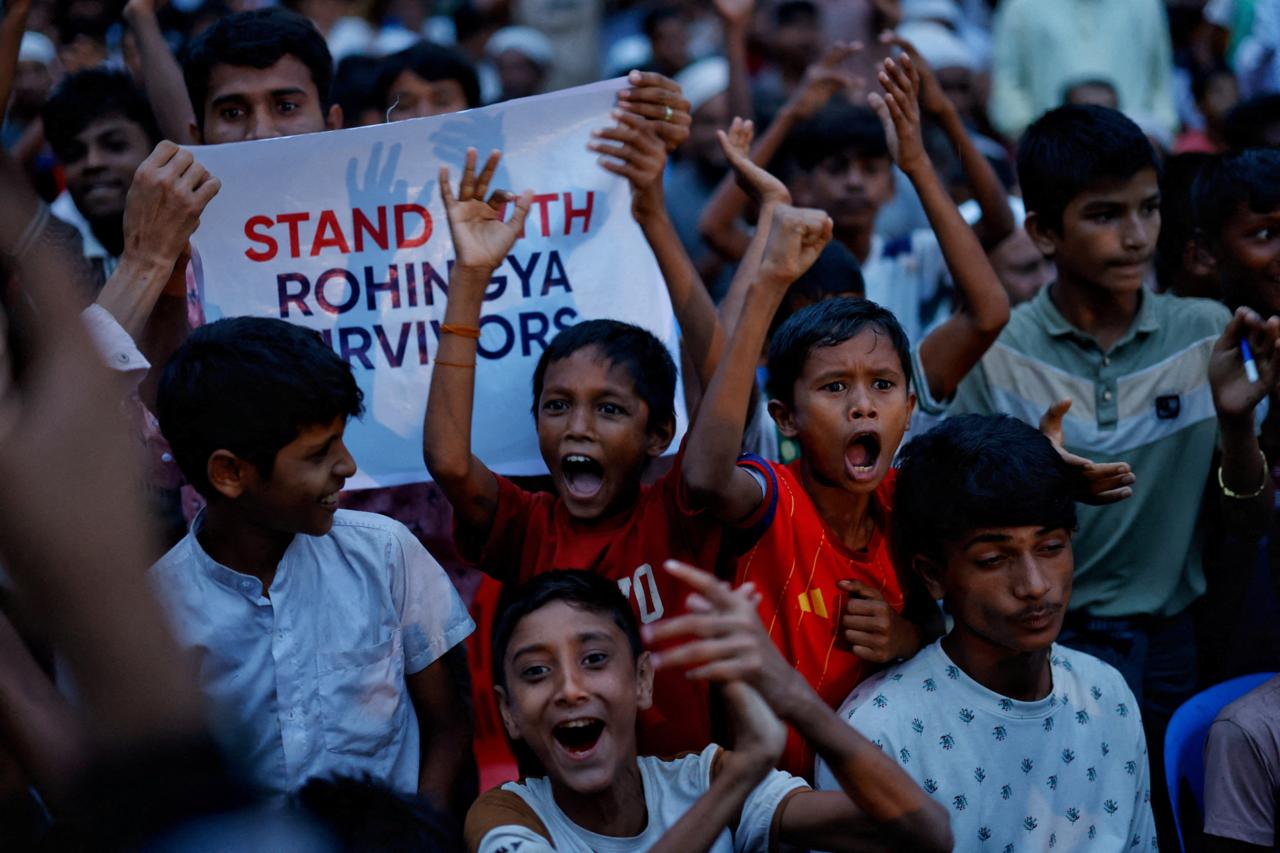
ROHINGYA. Rohingya refugee children react as the verdict is translated for the gathered crowd watching the live announcement by the International Court of Justice (ICJ) in a case accusing Myanmar of committing genocide against the minority Rohingya population, on a big screen at a refugee camp in Cox's Bazar, Bangladesh, November 19, 2026. REUTERS/Mohammad Ponir Hossain 'The court finds that Myanmar's security forces killed thousands of Rohingya civilians, perpetrated widespread acts of sexual violence, as well as acts of extreme violence against children...' Presiding Judge Yuji Iwasawa says The International Court of Justice ruled that Myanmar's military committed genocide against the Rohingya Muslim minority in 2017, marking a significant legal precedent. The court found Myanmar responsible for mass killings, sexual violence, and destruction of villages, and ordered compensation and guarantees for the Rohingya's safe return. This ruling is expected to influence future genocide cases and highlights the challenges of enforcing international law, as Myanmar denies the allegations. This is AI-generated. Read the article for full context. Report any errors. THE HAGUE, Netherlands – The United Nations’ highest court ruled on Thursday, November 19, that thousands of killings and widespread sexual violence by Myanmar’s security forces against the Rohingya Muslim minority population in 2017 amounted to state-sponsored genocide. The decision, seven years after the case was filed by predominantly Muslim Gambia, marked only the fourth time since the Nazi Holocaust that an international court ruled that the legal threshold to prove genocide had been met. It was the first time the court held a state responsible for genocide. “The court finds that Myanmar’s security forces killed thousands of Rohingya civilians, perpetrated widespread acts of sexual violence as well as acts of extreme violence against children and attacked fleeing Rohingya,” Presiding Judge Yuji Iwasawa said in a reading of the decision. The panel found “that the Republic of the Union of Myanmar has committed genocide against the Rohingya group in Northern Rakhine State.” For the 1.2 million Rohingya forced into exile in the sprawling Cox’s Bazar refugee settlement in Bangladesh, where more than 1,000 people cheered as the verdict came in on a TV screen, it was a historic moment of truth and vindication, a prominent Rohingya campaigner said. “For decades, the Burmese military tried to erase our identity, deny our existence, and dismiss our suffering,” said Wai Wai Nu, executive director of the Women’s Peace Network and a former political prisoner. “By finding that Myanmar committed genocide, ordering a guarantee of non-repetition, and ordering restitution and compensation, the world’s highest court has permanently shattered that state-sponsored lie.” Myanmar’s government, which has denied genocide, saying its forces were tackling a violent insurgency, did not immediately respond to a request for comment on the ruling. Decision is expected to influence other genocide cases Judges found that Myanmar’s military carried out mass executions of men and boys, committed widespread rape and sexual violence against Rohingya women and burned or razed hundreds of villages during so-called clearance operations. The military actively spread hate speech targeting the Rohingya population, they said. The court’s ruling is final and cannot be appealed. Genocide has rarely been established in international courts, largely because prosecutors must prove a specific intent to destroy, in whole or in part, a national, ethnic, racial or religious group. The decision by the International Court of Justice, or World Court, is expected to have repercussions far beyond Myanmar, including for South Africa’s 2023 case accusing Israel of genocide in Gaza. Both Israel and Myanmar deny genocide and say their forces responded legitimately to attacks by armed groups. The first major decision by the court in more than a decade on the application of the 1948 Genocide Convention will be pored over by legal experts for clues to how the bench assessed state responsibility in the alleged commission of international crimes. In a major legal victory for Gambia, the court found the state responsible for genocide resulting from a military offensive that drove at least 700,000 Muslim Rohingya from Buddhist-majority Myanmar. The court adopted a UN fact-finding mission figure of at least 10,000 deaths during so-called clearance operations, saying it was supported by the record. The court said “the only reasonable inference that can explain Myanmar’s actions is an intention to destroy a substantial part of the protected group namely the Rohingya population in Northern Rakhine state,” meeting the legal threshold for genocide. Judgment raises hopes for return but enforcement is unclear The ruling said Myanmar had an obligation to compensate the Rohingya for the violations it had committed, to be determined at a later date. Myanmar must also allow the “safe and dignified return to their place of residence and the reunification of families for the Rohingya displaced as a result of Myanmar’s wrongful acts,” it said. After losing everything, the Rohingya face struggles the court cannot solve, but the decision “will strengthen our efforts to return home,” said Sayed Ullah, a community representative speaking from Cox’s Bazar. James Goldston, executive director of the Open Society Justice Initiative, said that with growing pressure on international law and institutions upholding it, the ruling showed their vital role “in establishing truth, assigning responsibility, and protecting the values that bind our common humanity.” International courts previously recognised genocide only in Rwanda in 1994, the 1995 Srebrenica killings in Bosnia, and atrocities by Cambodia’s Khmer Rouge in the late 1970s. While rulings by the ICJ, which settles disputes between states and rules on alleged breaches of international treaties, are final, the court has very limited options to enforce them. Former colonial ruler Britain said on Thursday that it was expelling Myanmar’s defense attache and would set out further action in coming days. Two British lawmakers urged the government to bring a resolution to the UN Security Council to compel enforcement action. The ICJ is distinct from the International Criminal Court, which prosecutes individuals for war crimes, crimes against humanity and genocide and can impose jail terms. – Rappler.com How does this make you feel? Loading
Top UN court finds Myanmar committed genocide against Muslim Rohingya
Full Article
Original Source
Read the full article at Rappler →KhanList aggregates and links to publicly available news content. We do not host full articles from third-party sources. Always verify important information with original sources.