
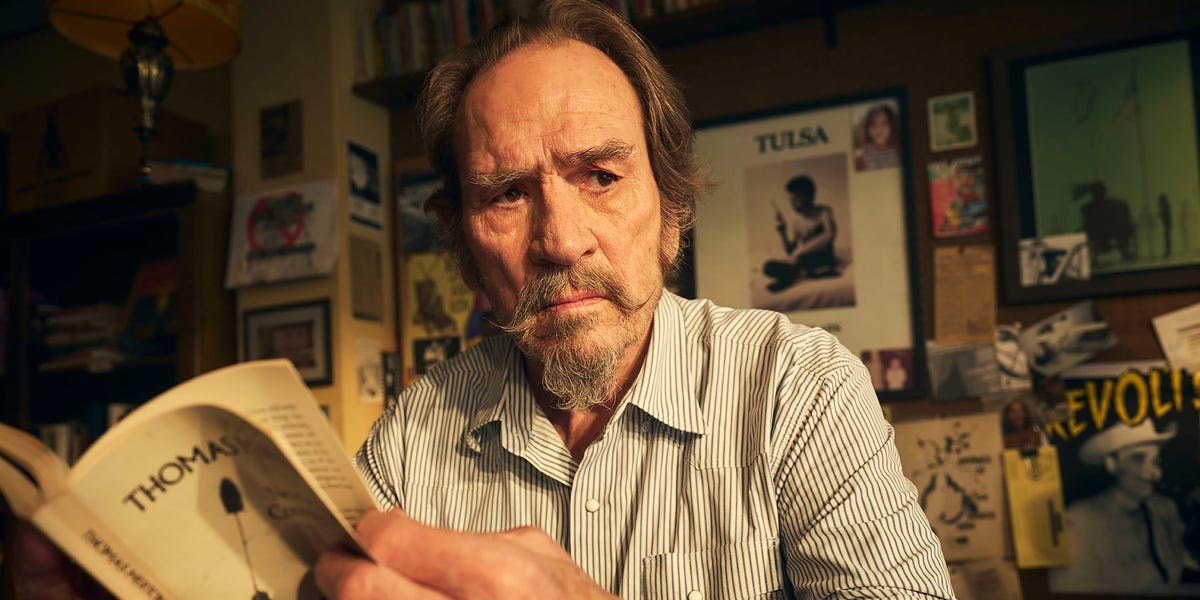
Kurt Iswarienko/FX11 min readTommy Lee Jones, 80, an Oscar winner and a star of the second season of The Lowdown, the noirish Tulsa crime story undercut with terrific dime-store waggery, sits flat-footed in the green room at Good Morning America, in downtown Manhattan. He has just done an on-camera interview with Ethan Hawke, who stars as the show’s protagonist. In the next dressing room are many adorable, pawing puppies being primped for a segment on National Adopt-a-Dog Month. Jones is adorable too, in his avuncular way, his face an old-dog scowl that softens when you ask the right question, as if you’d scratched him in the right spot.On The Lowdown, he plays Hawke’s estranged father, a crusty old bastard who holds secrets. There’s a bad history between them, and Hawke’s character, an impulsive, truth-seeking investigative journalist, at first wants nothing to do with his dad, but that situation evolves. They’re both named Lee Raybon.Jones wears a glen-plaid sport coat, a blue dress shirt, and comfortable sneakers. When the interview begins, he looks at you, ready but giving nothing until he’s asked to.ESQUIRE: I just watched the first six episodes of this season, and man, I wasn’t ready for [REDACTED].TOMMY LEE JONES: Oh, you watched all those episodes? The [REDACTED] scene was—I hope that was kind of shocking.We didn’t see it coming, which I guess is a testament to you all.That’s the whole point. You didn’t see it coming. That’s the reason we did it.The way you developed your character’s way of speaking, the way he trails off here and there, tells us that this guy knows some stuff he’s not giving away. He’s shifty. It’s just brilliant. I’m just trying to give a compliment, not really asking a question.Well, good. I’m glad you like the show.You said to Charlie Rose in an interview a long time ago that there’s no through line that runs through the characters you play. At the same time, you don’t take just any role that comes along. Do you ever think about legacy? How are they going to remember Tommy Lee Jones? Or is it really just “This role would be a challenge to play, so I’m going to take it?”I don’t have long-term thinking, and I don’t even think in a term like legacy. I think more like a dog. I’m absorbed with what’s in front of me. I might run off and chase a squirrel.Kurt Iswarienko/FXOn The Lowdown, Tommy Lee Jones plays Lee Raybon Sr., a crusty old bastard who holds secrets.I believe you. It’s just that I’ve started thinking recently, What am I writing about? Is there a body of work here? I hadn’t thought that way before. With each story it was just This is a cool story. I’ll do this story.That’s what I thought. I thought this show was really cool. The people that were working on it were cool, and Tulsa is an extremely cool place. Ethan made a good point on TV just now when he said good noir stories always have a sense of place, so the location was very important. It’s true about film noir, and this show really qualifies as part of that genre. A keen sense of place, leading to inarguable originality.How far are Tulsa and eastern Oklahoma from where you live in Texas?Oh, I don’t know. It’s northeast of Dallas. So I think the drive up—[He turns to his wife of of 25 years, Dawn, who sits in the corner looking at her phone.]How long would it take to drive to Tulsa from San Antonio?DAWN JONES: [Looking up.] Seven hours?Had you ever spent time there?When I was in prep school, we went up to Oklahoma to play a school in football, and they always cheated. Also when I was in high school, they would sell 3.2 beer to minors, and it was fun, a big adventure every once in a while, to pile into a car and drive to Oklahoma to buy a beer.Ethan’s hilarious on The Lowdown, but you’re also very funny! Always have been. The warden in Natural Born Killers, Dwight McClusky, is your funniest role, I feel. Samuel Gerard in The Fugitive. And then I’m watching this show and was reminded how funny you can be. How would you describe your sense of humor? What’s funny to you?People. People are hilarious. The best humor is found in human behavior. Any student of human behavior is going to be highly amused, when they’re not horrified.Did you watch stuff as a kid that made you laugh?The Three Stooges. Slapstick. Warner Brothers cartoons. That’s fundamental humor. I mean, if I see a fat lady slip on a banana peel, I swear I’m going to laugh.You share some beautiful scenes with the young actress who plays your granddaughter, Ryan Kiera Armstrong. I couldn’t think of many films in which we see you spend a lot of time with children.There was a movie called River Rats, and I was on a boat for a good part of this movie with two children, one of whom was Martha Plimpton, as a little slip of a girl, playing my daughter. We became good friends on that, and I was happy to see her on The Lowdown.Nothing [is] more embarrassing than going into a meeting with dog shit on your shoes.You and Ethan, and Martha now too, are seasoned veterans. Is the approach different when you’re working with young Ryan, who doesn’t have 50 films under her belt? Is there a greater need with a child actor to get to know each other before filming?Oh, actors are actors, so it’s not difficult for me to relate to an actor regardless of their age. And she’s a pro. Actors, they have a way of getting to know one another very quickly.I know, but she’s so young.Yeah, she is. And she’s a fearless and admirable young lady.Yeah, she really steals the show.She does what?[Shit.] Not from you. I don’t mean in your scenes. I mean her other scenes.Oh, I’m glad to hear that.Getting back to the idea of a through line: If I may point out one commonality across your performances, it’s that your characters have wisdom. You yourself are obviously well-read. You went to Harvard, and, for example, you’ve compared the satire of Natural Born Killers to Molière. Is reading still a big part of your life?Oh sure, of course it is.What are you reading now?I’ve been making a study of Texas history, which begins with—well, there is no beginning. It’s always been there. But its experience as an American territory, for me, begins with James K. Polk. I read a political biography of Polk. That’s a good place to start a study of modern Texas history.Not a guy you hear much about.Yeah, well, he was Andrew Jackson’s bitch.Getting back to Lee Raybon Sr., whose nickname is Frog, and his son. Fathers and sons are always rich territory.It’s an old theme.Ethan’s character changes his attitude toward you. It gets better. Did you see that as Frog’s project, what this character is after—his son’s love?[Mildly annoyed.] Well, I compared myself to a dog earlier because I really deal with what’s in front of me.[Acquiescing, or deflated.] Right.And all the qualities that you see in that character are ones that Sterling Harjo, the show’s creator, wrote. We learn that this character is dying. That slowly begins to dawn on us, and we see that he’s trying to somehow reconcile life with his son and get to know his granddaughter. But that quest in this character is not advertised. It’s discovered as we watch things unfold in an often amusing way, and always original. That was appealing. I mean, I think that’s the way it works.Can I, at the risk of pissing you off: I know you say that you’re like a dog. Are you telling me that—I don’t want to belabor that too much. I’m a little bit like a dog. [Laughs, kind of.]But this is what I’m getting at. I’ve seen every film you’ve ever made, and you don’t give a lot of interviews, but in the ones I’ve seen over the years you’ve made it clear that each character is its own separate project. No connections. But at the same time, I know how smart you are, and so part of me thinks, Come on. Of course you must see some continuum along the characters you play. We see similarities among characters in literature, even across different authors in different centuries. The through line of all your parts is that you chose them. So pushing back a tiny bit, I’m suggesting that your performance as Lee Raybon has inherited something from these previous men that you’ve inhabited in the last 50 years. Is that fair at all?Sure![Breathing a sigh of relief, and perhaps satisfaction.] Okay.Yeah.How so?[Pauses, hoping this line of questioning was over.] Oh. Well, I don’t know. I’m not aware of any continuum. [Any sense of Esquire’s relief or satisfaction disappears.] I don’t think it’s in my best interest, and I’m not inclined to think about what all the characters I play have in common. The only thing they have in common is that I’m playing them. And they’re all built out of experience. Let me refer you to an essay by T.S. Eliot called “Tradition and the Individual Talent.” It’s an indication of what happens to actors, really. Their performances are made out of the shards and the pieces and the bits of your experience of life and your thinking about it. One of the reasons you read that essay is so you have a better understanding of The Waste Land or even James Joyce. Modern art is comprised of the shards of experience, reassembled in a way that has a dramatic form, with a beginning, a middle, an end, and a purpose.Do you see a performance such as this one as a piece of art?No. Not really. I don’t know what it—you know, this is the thing I never give any thought to: What is art?Compare your view of God when you were six or seven years old to now.[Coming to life a bit.] Oh! Well? I never imagined a man in a white robe with a long white beard sitting on a throne mounted on a cloud with some lightning bolts in his hand. That’s one image. It’s probably almost as good as any other, but the question is, you either believe in such a thing as God or you don’t. I do.Has your view or understanding changed over your life?Not really. My grandmother and my aunts and my mother always took me to a Southern Baptist church. I was baptized in the Southern Baptist church. And, like all organized religions, there’s a good deal of nonsense in it. But it also leads to an awareness of the deity, which by definition exceeds our capability to define it.Fair enough.[A long pause as Jones stares at the floor, then looks up, eyebrows raised and smiling.]That was pretty good. I’m gonna write that down.Rick Kern//Getty ImagesOn The Lowdown, Tommy Lee Jones plays the father of Ethan Hawke’s character, who is an impulsive, truth-seeking investigative journalist. At first, he wants nothing to do with his dad.If you had to cook a meal for dinner, what’s the best thing you could come up with?[For the first time during the interview, Jones’s body relaxes—arm over the back of the chair.]I’d probably buy some pork ribs, an entire side of a little young pig, and slowly barbecue that over a mesquite fire and serve it with a mixture of sautéed yellow squash and onions and probably a sweet potato. You can scratch them with a fork and rub them down with butter, wrap them up in tinfoil and cook them alongside the pig right over the fire. You can feed a lot of people that way, and it tastes good. And it’s fun to eat.Is there a rub on the ribs? Or a sauce?There’s a product you can buy in San Saba, Texas, called Bill’s Season All. Bill’s Season All is something you sprinkle on pork ribs and it makes them taste real good. I don’t know what all’s in it, but it’s delectable.Texas chili: Do you have strong opinions?[Jones snaps to even more, speaking a little louder and with some of the gusto and urgency of U.S. Marshal Samuel Gerard saying, “Listen up, ladies and gentlemen. Our fugitive has been on the run for 90 minutes. Average foot speed over uneven ground barring injuries is four miles an hour, and that gives us a radius of six miles. What I want out of each and every one of you is a hard-target search of every gas station, residence, warehouse, farmhouse, henhouse, outhouse, and doghouse in that area. Checkpoints go up at 15 miles. Your fugitive’s name is Dr. Richard Kimble. Go get him.”]Don’t use ground beef. You need to cube it. Cube that beef into pieces about the size of the dice that you play Monopoly with. And after that, your own creativity comes in with the spices. But it’s important to avoid ground beef. And you don’t put beans in chili. That’s on the side. That’s at the discretion of the diner. Some people just like chili, but they just don’t necessarily want to see a bunch of beans floating in it. You’ll find one recipe in the Hill Country of Texas and another one in the hills above Santa Fe. Quite different.Last night, I was watching either the fifth or sixth episode of The Lowdown, and Martha Plimpton’s character talks about putting a couple spoonfuls of Tang in chili.I can’t imagine putting Tang in chili. But chili is like gumbo. Or Kentucky burgoo. Or Irish stew. It’s a food that’s in and of the people, so the way of cooking it and the ingredients vary from place to place and from circumstance to circumstance. Real gumbo has always got—well, it can have anything in it. Duck … goose … whatever crawled across the porch last night. Chili’s the same kind of thing. It’s the food of the people, and as such, the main ingredients are whatever you’ve got.Kurt Iswarienko/FX“I thought this show was really cool,” Tommy Lee Jones says of why he joined The Lowdown season 2. “The people that were working on it were cool, and Tulsa is an extremely cool place.”Are you a frugal person?A what person?Frugal.I don’t think so. I’m closer to profligate than frugal. We spend a lot of money on horses. My wife is one of the better female polo players in the United States. I played polo for 40-some-odd years. I’m a bit too old for it now. “Old and worn-out” is what they would call it.Can you ride?Anytime, if I need to.Where did you live when you lived here in New York?On the Upper West Side. In the ’70s.Different city then, I guess.Yeah, it was. When I first came here in 1969, the streets were covered in dog shit. And it really got to be bad. Land mines. They passed some ordinances in the city that people had to clean up after their dogs. You’d have to be very careful walking down the street. Nothing more embarrassing than going into a meeting with dog shit on your shoes.So now that you’ve turned in this astonishingly beautiful performance as Lee Raybon—Oh, thank you.—and are there hills left to conquer as an actor? Are there types of roles you have yet to play?Yeah, I need a job, actually.[Publicist knocks.]You have to do another TV spot now?I don’t know. There’s a schedule for the day. And I looked at it, but I don’t really—I’d have to ask her. That’s the reason I don’t have to know. I have her.Okay, well, I appreciate this. I hope it wasn’t too painful and I didn’t—No, it’s not painful at all.I know talking about acting is not the most interesting thing.It’s kind of boring for me.Well, it’s breakfast time. When it’s first thing in the morning at home, if your cook’s not there and you’re hungry, what could you whip up?I have a French press for coffee, a toaster for a bagel. And we’ve always got cream cheese and smoked salmon. Bagel, lox, cream cheese, coffee, and a grapefruit. That’s what I ordinarily eat for breakfast.You’re right, this is more interesting than talking about acting.What, cooking?Breakfast.Oh, breakfast. Breakfast is more interesting than anything.
Tommy Lee Jones Couldn’t Care Less About His Legacy
Full Article
Original Source
Read the full article at Esquire →KhanList aggregates and links to publicly available news content. We do not host full articles from third-party sources. Always verify important information with original sources.