
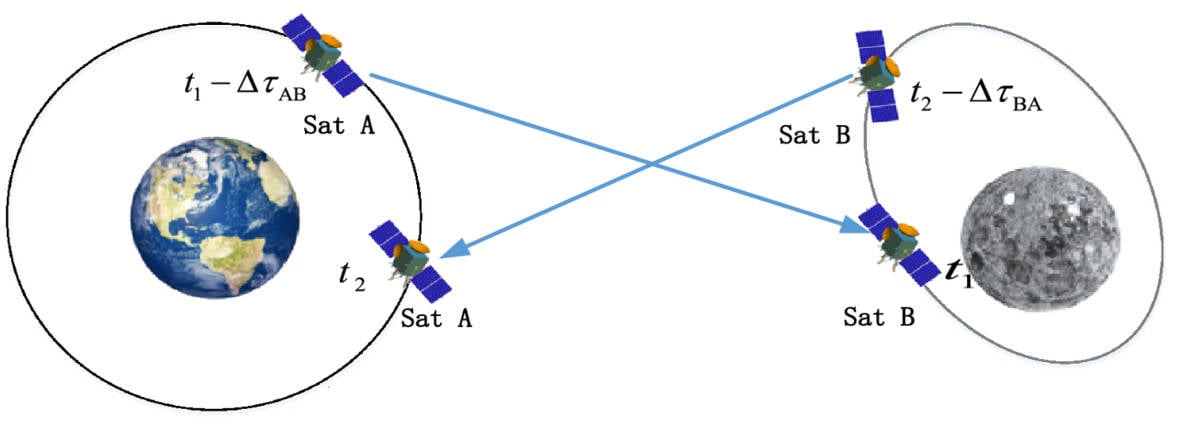
Global Positioning Systems are a key feature in everyday life for much of the world’s population. Whether it’s ensuring a ship delivers its goods safely, or you’re able to avoid a road closure on your commute home, GPS can help. But the system has a weakness - it relies on ground stations that could suffer from blackouts, natural disasters, or cyber attacks. And if those ground stations go offline for long enough, the whole system itself can begin to “drift”. Aerospace engineers have been attempting to counteract this problem for years, but so far with little success. But a new paper from a research team led by Xia Lin and Baojun Lin at the Shanghai Engineering Center for Microsatellites, and published in Satellite Navigation, explains a potential answer to this problem - link the GPS satellites up with some in orbit around the Moon. To understand the problem requires some explanation of orbital mechanics. In addition to their links with ground stations, traditional Earth navigation constellations use a technique called Time-Division Multiple Access to keep in contact with their neighboring satellites, measuring relative distances accurately down to the centimeter level. While that’s useful for relaying how far apart each satellite is, it can’t establish their absolute position in space. Earth’s gravity around its rotational axis is nearly symmetrical, so all of the satellites in an “orbital shell” can drift relative to their position on the ground simultaneously. This drift, known to orbital dynamicists as an orientational rank deficiency, slowly introduces position errors into the system if left unchecked by ground stations. And if those ground stations are offline for days or weeks at a time, that position error could accrue to significant distances. Fraser talks about the difficult of getting to the Moon itself. Aerospace engineers have tried several other solutions to this problem, including star trackers, pulsar counters, and “forecasting” an orbit ahead of time. But none work with the precision needed to keep the global GPS system functioning at the level it's expected to. So the researchers turned to a novel solution - the Moon. More accurately, satellites orbit around the Moon, in what is called cislunar space. Critically, they have to be in orbit around the Moon rather than around the Earth to make sure the “drift” that affects the Earth-bound constellations can be noticed and corrected. For their lunar satellite, the researchers chose Elliptical Lunar Frozen Orbits (ELFOs), the orbital paths that NASA’s LunaNet and ESA’s Moonlight projects are planned to use in support of missions on the south pole. To prove their idea, the researchers set up a simulation over the course of 60 days using real data from 24 operational BeiDou-3 Medium Earth Orbit (MEO) satellites and a simulated cross-link with four ELFO orbiters. They found that, left entirely to traditional Earth-only cross links with no ground station correction, the system drifted around 7.85m over the course of two months. Jesse Coffey talks about how orbits track on the ground. Credit - AFResearchLab YouTube Channel That drift admittedly got significantly better when they used trajectory prediction, dropping to just 0.6m by day 60 if the satellites predicted how their orbit was changing. But the best results came from the simulated joint Earth-Moon network, coming in at just 0.35m of drift over the course of the two month experiment. An added benefit of this setup is the correction works both ways. The Earth-bound satellites can offer correctional positional data to the Moon-bound ones. Though it wasn’t quite as good, the error for the four simulated ELFO satellites was only 2.26 meters of their expected position. Having well positioned lunar infrastructure in place is critical to planned crewed operations there. And this sort of system could both solve a problem we have on Earth as well as provide those future explorers with the precise positioning they will need on the lunar surface. Learn More: CAS - Lunar Satellites Could Anchor Earth's GPS: Study Finds a Fix for Drifting Navigation Constellations X. Lin et al - Preliminary analysis for the joint autonomous orbit determination of the BDS-3 MEO satellites and lunar ELFO satellites based on inter-satellite links UT - Tracking Deep Space Probes With GEO Satellites Improves Uptime UT - It's Time to Give the Moon Its Own Time
To Keep GPS Constellations From Drifting, Look To The Moon
Full Article
Original Source
Read the full article at Universetoday →KhanList aggregates and links to publicly available news content. We do not host full articles from third-party sources. Always verify important information with original sources.