
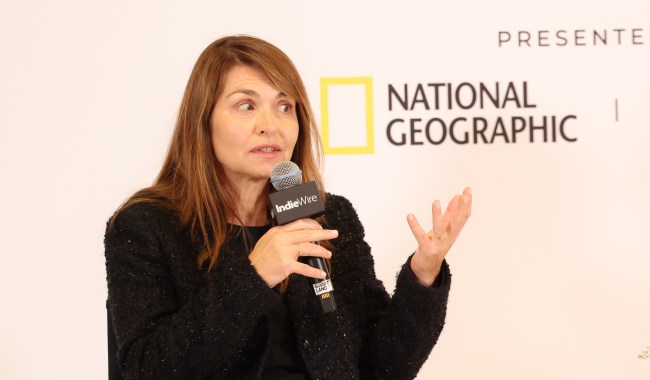
For one of the most important screenings of “To Hold a Mountain,” the filmmakers had to bring their own electricity. In July, co-directors Biljana Tutorov and Petar Glomazić hauled a tent, a generator, and a DCP up to the Montenegrin highlands where they had spent years filming. The creative couple, also partnered in life, wanted the shepherds who lived and worked in Sinjajevina to see the movie they had made possible. But by then, Montenegro had already resolved their story’s central conflict — scrapping the government’s plan to turn these people’s ancestral pastures into a military training ground after joining NATO in 2017. “To Hold a Mountain” won the World Cinema Grand Jury Prize for documentary at Sundance, and Montenegro’s prime minister and president even showed up to the shepherds’ screening with their families, unannounced. When the film opens at New York’s Film Forum on December 16, American audiences will see the feature’s updated conclusion. “We reopened the film to continue shooting and then a second end happened that was very empowering and powerful,” Tutorov said at IndieWire’s Art of the Doc series. ‘To Hold a Mountain’ (2026)Courtesy Sundance During our conversation, the filmmaker recalled arriving in Sinjajevina with Glomazić on the first day of protest. They wanted to help the community and make a movie, and agreed early on that those were two different jobs. “We will separate our activist mission from our filmmaker’s mission,” she said. “That was a very good decision because it allowed us to be very bold in both roles.” Onscreen, the fight over who would get to lay claim to the mountain centered on two people who already did: Gara, a shepherd and community leader, and Nada, the young girl she was raising. As the threat to their home brought a history of violence in their own family to the surface, the directors had to reckon with how much of Nada’s private life might become public. “We really wanted it to be an empowering experience for [her],” Tutorov said. Nada was twelve and a half when the filmmakers began to understand what the story would ask of her, and Tutorov said they decided to keep filming until she turned eighteen — precisely so Nada could decide for herself whether she wanted to be part of it. The crew logged more than 230 shooting days, though some yielded only half an hour of footage. (Left to right): Biljana Tutorov and IndieWire’s Alison ForemanIndieWire/Rich Polk Gara and Nada had work to do, too. The directors and cinematographer Eva Kraljević shared a small shepherd’s shed, assisting with various chores including cows that had to be milked twice a day. Over successive summers, their routine became a framing device. Tutorov, who studied art history, thinks of the mountain as a kind of chorus bearing witness to living things on it. Last July, just as the filmmakers were wrapping up, Montenegro’s government canceled the training-ground plan. Tutorov believes “To Hold a Mountain” and how it told the existing community’s story influenced that decision. She also pointed out that a different government was in power by 2025, following years of organizing by Sinjajevina locals. At the shepherd’s screening a year later, Prime Minister Milojko Spajić said the film reinforced his view that canceling the plan had been the right call. Then Montenegro chose “To Hold a Mountain” as its official submission for the international feature Oscar. Tutorov said there was irony in realizing that, after years of fighting the government, she and Glomazić would be proudly representing the country on a global stage. “It feels like they really kind of destroyed our strategy,” she said, warmly. It’s a good joke, and an even better reason to remember that rough-and-tumble showing. For an evening, the people who’d spent years making their case to the government got to host its leaders on the very land they’d fought to keep. Tutorov recalled what Montenegro’s president told the filmmakers after seeing the movie: “Thank you guys for teaching us democracy.” Watch the complete interview above. National Geographic Documentary Films, part of a joint venture between The Walt Disney Company and the National Geographic Society, is committed to bringing the world premium, feature documentaries that cover timely, provocative and globally relevant stories from the very best documentary filmmakers. Its award-winning and critically acclaimed films reach 300 million people worldwide in 180 countries and 33 languages across the global National Geographic channels and direct-to-consumer platforms Disney+ and Hulu.Recent films include the Emmy-nominated winner of the IDA Award for Best Feature “The Tale of Silyan;” Oscar® and Peabody nominee “Sugarcane;” Oscar-nominated and Peabody Award winner “Bobi Wine: The People’s President;” Emmy Award winner “Lost In The Jungle;” Oscar- and BAFTA-nominated “Fire of Love;” Emmy and Peabody Award winner “The Territory;” BAFTA nominees “The Rescue” and “Becoming Cousteau;” and Oscar- and BAFTA winner “Free Solo.” For more information visit films.nationalgeographic.com, or find us onFacebook,Twitter,Instagram, and YouTube.
‘To Hold a Mountain’ Took on the Government — Now It’s Montenegro’s Oscar Submission
Full Article
Original Source
Read the full article at Indiewire →KhanList aggregates and links to publicly available news content. We do not host full articles from third-party sources. Always verify important information with original sources.