
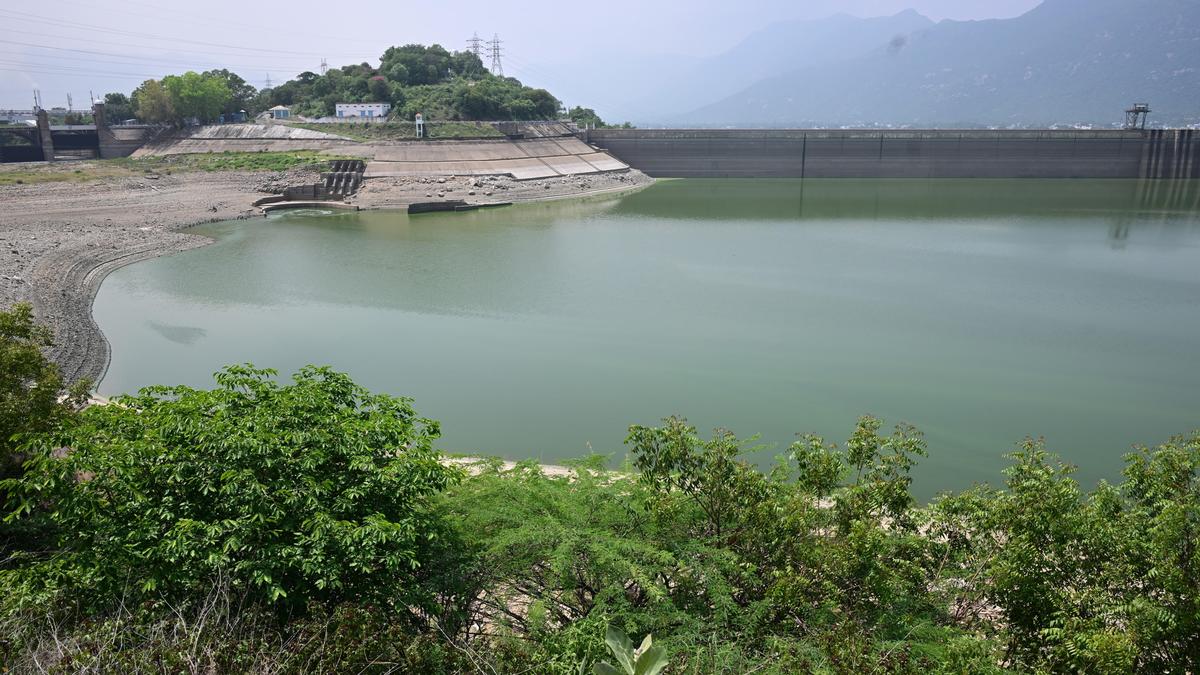
The State’s largest dam, Mettur, has about 23 thousand million cubic feet (tmcft) but this is hardly enough for the authorities to maintain sustained release of water to farmers, beyond a week, in the Cauvery delta. | Photo Credit: E. LAKSHMI NARAYANAN Tamil Nadu may be in for a spell of water crisis and lower rice production this time, if the current Northeast monsoon does not come to its rescue.As of now, the aggregate storage in the major 15 irrigation reservoirs is about a third of the combined capacity of the reservoirs. In the corresponding period last year, the situation was completely different with the combined storage being around 92%.The State’s largest dam, Mettur, has about 23 thousand million cubic feet (tmcft) but this is hardly enough for the authorities to maintain sustained release of water to farmers, beyond a week, in the Cauvery delta.The rainfall during the Northeast monsoon has been moderate as the State has received around 240 mm of rainfall against the anticipated 236 mm. It should get at least 260 mm more to be considered comfortable, the most of which should materialise in November. Ordinarily, December yields only about 20% of the total rainfall of the monsoon.In fact, the existing pattern of rainfall registered by the State so far during the season appears to be more in tune with the forecast made by the Tamil Nadu Agricultural University (TNAU), which, in late September, predicted that the State would get 438 mm during the entire monsoon against the normal 434 mm, a deviation of one per cent. The Meteorological department, in its outlook at the beginning of October for the season, referred to the southern peninsular region of the country in general and stated that the expected rainfall “ is most likely to be normal (88-112%) of the Long Period Average (LPA).”The TNAU, which was more specific in its forecast than the Meteorological department, had anticipated only a normal rainfall for the core districts of the Cauvery delta – Thanjavur, Tiruvarur, Nagapattinam and Mayiladuthurai. Despite the water availability at Mettur not being comfortable and the expectation of a subdued rainfall, farmers have gone in for raising paddy during the samba-thaladi cultivation season to the tune of around 3.62 lakh hectares. Of this, nearly 50% falls under “direct sown“ category of cultivation, which means that seeds are directly sown instead of transplantation. This method is followed in times of water shortage.But, the problem with water availability seems to be higher in the remaining areas of the State, a reflection of which can be seen in the way the farmers have taken to paddy this time. The paddy coverage in the non-delta areas of the State is about 1.3 lakh hectares shorter than what it was last year. As compared to the previous year’s share (39%) of direct sowing in the overall paddy coverage, this time the method’s share is about 57%. In 2025-26, rice production in the State was 77.5 lakh tonnes, about one lakh tonnes lower than the previous high of 79.07 lakh tonnes during 2021-22.As part of its efforts for protecting the crop in the Cauvery delta, the State government, at meetings of the Cauvery Water Regulation Committee (CWRC) and the Cauvery Water Management Authority (CWMA) on Friday, demanded that Karnataka release around 20. 7 tmcft including the backlog of about 16.9 tmc ft. However, the Authority ratified the decision of the Committee, which had recommended that Karnataka release 3.88 tmcft to Tamil Nadu through 3,000 cubic feet per second (cusecs) per day for 15 days from Saturday (November 7, 2026). Published - November 08, 2026 12:52 am IST
T.N. may be heading towards a water crisis, unless northeast monsoon comes to the rescue
Full Article
Original Source
Read the full article at Thehindu →KhanList aggregates and links to publicly available news content. We do not host full articles from third-party sources. Always verify important information with original sources.