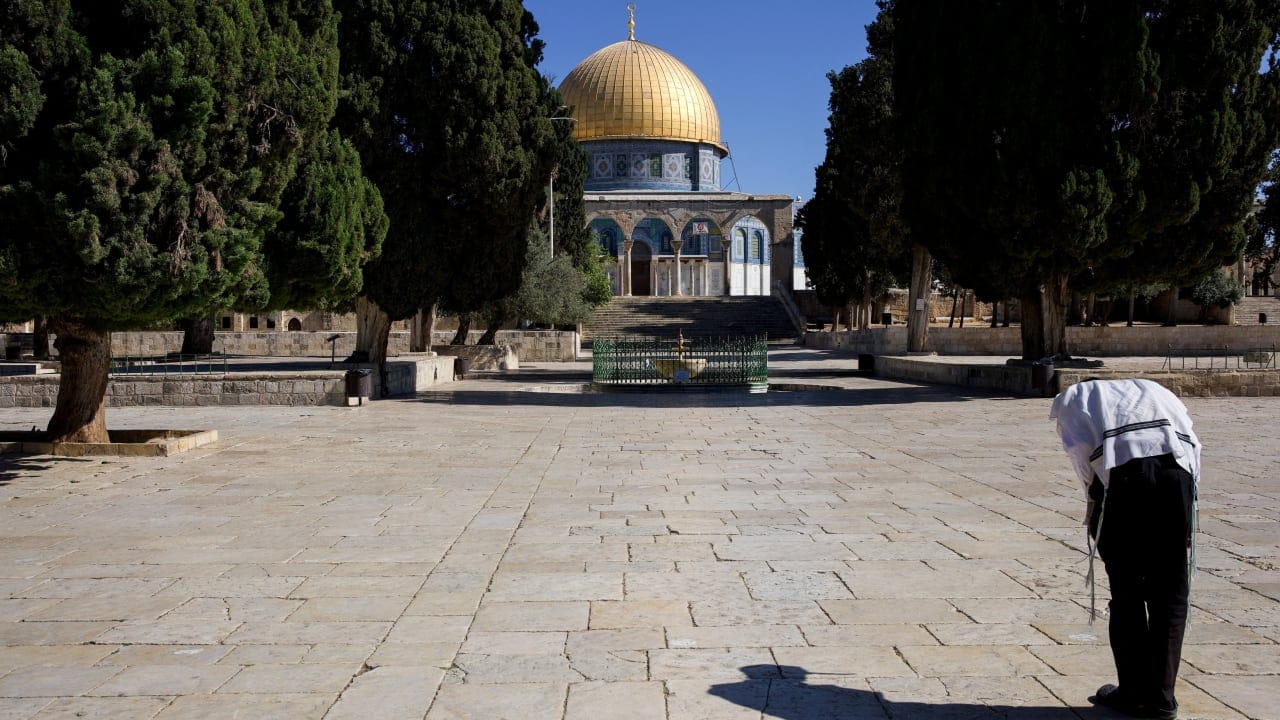
ByDAVID M. WEINBERGJULY 25, 2026 14:00Earlier this week, on Wednesday the eve of Tisha B’Av (the day of Jewish national mourning for the destruction of Jerusalem and its Temples and 2,000 subsequent years of exile from Israel), I ascended the Temple Mount, Har HaBayit.It was an opportunity to pray at the most sacred site in the world for Jews, to mourn the many misfortunes of Jewish history, and to rejoice in the slow but inevitable Jewish return to makom haShechinah, the apex of God’s presence in the Land of Israel – a whirlwind mix of emotions.I discovered a massive improvement in opportunities for Jewish/Israeli visitation of the site as compared to my previous journeys in 2022 and opportunities for yet more Jewish/Israeli rootedness on the holy mount. More on this below.But first, I had to answer for myself these questions: Is it permissible under halacha (Jewish law) to ascend the Temple Mount, given the religious holiness of the site and the ritual impurity imputed by Orthodox Jewish tradition to all people in our day?Even if this is possible, am I worthy of making this pilgrimage? Is the ascent to the Temple Mount worthwhile and necessary? And might it be recklessly provocative from a diplomatic perspective?My answers to these four questions: Yes, perhaps, definitely, and defiantly no.Jews gather for prayer at the Western Wall during Tisha B'Av on July 22, 2026. (credit: MARC ISRAEL SELLEM/THE JERUSALEM POST)Permissible: After four years of study with scholars, I am convinced that it is possible today to walk around the outskirts of the expansive Temple Mount plaza without transgressing Torah law – after appropriate ritual and devotional preparation and under the strict guidance of Torah sages.(You avoid the raised platform on which the Dome of the Rock rests and adjacent sections, because, according to halachic literature and modern research, this is where the First and Second Temples and their courtyards were located.)My guide this week was Rabbi Elisha Wolfson, who has published a comprehensive volume on the matter and who leads a Torah study session on the Mount every day. He calls himself head of the Har HaBayit Kollel.Leading figures that not only permit but mandate such visits include rabbis Avi Gisser, Dov Lior, Eliezer Melamed, Elyakim Levanon, Re’em Ha’Cohen, Shabtai Rappaport, Tamir Granot, Tzfania Drori, Yaakov Medan, Yehuda Shlush, Yitzhak Shilat, Yuval Cherlow, and Ze’ev Weitman.Meritorious: I am less sure of my personal worthiness in approaching the Divine Presence on the Mount.But in daring to do so, I am relying on the merits of my illustrious ancestors and saintly sons (all long-serving Israeli soldiers and yeshiva-trained scholars of upstanding character).Their virtues, and the sacrifices of so many Israelis in recent wars, give me confidence that the Heavens are smiling on a reclamation of the Temple Mount, approving of every demonstration of increased Jewish devotion.Worthwhile: Properly conducted, a visit to the Temple Mount can be an awe-inspiring experience. Theological anxiety and religious exhilaration pulse through the territory and concentrate the mind.The visit is an opportunity to focus one’s thoughts on the truly important things in life and to swiftly convey them to the Almighty.(Of course, one can and should attempt to pierce the Heavens when supplicating in any synagogue and communing in any prayer quorum, anywhere. But believe me, the prayer experience on Har HaBayit is powerfully different. In Jewish thought, the gates of Heaven, the most direct pathway to the Divine Throne, are directly above the Temple Mount.)The wonderful news here is that in recent years it has become possible for Jews to actually pray on Har HaBayit and to quietly sing, dance, and study Torah. There are even several abbreviated prayer services held twice a day on the Mount with a pickup halachic quorum (minyan).Israeli police on the Temple Mount now allow Jews to bow in prayer too, even to prostrate themselves face down on the ground with full extension of the arms and legs – which was the prayer practice in ancient Temple times.Over the centuries, genuflecting in this way (known as kri-ah and hishtachava-ya) has fallen out of use at Jewish places of worship worldwide. It is a ritual unique to the Temple Mount, reintroduced in our times.This was new, strange, and even scary for me. Full-scale prostration in prayer is a position of vulnerability and self-abnegation. And yet it was so uplifting.From restricted access to renewed presenceNecessary: None of this was possible four years ago when I first visited the Mount as part of a tour guide study group. (I highly recommend the intensive course of study about Har HaBayit open to any adult run by an organization called Capot HaManool, The Open Gate.)Then, Jews had only limited visitation rights and were ushered in tiny groups by very nervous police in and out of the Mount as swiftly as possible. Prayer was forbidden, and religious garb like kippot and tzitzit was inadvisable.Back then, the (Jerusalem) Wakf Islamic religious trust and other radical Islamic movements had rigged the Mount into a base of terror. Visiting Jews faced periodic “outbursts” of harassment and rock-throwing, Jewish worshipers experienced violence while praying at the Western Wall below, and several terrorist attacks involving live ammunition were launched from within the Muslim shrines on the Mount.The flags of ISIS, Hamas, and Turkey also flew brazenly on the Temple Mount, while wildcat Wakf construction projects on and beneath the Mount willfully destroyed centuries of Jewish archaeological treasures.Today, thanks to determined police and intelligence operations, the Temple Mount is calm. The radical Islamic gangs have been run off the reserve. And by showing up to visit in ever-growing numbers, the Jewish/Israeli public has pushed the Israeli government to assert its sovereign control and to facilitate partial, restrained expressions of Jewish prayer.Indeed, I found the atmosphere on the Temple Mount to be relaxed, even festive. The scent in the air was spiritual, not political. The police presence was significant but laid back and supportive.I visited for almost two hours alongside several large groups of Israeli men, women, and children (even babies in strollers) – and there was not a whiff of protest in any direction.No Jews violated the rules (which, alas, still ban Jewish prayer books and the Bible from the Mount), and no Muslims said boo.We brushed past a large group of Muslim schoolgirls (and their female teachers) in full hijabs in the plaza adjacent to the Aqsa Mosque, peacefully.No feathers were ruffled; no hard feelings were vented. The Arab/Islamic and Israeli/Jewish populations tolerated – or at least ignored – one other.So no, I don’t think that Jewish visitation and prayer rights on Har HaBayit are recklessly provocative. They need not be a political flashpoint.In fact, I think that it is time to lay out a new diplomatic initiative for the establishment of a synagogue to solidify Jewish/Israeli rights on Har HaBayit, hopefully through dialogue and even a regional consensus.You see, one of the things you learn when visiting the Temple Mount – something unknown to most people – is that there is plenty of room up there and loads of undeveloped and even desolate sections of land on the vast Temple Mount plaza.A Jewish house of prayer could easily be built in the southeast or northeast precincts of the Mount without interfering in any way with Muslim shrines and prayer practices.Several leading religious figures such as Rabbi Shmuel Eliyahu of Safed are now backing this suggestion (which I first made in this newspaper 12 years ago).Space-sharing and time-sharing arrangements can calmly be crafted, such as those in place at Ma’arat HaMachpela, the Tomb of the Patriarchs, and the Matriarchs in Hebron.Again, nobody needs to feel threatened by the presence of Jewish petitioners tucked away in a corner of the holy Mount – unless your opposition to Jewish visitation and prayer stems from wholesale denial of indigenous Jewish rights in Jerusalem and the Land of Israel.On the way out of the Temple Mount plaza, I tore my shirt in sorrow for the destroyed First and Second Temples that once stood on the site – just as a Jewish mourner does upon the death of a close relative.This tearing in grief and my earlier prostration in prayer – both of which are called “kri-ah” in Hebrew (although spelled differently) – were formidable bookends of a compelling visit to the Temple Mount.The writer is the managing senior fellow at the Jerusalem-based Misgav Institute for National Security & Zionist Strategy. The views expressed here are his own. His diplomatic, defense, political, and Jewish world columns over the past 30 years are at davidmweinberg.com.Follow us on Google
Tisha B'Av reminds us that Jewish prayer belongs on the Temple Mount - opinion
Full Article
Original Source
Read the full article at Jpost →KhanList aggregates and links to publicly available news content. We do not host full articles from third-party sources. Always verify important information with original sources.