
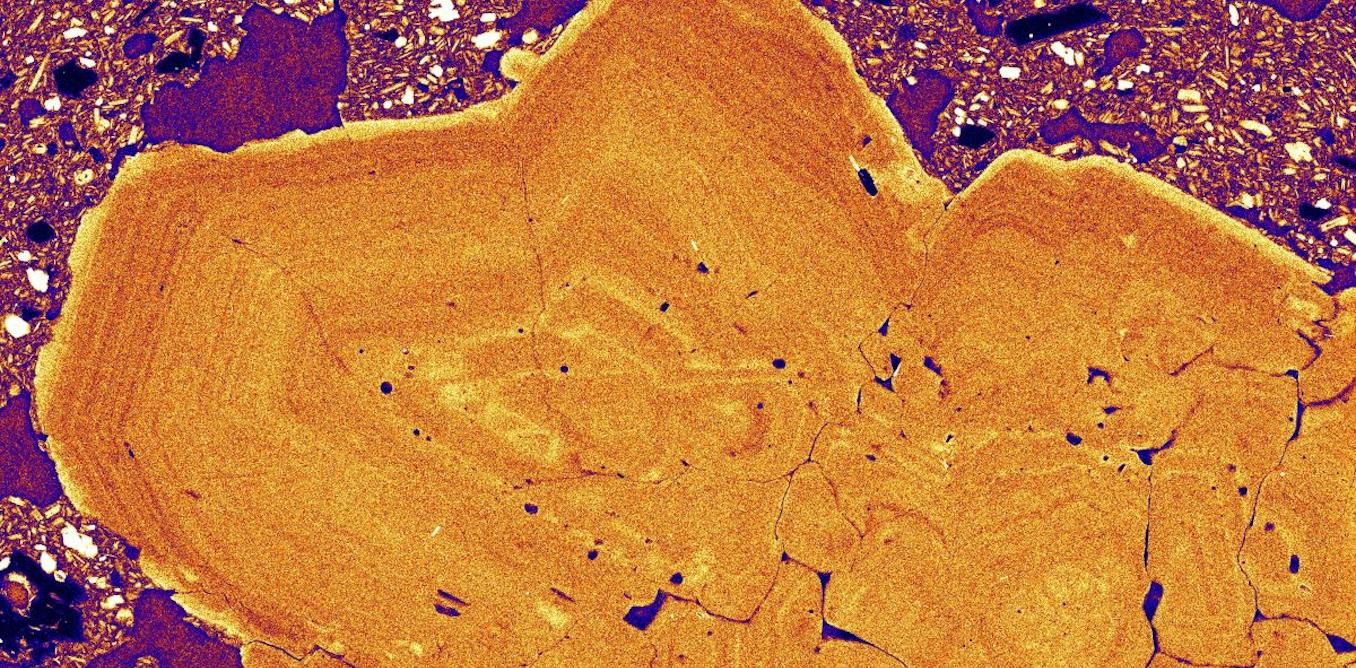
Thousands of millions of people live near active volcanoes along the Pacific Ring of Fire. This belt of seismic and volcanic activity arcs around the Pacific Ocean from Aotearoa New Zealand and the Pacific Islands through to Japan, and the Pacific coast of North and South America. We can’t precisely predict volcanic eruptions, but we can try to understand what triggers them. We monitor active volcanoes and try to interpret warning signs such as earthquakes. But we can also look deeper. In our new research published in Nature Communications, we found that the most abundant crystal in Pacific Ring of Fire volcanoes, a mineral called plagioclase, takes a specific shape and chemistry shortly before eruption. These tiny crystals that grow inside volcanoes reveal a common chemical fingerprint that could help identify when magma is ready to erupt. Volcanoes hold complex histories Magma is molten rock stored beneath a volcano. It’s made of liquid, crystals (minerals) and gases, such as water vapour. Large volumes of magma can remain stored quietly under volcanoes for days, months, even years. If nothing upsets this magma, it may eventually cool down underground and never see the light of day. However, when a critical event disturbs its peace, the magma will travel to the surface, causing a volcanic eruption. When it reaches the surface, it’s known as lava. An eruption at Mount Yasur, Vanuatu. Kurt F. Wieder Luckily, not all disruptions of magma are powerful enough to trigger volcanic eruptions. Knowing when this will happen is a challenge, but the good news is that volcanoes have a memory – they tend to repeat their eruptive behaviour. This means that exploring the past history of a volcano gives us clues to better understand its future eruptive behaviour, and perhaps even forecast it. But how can we explore the past of volcanoes? When a volcano erupts, the magma carries different types of crystals from different depths beneath the surface. These depths can vary by several kilometres. Because the crystals grow from magma rising from Earth’s interior, they might hold clues about what happened beneath the volcano that caused eruption. The challenge is to read these deep stories, and get to know what caused the eruption. In our research, we use a new approach to separate these different signals, using a superb magmatic crystal storyteller: plagioclase. A chameleon crystal Plagioclase is one of the most abundant minerals in volcanoes along the Pacific Ring of Fire. Like a chameleon, it changes its appearance and chemical composition as magma conditions shift. This means it can record the history of the volcano before it erupts, from deep within Earth to the surface. Plagioclase chemistry is largely defined by the chemical elements calcium and sodium. If the temperature or water content of the magma increases, plagioclase will increase its calcium content in response. If the temperature change is considerable, it might also dissolve part of the plagioclase before regrowing around it with a different composition. This produces what geologists call “crystal zoning”, which makes plagioclase look different under the microscope. In contrast with other crystals we find in magma, plagioclase shapes can be immensely diverse. Isolating the chemical and textural signatures of this crystal can unveil the complex history of a volcano. In our work, we investigated plagioclase crystals across different Pacific Ring of Fire volcanoes, discovering that the final changes recorded before eruption are remarkably similar worldwide. A new way to explore volcanic records We collected volcanic rocks across the Andean Mountains in South America to explore one of the most active regions of the Pacific Ring of Fire. These volcanoes take different forms. Some are active. Some last erupted three million years ago. Some have erupted several times, others just once. Our team in the Atacama Desert, Chile. In the back, the Socompa volcano. Daniela Parra-Encalada We used microscopy to describe the different plagioclase crystals in these volcanoes. Then, we used a range of technologies including lasers to find out the chemistry of each plagioclase type. This allowed us to produce maps of the key elements the plagioclase crystals are made of. We found that the tiniest plagioclase crystals, called “microcrysts”, which form just before eruption and directly from the final magma, share the same chemical composition across all volcanoes. When we calculated the temperatures under which these plagioclase crystals grew, we found this unique signature means hotter magma was replenishing colder magma reservoirs. We found this not just in Andean volcanoes, but as a common feature across the Pacific Ring of Fire. Volcanic rock under an optical microscope (thin section: about 2.5x4.5 cm). Plagioclase crystals can look white, grey, black and pale yellow under this type of light, reflecting how different orientations of the mineral react to light. Daniela Parra-Encalada In contrast, we found that plagioclase crystals forming earlier than “microcrysts” with lower calcium contents reflect magma that can’t erupt – meaning it’s accumulating and cooling inside the Earth’s crust. This non-eruptible magma is important because it can be a cradle for the accumulation of critical metals, such as copper. Also, it can only erupt in exceptional super-eruptions, such as the Yellowstone super volcano in the US. Now, we are investigating if we can use plagioclase to identify specific magmas that can accumulate metals such as copper and gold, critical to renewable energy. Our findings suggest that tiny versatile plagioclase crystals could become a powerful new tool to identify the potential for volcanic eruptions. Potentially, this could help us identify seemingly “quiet” volcanoes that might need a closer look.
Tiny crystals from volcanoes could reveal when they are about to erupt
Full Article
Original Source
Read the full article at Theconversation →KhanList aggregates and links to publicly available news content. We do not host full articles from third-party sources. Always verify important information with original sources.