
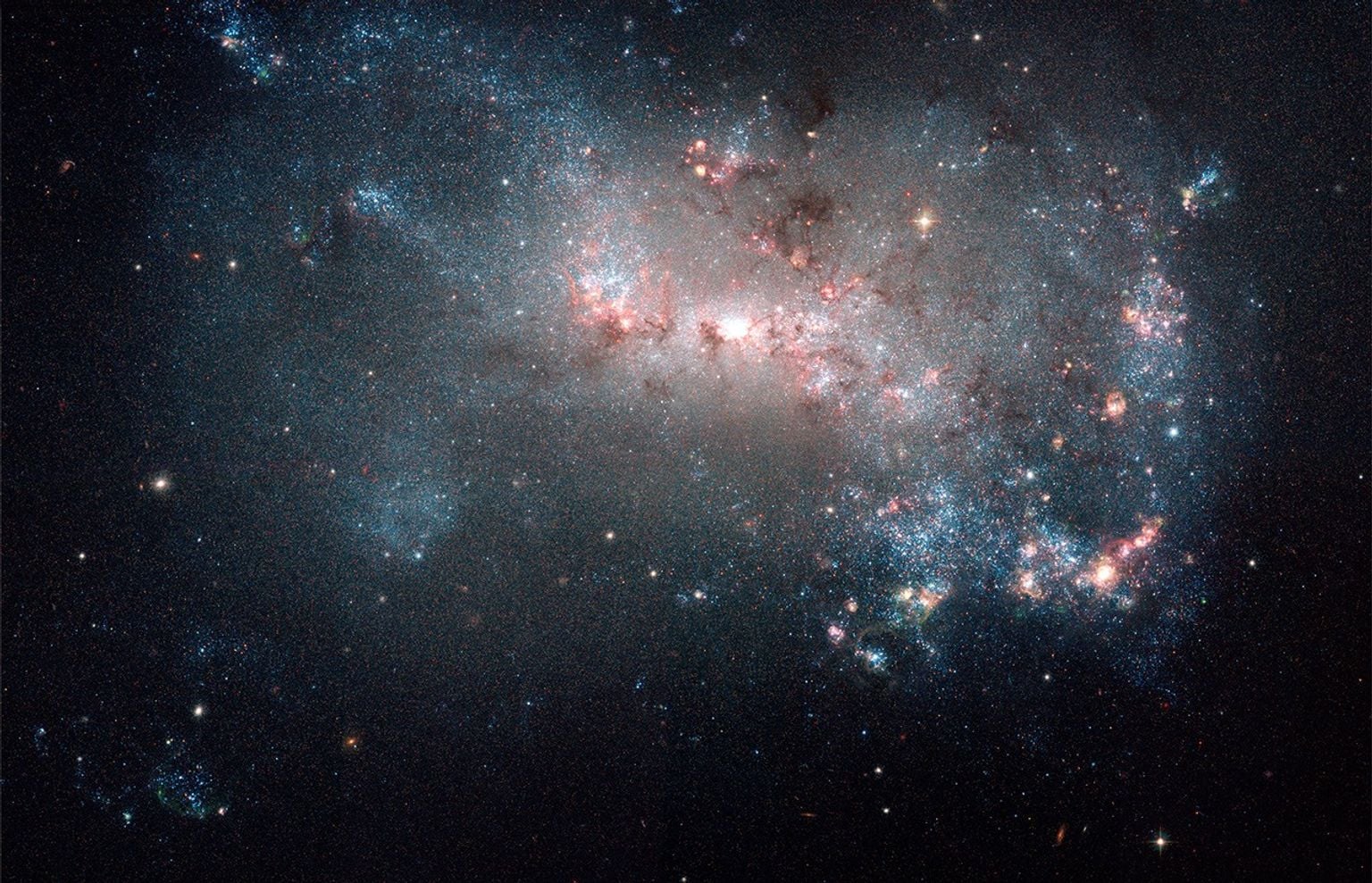
Vital to almost all life as we know it, oxygen has long been valued as a tracer of the chemical evolution of the of the cosmos. As such, it provides a practical means of tracing how the heavy elements of iron, carbon, nickel, magnesium and sulfur --- the real building blocks of habitable planets like our own --- are distributed throughout the galaxy and beyond. In a paper published in The Astrophysical Journal, researchers using Hubble studied 37 nearby dwarf galaxies — small galaxies containing a few thousand to hundreds of millions of stars — and found that much of the oxygen they expected to see is missing, says NASA. For the first time, we have measured both how much oxygen produced by stars in low-mass galaxies remains in those galaxies, and how much oxygen has been lost from those galaxies throughout their lifetimes, Grace Telford, the paper’s second author and an assistant professor at the University of Utah’s Dept. of Physics & Astronomy, told me via email. The findings show that dwarf galaxies can hold onto only a small fraction of the oxygen made by stars, says NASA. The team used Hubble Space Telescope data; data from NASA’s retired Spitzer Space Telescope as well as the ground based Very Large Array and Australian Telescope Compact Array, NASA notes. Most of the oxygen does come from core-collapse supernovae, which are the explosive deaths of massive stars, says Telford. Yet a very small fraction is also produced in other types of supernovae caused by the remnants of low-mass stars becoming unstable or merging, she says. As the cosmos’ third most abundant element, oxygen is relatively easy to detect and measure, and its production is well understood — making it a reliable indicator of how chemical elements are distributed in a galaxy, says NASA. We found that typically 15 percent of the oxygen produced by stars in these low-mass galaxies is still found inside those galaxies today: mostly in their gas, but small fractions are also in the stars and dust, says Telford. The explanation is that energetic radiation from massive stars and their deaths as supernovae drive oxygen-rich gas out of the galaxies over time, she says. This means that the missing oxygen is likely in the gaseous halos surrounding the galaxies. That is, the Circumgalactic Medium (CGM). This missing oxygen has also likely traveled even farther into the intergalactic medium. The Galaxies Losing Oxygen via Winds (GLOW) project, jointly funded by NASA and the National Science Foundation, is a large-scale effort to understand how gas and heavy elements move between low-mass galaxies, their CGM, and the intergalactic medium. To do this requires combining a large set of new and archival observations of low-mass galaxies from both ground-based and space telescopes, says Telford. The idea is that most of the oxygen found outside these dwarf galaxies has been driven there by energy from massive stars and supernovae explosions. Similar measurements of oxygen (and other heavy elements) lost from galaxies have been made for massive galaxies like the Milky Way, says Telford. But low-mass galaxies are expected to lose oxygen more easily due to their smaller gravity and our paper demonstrates that this is indeed the case, she says. As for our own Milky Way Galaxy? In the Milky Way, there is about one oxygen atom for every 2,000 hydrogen atoms, says Telford. In low-mass galaxies like those in the GLOW project, that value is more like one oxygen atom for every 10,000-20,000 hydrogen atoms, she says. The Bottom Line? The GLOW project found that low-mass galaxies lose more oxygen than current galaxy formation simulations predict, implying that we don’t yet have a complete understanding of how massive stars interact with their host galaxies, says Telford. Sources: Grace Telford NASA release APJ paper
Nearby Dwarf Galaxies Show Surprising Lack Of Oxygen, Says Paper
Full Article
Original Source
Read the full article at Universetoday →KhanList aggregates and links to publicly available news content. We do not host full articles from third-party sources. Always verify important information with original sources.