
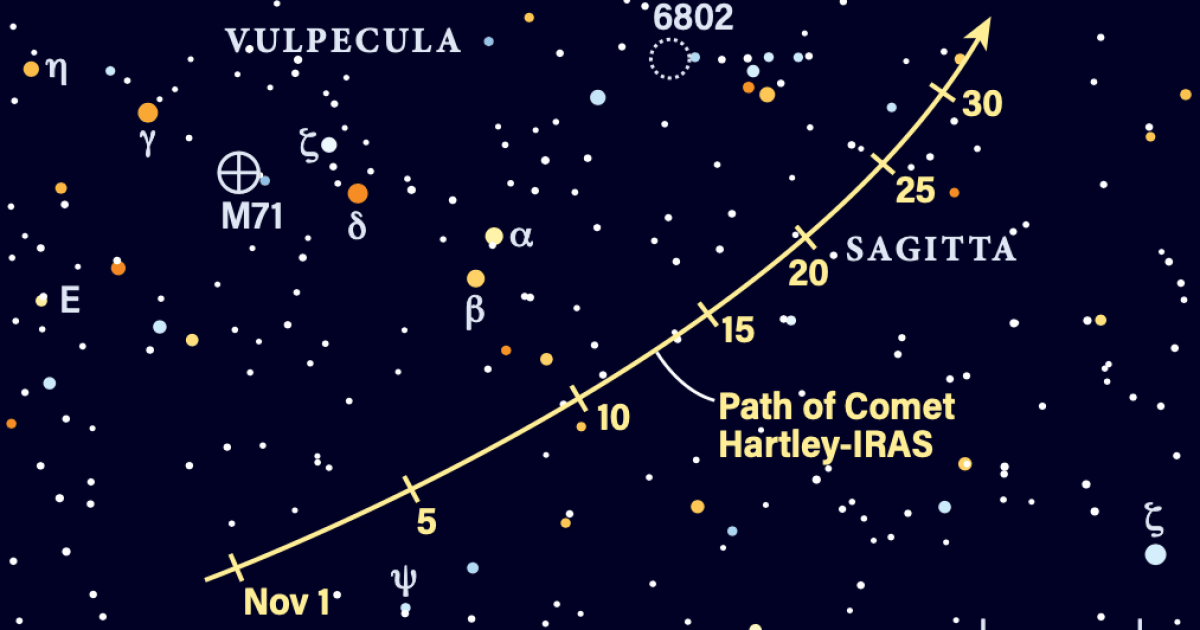
This icy fuzzball is floating through Aquila, not far from the famous Coathanger asterism in Vulpecula the Fox. | Published: November 9, 2026 Comet Hartley-IRAS is crossing an extremely crowded portion of the sky, but its green glow should give it away in astrophotos. Credit: Astronomy: Roen Kelly Looking for a sky event this week? Check out our full Sky This Week column. November 8: Io and Callisto race across Jupiter Dark skies make tonight the perfect opportunity to try spotting Comet 161P/Hartley-IRAS, still nearly 50° above the western horizon two hours after sunset. Glowing around 10th magnitude, the comet is currently located in far northern Aquila, near the Eagle’s border with Sagitta the Arrow. You can use Aquila’s bright luminary, Altair, to guide your way — the comet floats 7.7° north-northeast of this star. A closer but fainter guide is 4th-magnitude Alpha (α) Sagittae, just 2.3° north of the comet’s position tonight. Even a small scope will nab you the comet, but larger apertures will yield better views. Under high magnification, look at the comet’s southern side, which should be sharper as it plows into the solar wind. Not far from Hartley-IRAS’ position is the famous Coathanger asterism, located in Vulpecula the Fox. Cataloged as Collinder 399, you’ll find it roughly 5° northwest of the comet’s position, or about 4° northwest of Alpha Sge. Visible in binoculars or any telescope (in this case, lower magnification is better), you’ll immediately see why this star pattern bears its name. It looks exactly like its namesake, with a line of stars bisected by a small curve extending to the south. At the Coathanger’s eastern edge lies the open cluster NGC 6802. Sunrise: 6:38 A.M.Sunset: 4:49 P.M.Moonrise: 7:12 A.M.Moonset: 4:40 P.M.Moon Phase: Waxing crescent (1%)*Times for sunrise, sunset, moonrise, and moonset are given in local time from 40° N 90° W. The Moon’s illumination is given at 10 P.M. local time from the same location. Alison Klesman is senior editor of Astronomy magazine. She holds a Ph.D. in astronomy and has studied a variety of topics, from minor planets to supermassive black holes.
The Sky Today on Monday, November 9: Chase Comet 161P/Hartley-IRAS
Full Article
Original Source
Read the full article at Astronomy →KhanList aggregates and links to publicly available news content. We do not host full articles from third-party sources. Always verify important information with original sources.