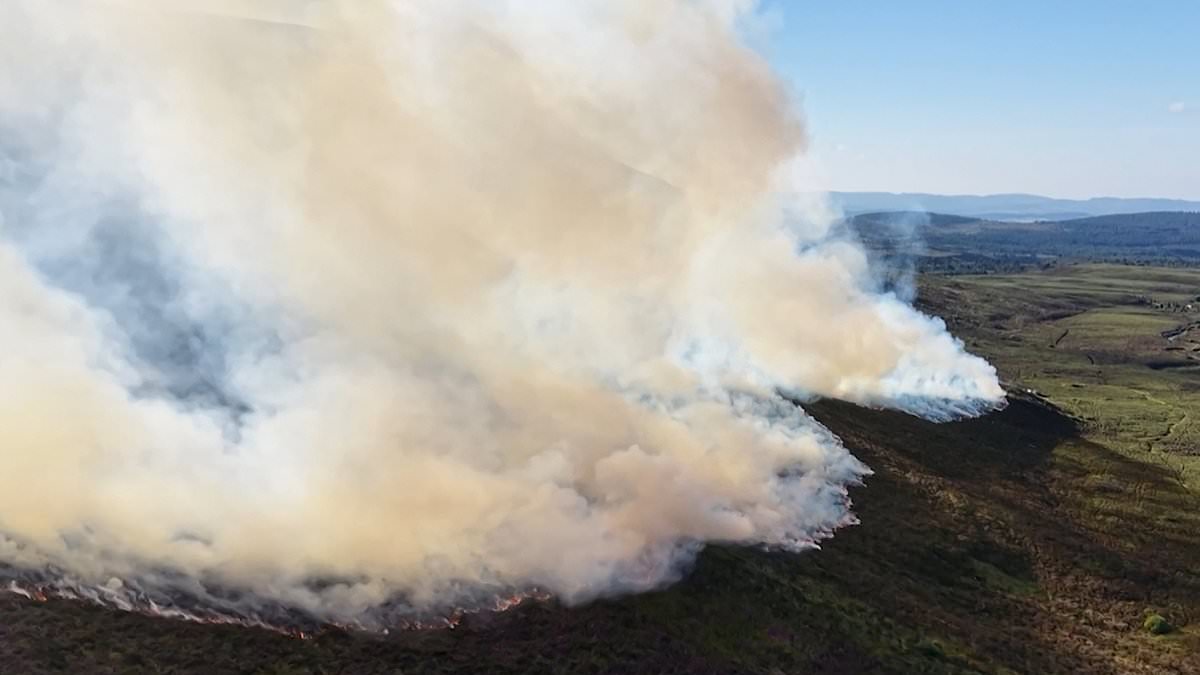
Britain could face its fourth heatwave this week bringing further wildfires which have devastated large swathes of the country and continental Europe.At the height of the third heatwave in mid-July, firefighters were battling 19 significant wildfires simultaneously in England and Wales.Now emergency services are braced for further blazes as hot and dry weather is set to return.Temperatures could reach highs of 33C (91F) on Wednesday in parts of southern England, with yellow warnings for heat issued for the East and West Midlands, the south-east, south-west and east of England, as well as Yorkshire and the Humber.The warning will begin at 9am on Tuesday until 9am on Friday.The Met Office has said UK heatwave thresholds will need to be adjusted to account for the consistently high temperatures caused by the warming climate, after records have been broken consistently this year.Meanwhile, blazes have wrought destruction in mainland Europe this week, with 220,000 forced out of their homes in south-west France and 116,000 evacuated in Spain.In Bordeaux, an 'apocalyptic' fire has grown so large that it is generating its own thunderstorms, with 38C (100F) heat threatening to fan the flames of the terrifying blaze. A huge wildfire burns through the Cairngorms national park in northern Scotland A helicopter flies over the Cairngorms National Park as a wildfire engulfed a large part of the parkOver the weekend in the UK, temperatures cooled and many areas saw light showers of rain.However, the break in heat is set to be short-lived, with yet another heatwave on the horizon. A National Fire Chiefs Council (NFCC) spokesperson said: 'With the Met Office warning that a fourth heatwave could develop this week, bringing another period of very hot weather to parts of the UK, fire and rescue services remain on alert and are continuing to prepare for renewed wildfire risk.'Battling nearly 20 wildfires at once demonstrates 'the scale of the challenge posed by the prolonged hot, dry conditions,' they added.'Most wildfires are preventable and we are asking everyone to play their part in helping to protect our communities, wildlife and natural spaces, while easing the pressure on firefighters who have already faced an exceptionally challenging summer.'The UK Health Security Agency (UKHSA) issued a warning of possible 'significant impacts' on health and social care services, including a rise in deaths among the elderly or people with health conditions, and an increase in drownings. Forecasters are expecting this week's hot spell to be a 'north-south split', with clouds and outbreaks of rain continuing in Northern Ireland, Scotland and northern England.But the peak will only last for a few days, with temperatures widely cooling close to average by the weekend, said senior Met Office meteorologist Dan Stroud.July was 3C above average across the UK, according to provisional Met Office data on the month so far.This could put it among the hottest three or four months of July on record, Mr Stroud said. The blaze in Scotland was declared a 'major incident' with more than 500 firefighters deplyed to battle the flames From above the fire appeared to spread live lava through one valley of the national park in ScotlandHeatwave thresholds for some counties have risen by a degree four or five years ago, said senior Met Office meteorologist Marco Petagna.'Going forward they'll need to be adjusted to take into account… current climate, otherwise we're going to more frequently go into heatwaves. It's a moveable thing, really, as we go through a warming world.'Southern England has dried up, seeing just one per cent of its average July rainfall. Leading to hose-pipe bans in force across much of the region.England has had just five per cent of its July rainfall and the UK as a whole has seen just 20 per cent. On Thursday, North Wales and the Upper Severn became the first part of the UK to declare drought status.With water running low, passengers at Gatwick were forced to spend hours without toilets or running water on Sunday.Although flights were unaffected, toilets in both terminals were out of use, cafes, restaurants and bars were shut, and taps were either not running at all or running with low pressure since Sunday morning. The airport was forced to deploy additional staff and hand out bottled water to travellers.By late afternoon, the Wetherspoon pub, Greggs, Giraffe restaurant and Black Sheep Cafe were still shut in the South Terminal before security, while in the North Terminal Starbucks had its shutters down.Toilets were shut with water running at very low pressure in the restrooms.By the evening, Gatwick Airport confirmed that the water had returned. If fires start this week, they could become exceptionally severe on Wednesday in pockets of the east, south and south-east of England, according to Met Office data used by Natural England and Natural Resources Wales.The 'exceptionally severe' warnings focus on eastern England on Thursday.The Fire Severity Index looks at data including rainfall, temperature and humidity and agencies use it to assess the severity of fire if it starts. It does not cover the chances of wildfires occurring.Emergency crews have already spent days fighting large wildfires in Wales and Scotland that forced people to evacuate from their homes.A huge blaze ripped through the Cairngorms National Park for ten days, leading to a major incident being declared.Huge flames also took hold at an iconic landscape on the Isle of Wight last week, spreading rapidly in the dry conditions caused by the recent heatwave. Firefighters were initially called at around 9.15am to tackle a blaze thought to be affecting an area of around 150m by 150m.That area later expanded to 200m by 250m, and is now around 1,000m by 800m, or 800,000 square metres, and is mostly heathland.Nine fire crews were forced to catch a ferry to the island to help to tackle the blaze. A huge blaze took hold of a heathland area near The Needles on the Isle of Wight The inferno spread rapidly in the dry conditions on the Isle of Wight following recent heatwavesIn southern France, firefighters are battling to contain kilometre-long wildfires.Convoys of tractors were spotted driving through towns on Sunday towing huge water tankers in an effort to reinforce the fire crews heroically battling the blaze, injuring 75 and killing two.One farmer was pictured wearing personal protective equipment as he prepared to drive into the inferno to reinforce crews with water.Some 2,500 firefighters, 1,500 military personnel and around 1,200 police have been deployed to the Gironde region.The Bordeaux blaze has caused an unprecedented 'pyrocumulonimbus' – a gigantic fire cloud that creates its own winds and packs lightning that causes more fires.The country has not seen this many fires and ones of this size since the Second World War.French president Emmanuel Macron has called a Monday morning crisis meeting with his cabinet to discuss the emergency.Scientists say climate change is making such extreme weather events more frequent and intense.Coming at the height of the summer holiday season, the fires were fuelled by woodland parched to tinder by successive heatwaves and lack of rain since May.The prefect of the southwestern Gironde region where the country's fires are concentrated urged tourists to stay away and seek 'alternative destinations'.Residents are desperately doing what they can to prevent the spread of the fire to their homes - armed only with their hosepipes.Local man Georges Clivaz sprayed water along a road leading to his property in Saint-Jean-d'Illac as the blaze burned a few kilometres away.He said: 'We're doing this to slow down the fire's advance; we want to save our homes.'Although the village was evacuated on Friday, Mr Clivaz said he and his family were trying to hold out.'But,' he said, 'the firefighters are telling us that in two or three hours the fire will be here.'Interior minister Laurent Nunez warned that 'the situation remains very unfavourable' across France, where more than 250,000 people had been evacuated.The main fire in Gironde, home to Bordeaux, was 'extremely intense and unpredictable... generating its own winds and advancing erratically toward the Bordeaux metropolitan area', said Mr Nunez.Since Wednesday, the fire in the Gironde region has injured 75 firefighters, ten of whom have been evacuated, according to the latest situation report published on Sunday by the prefecture.It comes amid claims from the leader of France's CFDT union, Sebastien Bouvier, that firefighters are not adequately equipped to protect themselves from the fire's toxic fumes.The final leg of the Tour de France, which took place on Sunday, had been shortened from 113km (83 miles) to 89km (55 miles) so that security forces can be redeployed to areas affected by the fire.Across Europe, Spain and Italy are fighting their own battles against wildfires wreaking havoc on thousands of people.Spain's interior minister Fernando Grande-Marlaska said on Sunday evening that the fires were advancing, but slowly.Firefighters there were battling a new blaze near the eastern coastal city of Valencia, where 15,000 people have been forced to flee their homes.'Difficult hours lie ahead,' Spanish prime minister Pedro Sanchez said as he visited the fire zone in Avila province west of Madrid Sunday. He is due to visit affected areas in Valencia on Monday.Describing the fire around Avila, civil protection chief Virginia Barcones said the country was battling a 'monster'.'We are dealing with a perimeter of 280 kilometres encompassing 77,000 hectares,' Ms Barcones told state broadcaster TVE of the wildfire. Bordeaux Council is considering a total evacuation of the city where more than 270,000 people live. So far, over 300,000 residents have been evacuated between France and Spain Burning forest near the town of Lege-Cap-Ferret, southwestern France yesterdayOther EU countries have sent aircraft, crews and vehicles to help both countries.The first death of the wildfires was recorded yesterday in Spain, where a man – believed to be in his 70s – was found in a car in a ravine in the Spanish town of Manises near Valencia following a forest fire, according to the local fire brigade.Ms Grande-Marlaska told local press: 'It has not been a positive day. The weather conditions have been absolutely difficult.'If it hasn't got worse, it's thanks to the work of all the emergency services.'Wind gusts yesterday blew the flames south, and Mr Grande-Marlaska warned yesterday that 'the night is not going to be very positive or very friendly to us'.Nearly 60,000 people have been evacuated from the Madrid and Ávila regions, while more than 28,000 remain confined to their homes, according to Spain's interior ministry.Eight municipalities near Toledo were ordered to evacuate late last night, but it is not clear how many that involved.Mr Sánchez said that 130,000 hectares have been reduced to ash in the fires – ahead of the annual average of 100,000 hectares.Officials voiced optimism they were starting to get a grip on some fires – though a new blaze near the eastern coastal city of Valencia forced 15,000 people to flee over the weekend.King Felipe VI, visiting an emergency shelter on Madrid's western outskirts, said the wildfires had caused 'incalculable' damage to Spain's natural heritage.Around 75,000 residents have been evacuated from the Madrid region, Avila, Toledo and from the eastern region of Castellon in Valencia.Officials said winds were pushing wildfires near Madrid to the south, away from the capital for now, but forcing more evacuations of villages in their path.One person was killed on Saturday in a separate, smaller fire near Valencia, the only civilian death so far reported in the wildfires. In France, two firefighters were killed near Bordeaux on Tuesday.Pope Leo XIV, in his prayers on Sunday, expressed solidarity with all those affected by the 'devastating' Spanish and French fires and called on people to pray for them and first responders. Smoke from nearby wilfires has covered the skyline of the city of Bordeaux Firefighters launched an aerial and ground response to contain a wildfire that broke out in scrubland near Torretta, outside Palermo on the island of Sicily, Italy, on Sunday. The island has also been hit by wildfires Wildfires have also taken hold in Italy where more than 350 fires – including ten major fires – ignited on the island of Sicily.Hundreds of people were evacuated by sea on Sunday as a wildfire swept through parts of the southern Adriatic coast, with many more expected to be rescued, the coastguard said.'More than 400 tourists and beachgoers have been evacuated by sea, the only viable evacuation route,' the coastguard said, adding that operations were ongoing.Evacuees were being rescued from the area around the town of Peschici in the southern Puglia region.A coastguard spokesman said that around 300 more people were expected to be evacuated.Six coastguard vessels, three boats from Italy's financial police and around 10 private vessels were involved in the operation.Images showed firefighters and a Canadair waterbomber battling the blaze, which was not immediately threatening homes in the town.A huge plume of smoke could be seen from dozens of kilometres away.
Tinderbox Britain braces for fourth heatwave this week as wildfire risk grows in drought-hit regions while Europe burns in 'apocalyptic' infernos
Full Article
Original Source
Read the full article at Dailymail →KhanList aggregates and links to publicly available news content. We do not host full articles from third-party sources. Always verify important information with original sources.