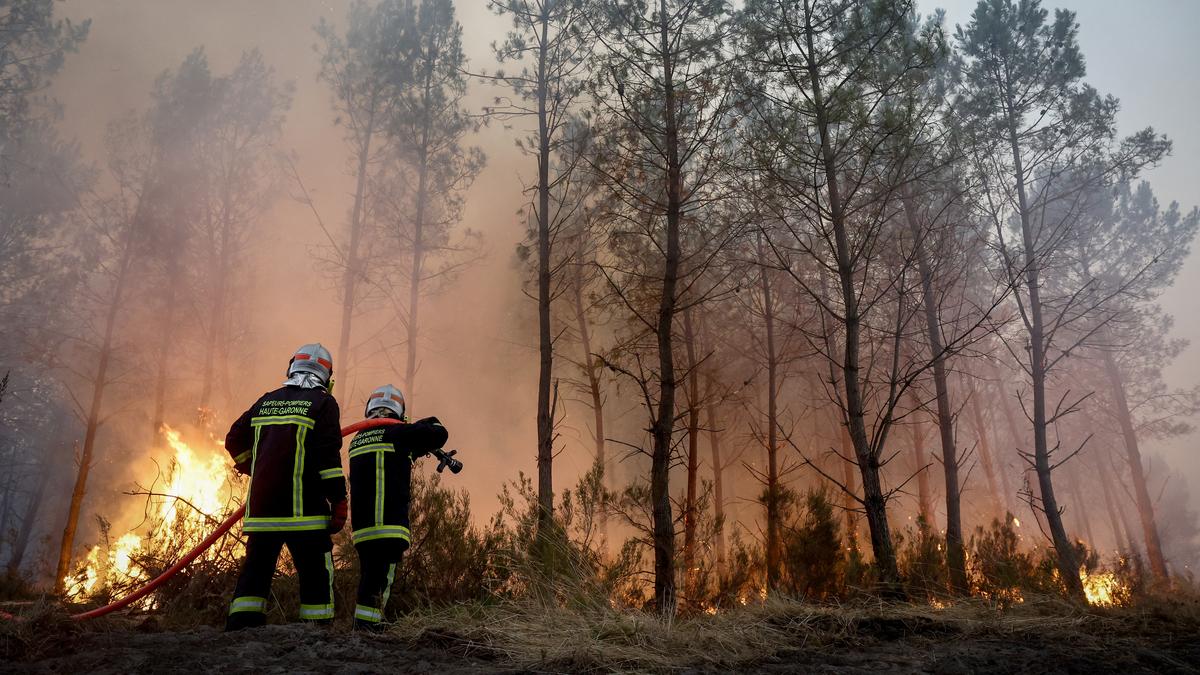
The story so far : Southwestern Europe is witnessing one of its worst wildfire emergencies in decades. Since late July, untamed fires in France’s Gironde department and across three provinces west of Spain’s Madrid have driven over 325,000 people from their homes.Both the countries have been dealing with dozens of minor wildfires amid deadly heatwaves circulating through the continent. France’s fire broke out near Saumos in the Médoc on July 22 and tore toward Lège-Cap-Ferret, forcing evacuation of the entire Arcachon Bay area. By July 26, flames sat barely 15 km from Bordeaux. Gironde’s prefecture had ordered 220,000 people out, and crews lit deliberate “backfires” near Marcheprime as a last defensive line. In Spain, regional authorities suspect a blaze that started near Burgohondo, in Avila’s Sierra de Gredos, around July 20-21, swept through the Valle de Iruelas nature reserve, merged with a fire in Madrid and reached into Toledo province. By July 26, its perimeter measured some 160 km, with nearly 89,000 people evacuated.Wildfires amid Europe’s summer heatwaveRoughly 69,500 hectares in France have been lost to wildfires since January, according to the EU’s EFFIS satellite system. Spain’s toll stands near 150,000 hectares for the same period, with the Avila-Madrid-Toledo fire alone damaging 77,000 hectares, according to the country’s Environment Minister.France has deployed about 1,000 firefighters, a military aircraft carrying 20,000 litres of retardant, and planes loaned by Croatia, Portugal, Czech Republic, and Slovakia. Spain has mobilised over 2,700 personnel, including a military emergency unit, plus planes from Greece, Italy, Portugal and Turkey through the EU’s civil-protection mechanism. Both crises coincide with Europe’s ongoing third summer heatwave. An earlier spell led to roughly 1,000 excess deaths in France in June. A firefighter helicopter dumping water is pictured as a fire started in an industrial area of San Martin de Valdeiglesias, about 70km west of Madrid, on July 26, 2026. | Photo Credit: AFP Growing influence of climate changeFor the first time on French soil, the Gironde fire generated a pyrocumulonimbus: a storm cloud born of the fire’s own superheated air plume, which cools, condenses ash-laden moisture, and triggers lightning that ignites new blazes, authorities said.Scientists say the crisis reflects the growing influence of climate change on Mediterranean fire regimes. Higher temperatures accelerate evaporation, cause vegetation to dry quickly and lengthen fire seasons. Frontline workers have pointed out that these conditions and the change in wind patterns have further complicated suppression efforts. Emergency responsesGovernments in both nations have been escalating their responses. Spain has declared a national emergency across Avila, Madrid and Toledo and Prime Minister Pedro Sanchez is pressing Opposition parties to back a climate pact on prevention funding and crisis communication. French President Emmanuel Macron has convened an emergency Cabinet meeting on Monday (July 27, 2026). Authorities continue to issue mandatory evacuation orders and have urged tourists to avoid affected regions, particularly around Bordeaux and the Gironde coast.Local media reported the death of two French firefighters during their line of duty near Bordeaux. A now-contained fire near Almería killed thirteen and left ten missing earlier this month, Spain’s deadliest in years, while one more person died near Valencia. Losses include destroyed homes, closed motorways and disrupted rail lines. Culturally and ecologically, Bordeaux’s surrounding vineyards — Gironde alone holds some 115,000 hectares of vines, France’s top wine-growing department — sit in the fire’s projected path, while most parts of Avila’s Valle de Iruelas reserve, home to one of Europe’s most important black-vulture colonies, and Castellon’s Sierra de Espadan natural park have already burned.The latest wildfire emergency extends beyond France and Spain. Italy has evacuated hundreds of people from its Adriatic coast as separate fires swept through Puglia, while Scotland and other Mediterranean countries have also reported significant flare-ups.Evacuees in both countries have been told that they cannot return home until the fires are brought under control. Meanwhile, forecasters have warned of rising temperatures again from Tuesday (July 28, 2026).
Inside the wildfire crisis raging across France and Spain | Explained
Full Article
Original Source
Read the full article at Thehindu →KhanList aggregates and links to publicly available news content. We do not host full articles from third-party sources. Always verify important information with original sources.