
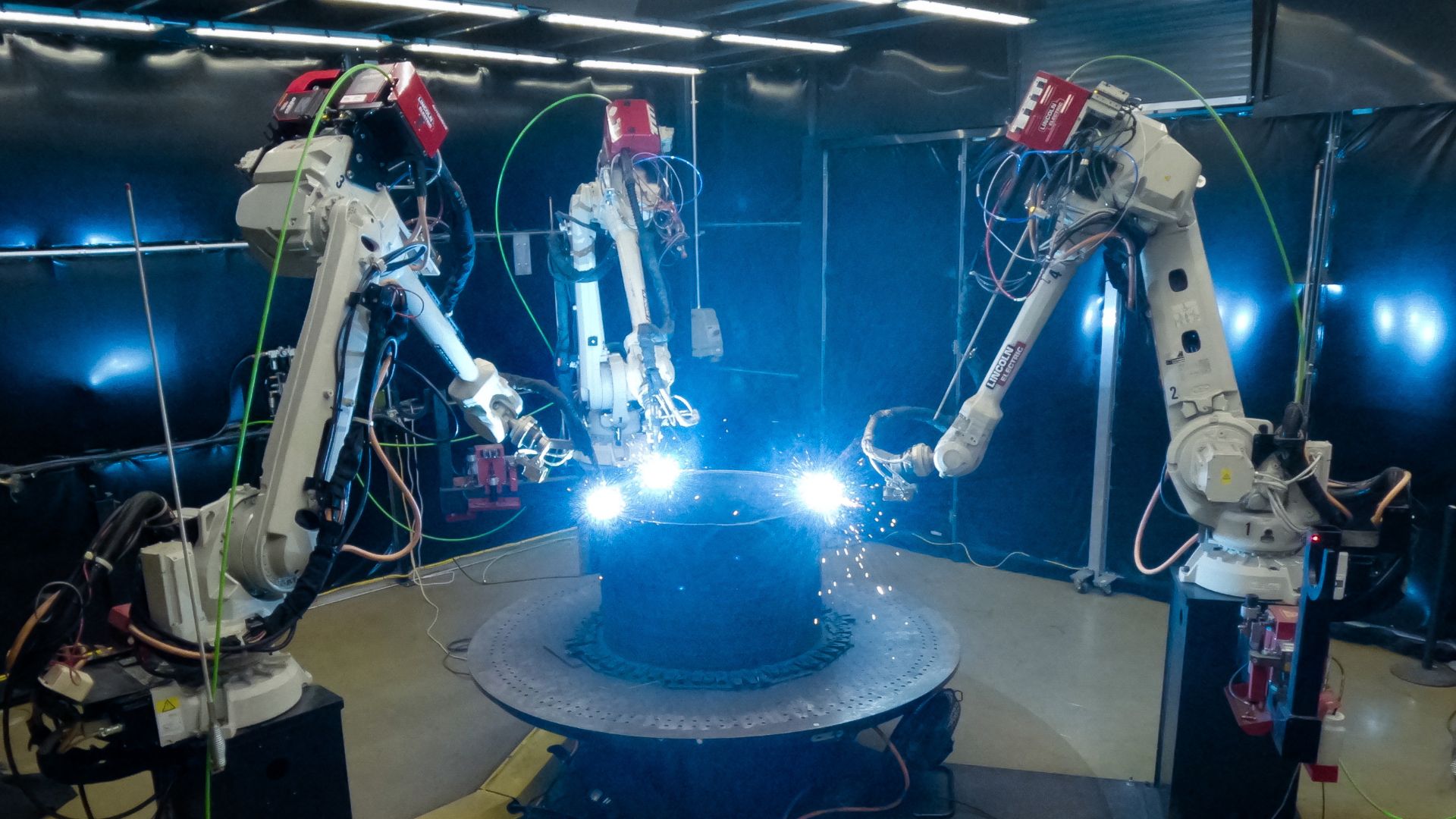
The United States is turning to large-scale metal 3D printing to address a manufacturing bottleneck that could affect its nuclear expansion plans. Oak Ridge and Idaho National Laboratories have joined forces to develop wire arc additive manufacturing for industrial pressure vessels. These massive components must withstand extreme pressure, heat, and harsh operating conditions. The technology could give US manufacturers another option as domestic forging capacity remains limited. That shortage could create supply challenges as the country pursues new nuclear projects. ORNL recently demonstrated the technology by printing a nuclear-relevant pressure vessel measuring roughly three feet by five feet. The team used MedUSA, a manufacturing platform that coordinates three robotic arms. The system builds complex metal structures by melting steel wire with electric arcs. Researchers successfully produced a large, enclosed vessel using a steel alloy relevant to nuclear applications. The demonstration marked an early step toward using additive manufacturing for components traditionally produced through forging. Pressure vessels play a critical role across the energy sector. They must maintain their structural integrity under punishing conditions, making manufacturing quality especially important. ORNL and INL now want to determine whether the process can produce components that meet demanding nuclear requirements. Printing the vessel solves only one part of the problem. Engineers must also verify that each component can survive years of operation in extreme environments before it enters service. Qualifying parts during printing That challenge sits at the center of the new collaboration. The laboratories plan to combine large-scale additive manufacturing with digital engineering and real-time monitoring. Researchers want to track a component’s shape and material properties as it takes form. The long-term goal involves creating what ORNL calls “born-qualified” pressure vessels. Engineers could use data gathered during production to evaluate whether a component meets performance requirements. That approach could reduce reliance on lengthy testing after manufacturing ends. INL will contribute expertise in nuclear materials, digital engineering, and data science. Jorgen Rufner, INL’s advanced manufacturing group lead, said researchers want to evaluate a component’s performance as it is being produced. That could shorten qualification timelines and help move nuclear hardware toward deployment faster. ORNL has already tested similar digital manufacturing methods on another nuclear project. Researchers used MedUSA and the same material system to produce neutron sensor brackets for Antares Nuclear’s R1 Mark-0 microreactor, which reached criticality at INL in June. Expanding US manufacturing options The immediate focus remains nuclear energy, where new reactor designs will require a stronger domestic manufacturing base. ORNL brings extensive additive manufacturing capabilities through its Manufacturing Demonstration Facility. INL contributes decades of experience developing and testing nuclear technologies. Together, the laboratories hope to expand US options for producing large, high-integrity metal components. The technology could eventually support aerospace, defense, chemical processing, and oil and gas. All rely on structures designed for demanding environments. If researchers can reliably print and qualify pressure vessels, manufacturers could gain another route around limited forging capacity. That could help convert advanced reactor designs into operational hardware as the United States expands its nuclear energy ambitions. Get the latest in engineering, tech, space & science - delivered daily to your inbox.Aamir is a seasoned tech journalist with experience at Exhibit Magazine, Republic World, and PR Newswire. With a deep love for all things tech and science, he has spent years decoding the latest innovations and exploring how they shape industries, lifestyles, and the future of humanity.
Three robotic arms 3D print nuclear vessel for America’s expanding reactor fleet
Full Article
Original Source
Read the full article at Interestingengineering →KhanList aggregates and links to publicly available news content. We do not host full articles from third-party sources. Always verify important information with original sources.