
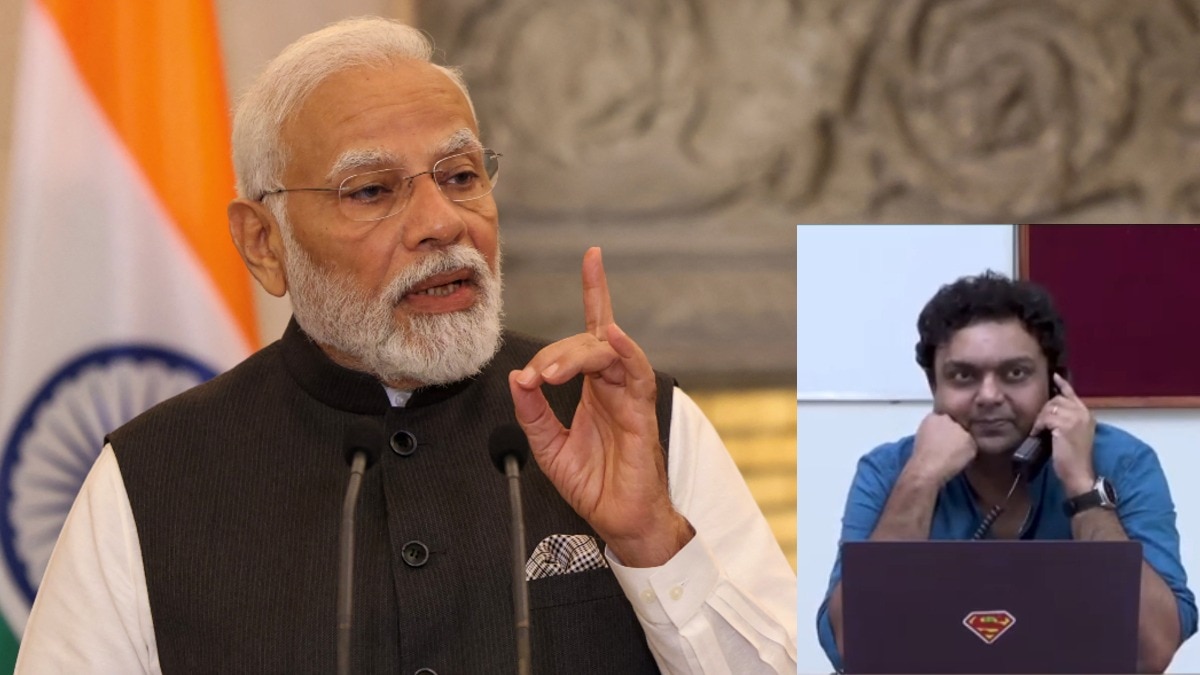
Mumbai-based Krishna Seshadri has gone viral after Prime Minister Narendra Modi praised his BharatRajya history website on Mann Ki Baat. Seshadri built the interactive platform using generative AI tools despite having no professional coding experience.A Mumbaikar with no coding experience created the Bharat Rajya history website. (image credit: Reuters)A Mumbai-based developer with no professional coding background has suddenly found himself in the spotlight after Prime Minister Narendra Modi mentioned his history website, BharatRajya, on his monthly radio program Mann Ki Baat.Krishna Seshadri created Bharat Rajya site as an interactive way to explore the political history of the Indian subcontinent. The website has now attracted widespread attention on X after Modi praised the project and spoke directly to Seshadri about it.In the 137th episode of Mann Ki Baat, Modi explained how the website works. "You go to this website, choose any one year, and you will get to know who ruled which part of Bharat at that time. This was done by Mumbai's Krishna Sheshadri." Modi said he discovered Seshadri's project on social media around Ashadha Ekadashi and found the concept interesting. He also praised its potential as a learning resource.Something extraordinary actually happened today.Stuff so extraordinary, that even if it comes as a dream, you dismiss it as something that is impossibly improbable.Thanks to your support and blessings, today I had the ultimate honor and privilege of having a conversation pic.twitter.com/QBQiYBGsoP— The Kaipullai (@thekaipullai) August 30, 2026"His effort will not only be beneficial for students of history, but it will also help us learn history in an interesting manner," the Prime Minister said. BharatRajya lets users select a year and explore the kingdoms and rulers that controlled different parts of the subcontinent at that point in time. According to ANI, its timeline covers 13 centuries, from 700 CE to the present, allowing users to see how political boundaries changed over time.The platform goes beyond broad historical maps. Its database attempts to show territorial control at a more granular level, covering more than 1,000 districts and displaying changes involving major empires and regional powers, including the Mughal and Maratha empires as well as princely states.How an amateur builder created the history website with AI What makes Seshadri's project particularly interesting is how he built it. Despite having no professional coding experience, he used generative AI tools like Claude to develop the website, write its code and create its database. The project's mapping data is also available under a Creative Commons Zero (CC0) licence. This lets students, teachers, content creators, and media organisations reuse, modify, and print the maps without permission.Following his conversation with Modi, Seshadri shared his reaction on X, saying he was still struggling to believe that the Prime Minister had spoken to him about his work. "For an amateur builder like me, I don't think there is a greater recognition or validation than this," he wrote.Seshadri said the conversation has motivated him to take BharatRajya further and turn it into a more comprehensive history reference and visualisation platform. The interaction also ended on a lighter note. When Modi asked what Seshadri does apart from working on history and technology, he replied, "I am a boring type of person who remains immersed in history and techonolgy." The response drew laughter from the Prime Minister before he wished Seshadri well.After the Mann Ki Baat episode, Seshadri's story quickly spread across X, with thousands of users sharing his website and praising the project. - EndsPublished By: Ankita GargPublished On: Aug 31, 2026 13:33 IST
Mumbaikar with no coding experience gets PM Modi's mention
Full Article
Original Source
Read the full article at Indiatoday →KhanList aggregates and links to publicly available news content. We do not host full articles from third-party sources. Always verify important information with original sources.