
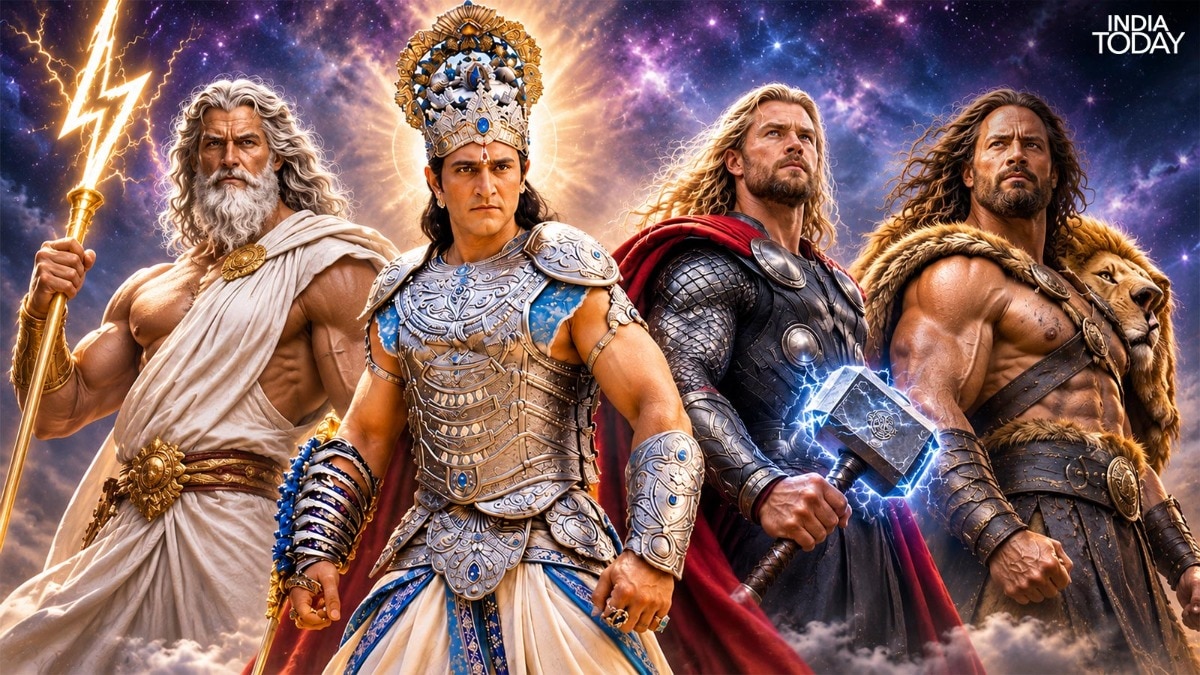
For decades, Hollywood has been obsessed with thunder gods. Marvel gave us Thor, the hammer-wielding Norse deity who can summon lightning at will. Greek mythology gave us Zeus, whose thunderbolts could bring even the mightiest mortals to their knees. And then there is Hercules, the demi-God, son of Zeus, whose extraordinary strength has inspired countless films and television adaptations, including a brief appearance in Thor: Love And Thunder (2022).But what about India? We have a god who commands thunder, rain and lightning, wields a weapon capable of striking down formidable enemies, and has fought battles that could give any superhero franchise a run for its money. Meet Devraj Indra, the king of the heavens.India isn’t the only civilisation to have imagined powerful deities commanding the forces of nature. Egyptian mythology has Baal, Japanese mythology has Rajini, Greek mythology has Zeus, and Chinese mythology has Leigong, each associated with distinct traditions surrounding divine power, thunder or storms. Yet, while some of these figures have found their way into global popular culture, India’s own Devraj Indra has plenty of fascinating tales that deserve a larger cinematic depiction.And if you think Indra is merely India’s answer to Thor or Zeus, wait until you hear about the time he spent 101 years learning from his mentor. Yes, 101 years!Meet Devraj Indra, the original God of Thunder Before superhero films made thunder and lightning a staple of cinematic spectacle, Indian scriptures had already imagined a deity associated with the forces of the heavens.Indra, also known as Devraj (king of Gods), occupies a prominent position in Vedic literature. He is associated with rain, storms and thunder, and is celebrated as a warrior who confronts formidable adversaries. His weapon of choice? The Vajra, the legendary thunderbolt. Think of a weapon that is not merely an extension of its wielder’s strength but a symbol of the forces of nature themselves. That is the kind of imagery associated with Indra’s Vajra.One of his most celebrated victories is his battle against Vritra, a serpent-like adversary associated with the obstruction of waters. Indra’s triumph releases the waters and restores their flow, making the episode more than a story about a god defeating a monster. It is also a story about overcoming the forces that hold life-giving resources captive.And that is what makes Indra such a fascinating cinematic proposition. His battles are not simply about who can throw the biggest punch or unleash the most spectacular explosion. They are rooted in a world where the forces of nature, cosmic order and divine power intersect.The comparison with Thor and Zeus is inevitable. But the legend of Lord Indra has its own vocabulary, conflicts and traditions. His story deserves to be explored on its own terms.The Vajra: Indra’s answer to the superhero arsenalEvery superhero needs an iconic weapon. Thor has Mjolnir. Wonder Woman has her Lasso of Truth. And Indra has the Vajra.But the Vajra is more than a visually striking accessory. In Vedic tradition, it is closely associated with Indra’s victory over Vritra. Its significance comes from the role it plays in one of the most celebrated episodes in Indra’s story.Indra is also known by the epithet Purandara, commonly understood as the destroyer of forts or strongholds. The title evokes the image of a warrior who can break through seemingly impregnable defences. Fighting the Vajra is almost equivalent to entering a volcano.Now imagine bringing this mysticism to the big screen: the gathering storm clouds, the rumble of thunder, the flash of lightning and Indra raising the Vajra before confronting an adversary who threatens the cosmic order.It is the sort of spectacle that lends itself to ambitious fantasy filmmaking. Yet the real opportunity lies in getting the epic right — allowing Indian audiences to experience the scale of these stories without reducing them to familiar superhero conventions.After all, Indra does not need to borrow his identity from a Hollywood franchise. His puranic legacy has supplied generations of storytellers with its own formidable imagery.Indra spent 101 years learning. What was he searching for?Here is where the story takes an unexpected turn.We usually imagine the king of the gods as a figure who issues commands, defeats enemies and enjoys the privileges of his position. But the Chandogya Upanishad presents another side of Indra: a student who refuses to settle for an answer that does not make sense to him.The story begins when Prajapati (also referred to as Lord Brahma, the creator) speaks about the Atman (soul) - the Self that is beyond old age, death, sorrow, hunger and thirst. Whoever discovers and understands this Self, he explains, attains all worlds and desires.Naturally, such a promise attracts attention. Indra, representing the gods, sets out to learn the truth. Virochana, representing the Asuras, undertakes the same journey. Both approach Prajapati as students and spend 32 years living under his instruction.Their first lesson appears deceptively simple. Prajapati asks them to look at their reflections. Both see their own images and initially accept the explanation they receive.But there is a problem. If the Self is the reflection of one’s physical appearance, what happens when the body grows old, suffers an injury or dies?Virochana is satisfied with the answer and returns to the Asuras. Indra, however, begins to question it. He cannot reconcile the idea of an immortal Self with a reflection that depends entirely on a mortal body.So he goes back to Prajapati. And this is where the difference between the two students becomes important. Indra is not content merely because his teacher has spoken. He wants to understand what teaching actually means.The king of the gods refuses to take the easy answerPrajapati continues instructing Indra, successively explaining the Self through the dream state and the condition of dreamless sleep. Each time, Indra initially departs believing he has understood. Each time, a difficulty occurs to him.If the Self is the dreamer, why does it appear to experience suffering and fear in dreams? If it is the one who sleeps without dreams, what does it mean if it seems to lose all awareness of itself and other beings?Indra returns with his doubts. Prajapati asks him to remain for another 32 years, then another 32 years, and finally five more years. By the end, Indra has spent a total of 101 years as a student.That number is explicitly mentioned in the Chandogya Upanishad. It is not simply a dramatic embellishment added by a modern storyteller.The final teaching concerns the immortal Self, which is distinct from the mortal body and is not defined by the body’s limitations. The passage explores the difference between bodily existence and the deeper nature of the Self.There is something striking about this episode. The king of the gods, a figure celebrated for his power, is prepared to spend more than a century seeking an answer he can genuinely understand.His persistence is as important to this story as his victories on the battlefield.More than a warrior, Indra is a student who keeps asking questionsWhat makes this episode especially interesting is the contrast between Indra and Virochana.Both begin their journeys with the same objective. Both receive instruction from the same teacher. Yet they respond differently when the answers demand further thought.Virochana accepts what he is told and returns home satisfied. Indra recognises that something remains unresolved and continues his search.The story does not suggest that every question has an easy answer. Instead, it shows why the willingness to question an apparently satisfactory explanation can matter.And this adds another dimension to Indra’s character. The warrior who confronts Vritra is also the student who returns to Prajapati when his understanding falls short.For a cinematic universe, that is a compelling combination: spectacular battles on one hand, and a deeply human determination to understand the truth on the other.From Indian scriptures to Thailand’s Phra InIndra’s cultural presence also extends beyond India.In Thailand, the deity is known as Phra In and occupies a place in religious and cultural traditions. His presence offers a reminder that stories and divine figures have travelled across South and Southeast Asia, acquiring distinct forms and meanings along the way.That makes Indra an interesting character for audiences beyond India, too. His story connects mythology, religious tradition and the shared cultural history of the region.The opportunity for cinema is to bring these connections to life without flattening the differences between traditions. Indra’s identity in Indian scriptures and his place in Thai culture can be explored together while respecting their particular contexts.And with a major cinematic portrayal bringing him to a wider audience, there is plenty of room to rediscover the stories that made him such a prominent figure in the first place.Why should Thor have all the fun?Hollywood has spent years turning its mythological figures into global entertainment properties. Thor has become a familiar face to audiences who may know little about Norse mythology. Zeus and Hercules continue to inspire new interpretations of Greek legends.India, meanwhile, has an extraordinary storehouse of stories waiting to be explored with imagination, research and cinematic ambition.Indra offers filmmakers a particularly rich starting point. There is the Vajra and the battle against Vritra. There is the imagery of storms and lightning. There are his titles, his place among the gods and the many traditions associated with his character.And then there is that remarkable episode from the Chandogya Upanishad: 101 years spent learning from Prajapati, because the king of the gods refuses to accept an answer he cannot fully understand.That is a character with more than enough material for a cinematic universe of his own.Perhaps the most interesting thing about Devraj Indra is that his mythology does not ask us to choose between spectacle and substance. It gives us both: a formidable warrior who commands the thunderbolt, and a persistent student who understands that even a king must keep learning.Now, that is a thunder god worth watching.- Ends
Thor who? India's Devraj Indra has a Vajra, epic battles and a 101-year story
Full Article
Original Source
Read the full article at Indiatoday →KhanList aggregates and links to publicly available news content. We do not host full articles from third-party sources. Always verify important information with original sources.