
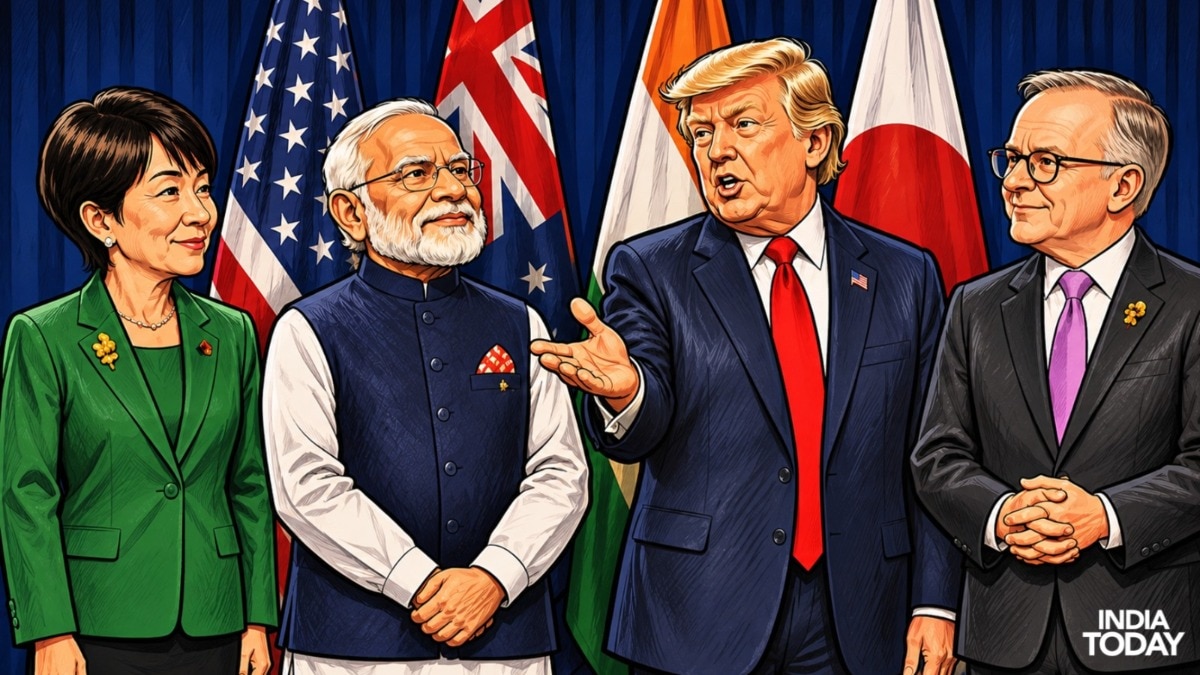
“The Quad provides trusted solutions.” Prime Minister Narendra Modi said this in Manila, where US President Donald Trump announced a series of Quad initiatives, including on maritime security, and said the first-ever "Quad Business Forum would be held next year."Yet another meeting on Trump’s itinerary, scheduled in China’s Shenzhen, tells a different story. From its revival in 2017 to renewed leader-level engagement in 2026, the Quad’s trajectory reflects shifting Indo-Pacific priorities India Today Open-Source Intelligence (OSINT) compared the two tracks. The numbers tell a story that the handshakes do not.Trump is expected to meet Xi Jinping and Vladimir Putin on November 19. With the US-Russia New START treaty expired, Trump wants China involved in future nuclear arms control talks. The outreach also reflects Washington’s dependence on Beijing for rare earths: the US relies on imports for 67 per cent of its requirements, while China accounts for 71 per cent of those imports. Meanwhile, the Quad had gone 26 months without a leaders’ meeting before Manila.THE QUAD'S LONG WAIT The Quad was revived in 2017 as a “counterweight” to China in the Indo-Pacific, and today that same grouping is being made to wait. Its leaders last met in Wilmington in September 2024. A summit was proposed for 2025, only to be postponed, and that too while India was the chair. Manila came after a gap of over 2 years. Washington’s tariff pressure on its Indo-Pacific partners raises questions about the grouping’s cohesion Meanwhile, Trump has kept reaching out to Xi, and every meeting has brought something concrete: rare-earth licensing in Busan, a trade dialogue in Beijing and a tariff-relief framework in Washington. The Quad partners, on the other hand, got tariffs. India faced a combined 50% US tariff between August 2025 and February 2026, which included a 25% penalty for buying Russian oil. Japan faces a 15% baseline tariff, and Australia 10%, despite its free trade agreement with Washington. Yes, China was hit with tariffs too, but Trump has dealt with his adversary and his allies in much the same way: tariffs for both.WHY WASHINGTON KEEPS GOING BACK TO BEIJING Because it needs China more than it likes to admit, as simple as that. Trade tensions and dependence on Chinese rare earths pushed Washington back to the negotiating table Start with the shopping bill. According to US Census Bureau data, the US bought $440 billion worth of goods from China in 2024 and sold only $143 billion, leaving a $297 billion gap, the very deficit Trump promised to shrink. Tariffs brought it down to $203 billion in 2025, nearly a third lower, but the gap is widening again. It has grown every month since March and hit $21.9 billion in September, the highest since January 2025, according to the latest monthly trade report of the Census Bureau and the Bureau of Economic Analysis.Then there are the minerals America cannot do without. According to the US Geological Survey’s Mineral Commodity Summaries 2026, the US depended on imports for 67% of its rare earths in 2025, and China supplied 71% of those imports between 2021 and 2024. These go into magnets, electric vehicles and weapons. US Secretary of State Marco Rubio, without naming China, warned at the Critical Minerals Ministerial in Washington on February 4 that such concentration can become “a tool of leverage in geopolitics”.Beijing knows this. Two days after the US announced tariffs on April 2, 2025, China hit back with 34% tariffs and rare-earth export controls. Within six weeks, both sides were in Geneva, each cutting tariffs by 115 percentage points. In Busan, the US halved its fentanyl tariff to 10%, while China paused its new rare-earth curbs for a year. In September, Washington agreed to recommend tariff cuts on $30 billion of goods each way, and on November 13, the new Board of Trade held its first meeting.THE NUCLEAR QUESTION BEHIND SHENZHEN It is not only about trade. New START, short for New Strategic Arms Reduction Treaty, was the last big pact keeping US and Russian nuclear weapons in check. Barack Obama and Dmitry Medvedev signed it in Prague on April 8, 2010, and it came into force on February 5, 2011, capping each side at 1,550 deployed long-range warheads. Extended by five years in 2021, it expired on February 5, 2026, and nothing has replaced it. Trump, Xi and Putin meet as nuclear arms control, Iran and the Ukraine war shape the global agenda Washington says the gap cannot be filled without Beijing. As Rubio put it in February, it is "impossible to do something that doesn't include China" in arms control. The rankings show why. Russia is first, with about 4,400 warheads in its military stockpile, and the US is second with 3,700. China is at some distance with 620 but ranks third globally.Beijing, however, has been reluctant. It says “its arsenal is far smaller than those of the US and Russia,” so it should not be bound by limits built around them. When New START lapsed, China said it “regretted the expiry” and urged “Washington to resume talks with Moscow” instead. Yet on Thursday, Beijing hosts both leaders in Shenzhen, in the first-ever meeting of the three, and all sides have confirmed it. China calls it a meeting of "groundbreaking significance" and speaks of world peace and stability among major powers, but it has named no agenda. Trump wants arms control and a deal on Iran, while Putin wants to talk about Ukraine.WHERE DOES INDIA STAND?India has an estimated 190 nuclear warheads, sixth in the world behind France and the UK, according to the Federation of American Scientists' 2026 assessment, yet it is absent from the proposed US-China-Russia nuclear talks. It is also not part of APEC, the forum on whose sidelines the trilateral is planned, despite applying for membership in 1991, and its application remains pending amid APEC's moratorium on expansion.There is another contradiction in Trump's China policy. In September 2025, he wrote: "Looks like we've lost India and Russia to deepest, darkest China." The Ministry of External Affairs declined to comment.India's strategic dependencies show why it cannot be seen through a single alignment. China accounted for 90.4% of India's permanent-magnet imports by quantity in 2024-25, while Russia supplied 40% of its arms imports in 2021-25, according to SIPRI.The implications reach well beyond these three countries. Nuclear arms control, rare earths, and security arrangements discussed by Trump, Xi, and Putin could directly affect India's strategic and economic interests. For New Delhi, the concern is whether decisions taken in Shenzhen could shape its security and strategic choices without India having a seat at the table- Ends
Trump courts the Quad in Manila, but takes big decisions to Shenzhen
Full Article
Original Source
Read the full article at Indiatoday →KhanList aggregates and links to publicly available news content. We do not host full articles from third-party sources. Always verify important information with original sources.