
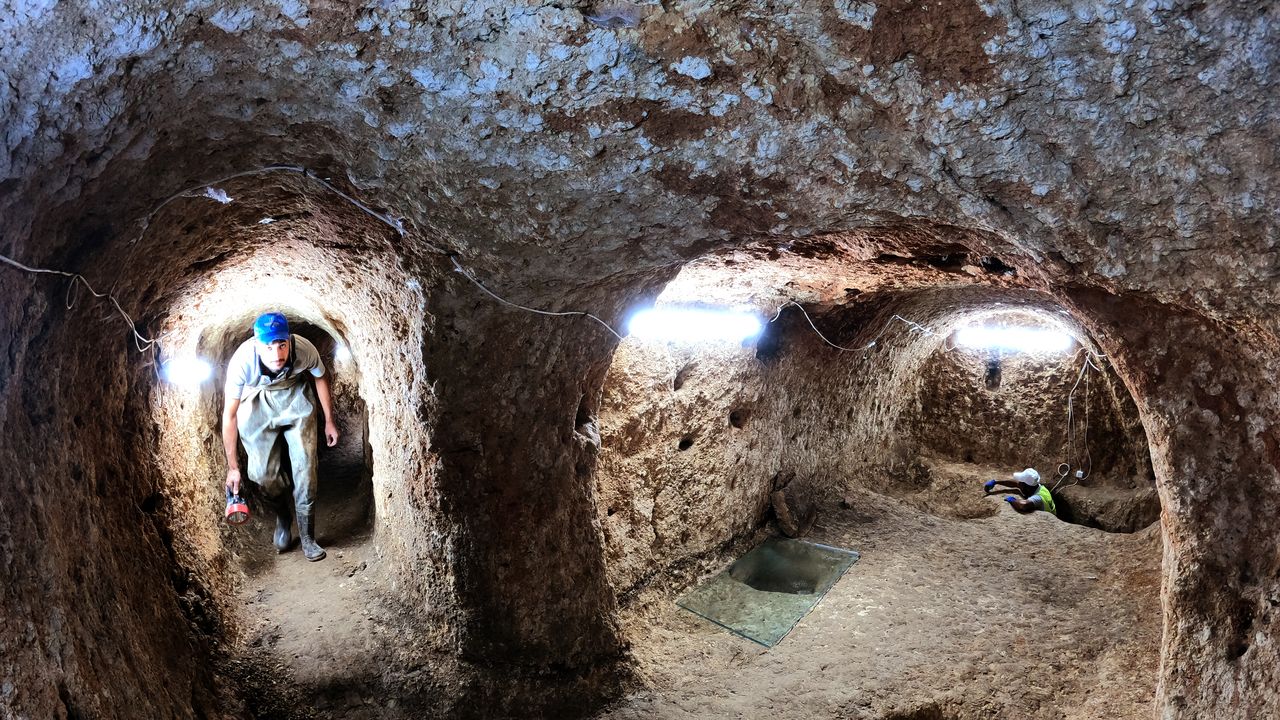
An underground city in Türkiye may not be the first picture of the country’s architectural paragon—that honor often goes to the soaring domes of the Hagia Sophia, or the azure tiles that envelop the Blue Mosque. But perhaps that’s what makes the country’s most fascinating architectural feat so impressive: that it’s not so apparent to the typical tourist’s eye. Instead, it’s built entirely out of view, carved into the bedrock beneath the Sarayönü district of Konya. This is Sarayini, an underground city dating back to the eighth century that spans an estimated 215,000 square feet of interconnected chambers, corridors, and workspaces. It contains 30 rooms and counting, complete with a working wine press and a passageway wide enough to rival some of those aboveground. It’s not the only one—Türkiye has dozens of underground cities—but Sarayini is one of the largest and most advanced. Still, it wasn’t built for luxury. Instead it was crafted for survival. Read on for everything you need to know about one of the most archaeologically rich and culturally significant sites in the country.What is Sarayini?Below what is now the Sarayonu district of Türkiye’s Konya metropolitan area, Sarayini is a labyrinth of 30 chambers, several topped with barrel-vaulted ceilings, and outfitted with chimneys, storage rooms, cellars, and wells. The multilevel network reportedly dates back to the eighth century and was constructed by local Christians to protect themselves against persecution from the Roman empire and local Muslim leaders. Hasan Uğuz, a Konya Museums archaeologist who was directing the city’s excavation in 2023, said that the teams working on-site were not expecting the settlement to cover so much ground. In addition to its many rooms and halls, one particularly wide passageway was being described as a “main street,” according to Turkish news outlet Anadolu Agency. The areas within the structure are likened to palaces for their comfortable nature and for the high quality of life the network was able to support—far from the primitive caves one might imagine in discussions of subterranean dwellings.Though it had long been subject of rumors in the area, excavation work to determine the true enormity of Sarayini began only two years ago and is still ongoing. Photo: Serhat Cetinkaya/Anadolu Agency via Getty Images“The name Sarayini essentially means ‘the palace cave,’” says Davide Tanasi, archaeologist, professor of history, and associate department chair at the University of Florida. “It is what 19th-century travelers and locals have always called it, because the architecture is so spacious. We imagine underground refuges as desperate places, and Sarayini turns that on its head [with features like] wide corridors, wine production, and water for thousands. Even in hiding, these people insisted on living well.”The winery is one of the greatest indicators of the lifestyle in Sarayini and is complete with a marble grape-crushing installation that was found with grape seeds still in place, and grooved channels designed to funnel the juice into storage cubicles. Archaeologists have also identified what appear to be stables among the excavated chambers, spaces large enough to have sheltered livestock alongside the human residents. Small chapels carved into the rock have likewise been noted. It’s details like these that also reveal how Sarayini was truly built to sustain daily life, not just shelter its inhabitants temporarily.How was Sarayini built?“It was not ‘built’ so much as carved,” explains Tanasi, “subtracted from the rock over generations, with picks, patience, and a very good understanding of the ground. Everything people needed came with them, such as wells, cisterns, ovens, kitchens, and workshops.” Like one of Türkiye’s most famous underground cities, Derinkuyu, Sarayini relies on a network of ventilation shafts to keep air circulating through even its deepest chambers.The excavation work has unearthed a labyrinth of corridors and galleries as well as a number of amenities that give an idea of what life in the temporary retreat was like, including stoves, cellars, and storage areas. Photo: Anadolu Agency/Getty ImagesThis technique had been ongoing for years before Sarayini’s creation. Konya sits in the heart of Anatolia, a region with a long history of underground construction. The Hittites and Phrygians, ancient civilizations that once dominated much of central Anatolia, are credited with some of the earliest known rock-cut chambers in the region, and their engineering traditions are thought to have been the basis for many underground building techniques. By the time they were expanding and inhabiting Türkiye’s now most-famous sites during the Byzantine era, the practice of carving entire communities into tuff (soft volcanic rock) was already a well-established regional tradition.“The engineering is remarkable,” adds Tanasi. “These were not people cowering in a hole; they were running an economy underground.”How was Sarayini discovered?“It was never really lost; this is a story about listening to people,” says Tanasi. “Village elders told the survey team they had explored the tunnels as children and described an enormous underground city. The archaeologists were skeptical, then realized at least half of it was true.”What followed was the systematic excavation that quickly revealed the site to be much larger than first estimated—an early assessment of 5,000 square meters quickly ballooned to at least 20,000 (about 215,000 square feet). From there, ground-penetrating radar also revealed an entirely separate underground city, just one kilometer north of Sarayini, connected to it by tunnels and centered on a cistern large enough to have supplied water for around 20,000 people.Among the items recovered during the excavation are animal bones and lamp stands. One particular room in the network was found to house a column drum and an object positioned in the manner of a tombstone. Photo: Serhat Cetinkaya/Anadolu Agency via Getty ImagesThe true depth of the underground city has not yet been determined. Ventilation systems and chimneys have been discovered in the structure, indicating a relatively high quality of life for the residents seeking temporary refuge in Sarayini. Photo: Serhat Cetinkaya/Anadolu Agency via Getty Images“We did not think that it could spread over such a large area,” Uğuz, the archaeologist who led the 2023 excavation, told Anadolu Agency. “During the surface surveys, the old men living here said that they had visited this place when they were children and that it was a very large underground city.”Excavation work at Sarayini has been in process for the past five years. Many of the ancient underground cities unearthed in Türkiye have only been discovered in recent years, and most have not been fully explored. Given the 2024 discovery of another underground city just one kilometer away from Sarayini, archaeologists are now investigating whether the wider region might conceal one continuous, interconnected network, rather than a series of isolated sites—a question that could reshape how historians understand underground settlement across Anatolia more broadly.Can you visit Sarayini?For now, Sarayini is not open to the public. Excavation is still active, and much of the site remains unstable or only partially cleared. Researchers are also continuing to map new sections with ground-penetrating radar, so visits are not yet an option for tourists. But the underground city in Türkiye is a strong candidate to become one of country’s next major tourism draws, and local officials have echoed that hope, though no timeline for public access has been announced.“In the meantime, Cappadocia’s Derinkuyu underground city gives you a great taste of this Anatolian tradition,” suggests Tanasi. “But keep an eye on Sarayini; it will be worth the wait.”
This Underground City in Türkiye Is One of the World’s Largest and Most Advanced
Full Article
Original Source
Read the full article at Architecturaldigest →KhanList aggregates and links to publicly available news content. We do not host full articles from third-party sources. Always verify important information with original sources.