
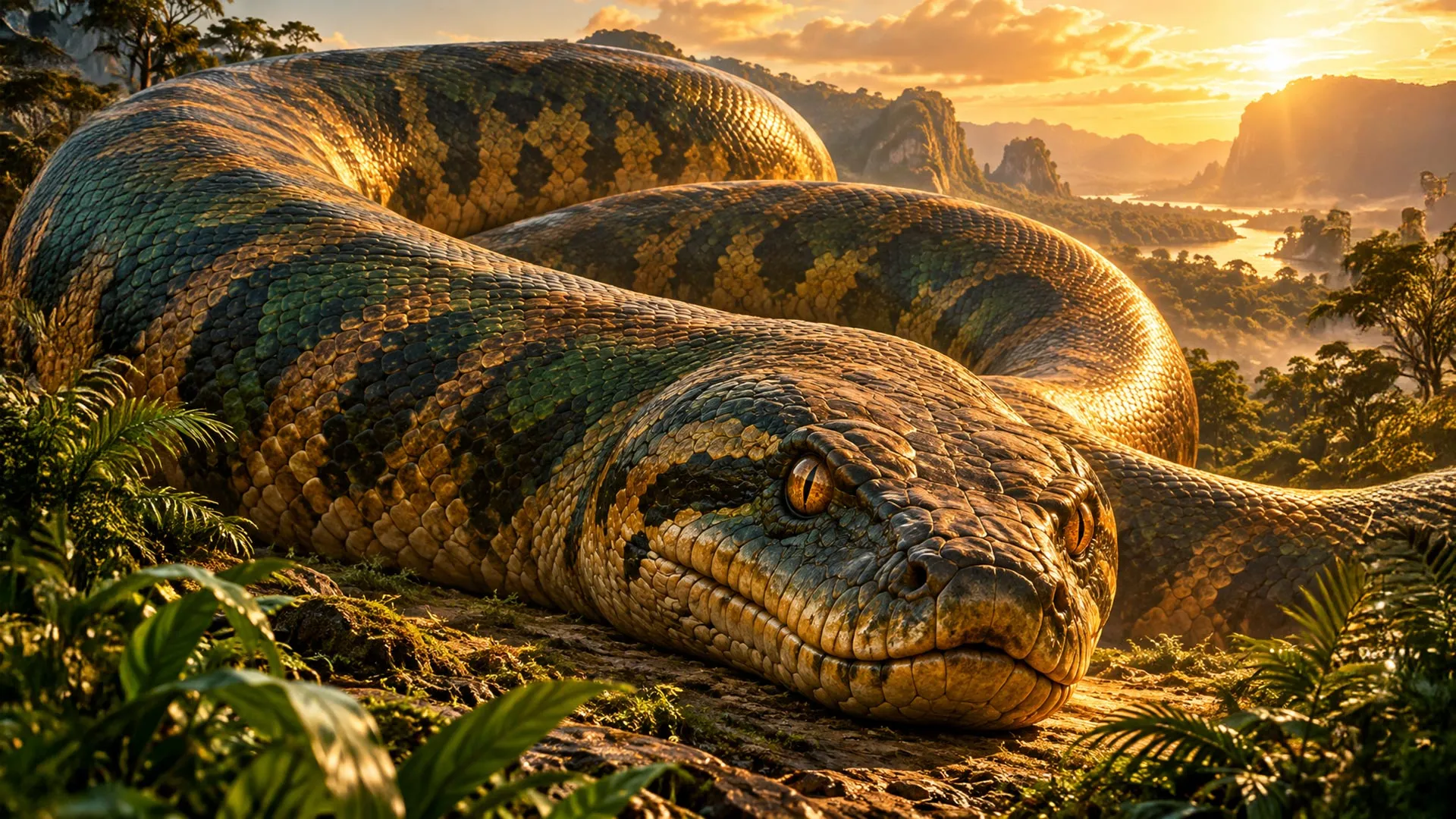
A colossal prehistoric snake that lived in India about 47 million years ago may have been one of the largest snakes ever to exist. Known as Vasuki indicus, the ancient reptile could have reached an extraordinary 15.2 meters (50 feet) in length, putting it in the same league as Titanoboa, the enormous extinct snake long regarded as the largest ever discovered. The remarkable discovery, described in 2024 in the journal Scientific Reports, came from fossils unearthed in Gujarat, western India. Researchers estimate that Vasuki measured between 10.9 and 15.2 meters (36 and 50 feet) long, although its exact size remains uncertain. Its enormous body and unusual evolutionary history offer a glimpse into a time when giant snakes inhabited the warm, tropical landscapes of ancient India. Giant Snake Fossils Unearthed in India Paleontologists Debajit Datta and Sunil Bajpai of the Indian Institute of Technology Roorkee identified the species from fossils recovered at the Panandhro Lignite Mine in Kutch, Gujarat. The remains date to the Middle Eocene, a period roughly 47 million years ago when Earth's climate was considerably warmer than it is today. The researchers examined 27 fossilized vertebrae, the individual bones that make up a snake's backbone. Many were remarkably well preserved, and some remained connected in their original arrangement. The bones appear to have belonged to a fully grown animal. The species was named Vasuki indicus in honor of Vasuki, the mythical serpent associated with the Hindu deity Shiva, who is traditionally depicted with the snake wrapped around his neck. The second part of the name refers to India, where the fossils were discovered. How Big Was This Prehistoric Snake? Although the scientists did not recover a complete skeleton, the preserved backbone provides important clues about the snake's enormous proportions. Individual vertebrae measured between 37.5 and 62.7 millimeters (1.48 and 2.47 inches) long and between 62.4 and 111.4 millimeters (2.46 and 4.39 inches) wide. Their unusually broad shape suggests that Vasuki possessed a thick, cylindrical body capable of supporting tremendous weight. To estimate its total length, the researchers compared the fossilized bones with vertebrae from living snakes whose body lengths are known. Two different methods produced estimates ranging from 10.9 to 12.2 meters (36 to 40 feet) and 14.5 to 15.2 meters (48 to 50 feet). Those measurements place Vasuki among the largest snakes ever identified. Its estimated length rivals that of Titanoboa, the giant snake that inhabited what is now Colombia approximately 60 million years ago and is thought to have reached around 13 meters (43 feet). However, the researchers caution that their calculations involve considerable uncertainty. Different methods can produce substantially different estimates, particularly when scientists must reconstruct an extinct animal using an incomplete backbone. It remains unclear whether Vasuki actually exceeded Titanoboa in length. A Massive Predator That Likely Hunted by Ambush Despite its intimidating size, Vasuki probably was not a particularly fast or agile hunter. The researchers suggest that its enormous body and distinctive vertebral structure would have favored relatively slow movement. Rather than actively chasing prey, the snake may have relied on ambush tactics, remaining concealed until another animal came within striking distance. Its hunting behavior could have resembled that of modern anacondas and large pythons, which can overpower prey through constriction. These snakes use their muscular bodies to tighten around captured animals, interfering with circulation until the prey dies. Scientists suspect Vasuki may have hunted in a similar way, although its precise diet and hunting behavior cannot be determined from the surviving fossils. Its anatomy also suggests that the snake may have spent much of its time on land or in shallow, swampy environments, rather than living exclusively in water. The ancient landscape surrounding the fossil site contained wetlands and marshes that could have provided suitable habitat for an enormous ambush predator. Ancient India's Warm Climate May Have Helped Snakes Grow Enormous The discovery also raises questions about why some prehistoric snakes reached sizes far beyond those of most species alive today. During the Middle Eocene, the region where Vasuki lived experienced tropical conditions, with average temperatures estimated at approximately 28 degrees Celsius (82 degrees Fahrenheit). Snakes are ectothermic animals, meaning they depend heavily on external sources of heat to regulate their body temperature. Warm environments can support the activity, digestion, and growth of large reptiles, potentially helping explain why exceptionally large snakes appeared during some of Earth's warmer periods. However, temperature alone does not determine how large a snake can become. Food availability, suitable habitat, evolutionary history, and other environmental factors also influence body size. A Lost Lineage of Giant Snakes That Spread Across Continents Beyond its extraordinary size, Vasuki provides evidence of an ancient branch of snake evolution. The species belonged to Madtsoiidae, an extinct family of snakes that survived for roughly 100 million years, from the Late Cretaceous to the Late Pleistocene. Members of this group occupied regions including India, Africa, Europe, South America, and Australia. Unlike modern anacondas and pythons, Vasuki represented a separate evolutionary lineage within this long-extinct family. The researchers found that its closest relatives included Madtsoia pisdurensis, a fossil snake from ancient India, and Gigantophis garstini, another large prehistoric snake known from North Africa. These relationships suggest that a lineage of giant madtsoiid snakes originated on the Indian subcontinent before spreading into other parts of the world. As India moved northward and collided with Asia around 50 million years ago, changing geographic connections may have allowed these snakes to disperse through southern Eurasia, including southern Europe, and eventually into Africa during the Eocene, approximately 56 to 34 million years ago. Later Fossil Discoveries Reveal an Ancient World Filled With Snakes Research published in 2025 has added important context to the discovery of Vasuki. In a study published in the Journal of Paleontology, Datta and Bajpai described additional fossil snakes from Eocene deposits in western India. Their findings revealed a surprisingly diverse community of ancient reptiles, including aquatic snakes, another large member of the madtsoiid family, and other extinct snake groups. Among the discoveries was Pterosphenus rannensis, an ancient aquatic snake species that adds to scientists' understanding of how these reptiles evolved and spread. The researchers also identified another madtsoiid snake that appears to have shared a marshy environment with Vasuki. This suggests that the giant predator was part of a broader community of snakes occupying different ecological roles, rather than an isolated evolutionary oddity. Evidence from the fossil deposits indicates that some of these snakes inhabited tidal environments, while others occupied swamps and marshes. Together, the discoveries paint a more detailed picture of the complex ecosystems that existed in India tens of millions of years ago. What Modern Anacondas Reveal About Giant Snakes Additional evidence about snake gigantism emerged from a separate 2025 study published in the Journal of Vertebrate Paleontology. Researchers examining fossilized anaconda vertebrae from Venezuela found that these enormous snakes had already evolved large bodies by approximately 12.4 million years ago. Ancient anacondas reached estimated lengths of around 5.2 meters (17 feet), comparable to the size of many living anacondas. The findings suggest that anacondas maintained their impressive size for millions of years, even as climates and ecosystems changed. They also show that prehistoric snakes did not necessarily grow larger simply because the planet was warmer. Although anacondas are evolutionarily distinct from Vasuki, the research offers a useful comparison for understanding how different snake lineages became giants and adapted to their environments. For Vasuki indicus, the full story remains incomplete. Its precise size, appearance, and behavior are still uncertain, but the fossil evidence establishes it as an extraordinary example of prehistoric gigantism. Together with later discoveries from the same region, the ancient snake is helping scientists reconstruct a largely forgotten world in which massive serpents occupied the tropical landscapes of India.
Gigantic prehistoric snake discovered in India may have been one of the largest ever
Full Article
Original Source
Read the full article at Sciencedaily →KhanList aggregates and links to publicly available news content. We do not host full articles from third-party sources. Always verify important information with original sources.