
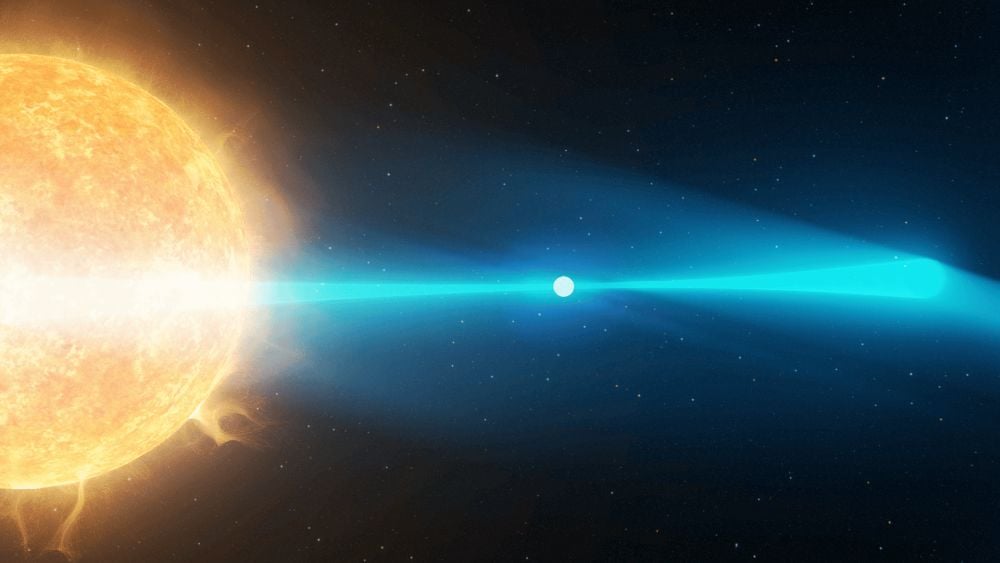
Unusual electromagnetic signals permeate the cosmos, and they range from powerful and deadly gamma-rays down to generally harmless radio waves. The sources of many of these signals are well-understood, and in some cases, special spacecraft have been launched to monitor them. But some remain unexplained. Radio waves are widespread throughout the cosmos because they come from objects with a wide variety of temperatures. Radio astronomy has been around for decades, so many of these are well-understood. But not all of them. Some of them have only been discovered more recently and are awaiting an explanation. One of these phenomenon are called long-period radio transients (LPTs), and their periodic radio pulses range from a few minutes to several hours. That's important because it differentiates them from pulsars and their extremely short radio periods. Astronomers have only detected about 15 LPTs in total, and they've had difficulty explaining exactly what they are and how they generate their radio pulses. There are different hypotheses invoked to explain them. They could be magnetars, which are neutron stars with extremely powerful magnetic fields that rotate very slowly. Or they could be something exotic and speculative, like strange dwarf pulsars. But at least some of them have been confirmed to be White Dwarf-Main Sequence (WDMS) binaries, a binary star containing a white dwarf (WD) and another main sequence star. Astronomers have only been able to confirm the white dwarf's companion in a handful of cases, and in those, the companion is a red dwarf. Now astronomers have identified for the first time a LPT that consists of a white dwarf with a Sun-like, G-type star as its companion. Their results are published in Nature Astronomy in a paper titled "A long-period transient with a Sun-like companion." The lead author is Dr. Sam McSweeney, who made this discovery while working as a researcher at the Curtin University node of ICRAR. At the time of this research, there were only 12 detected LPTs, and the ones with identified components favoured WD and red dwarf pairs. "An optical follow-up confirmed that at least 4 (ouf of 12) long-period transients are binary systems comprising a white dwarf and an M dwarf," the authors write. But this newly-detected LPT, named GPM J071507−114153, bucks that trend. "It is a binary system comprising a low-mass white dwarf and a G-type star identified via optical spectroscopy." “We detected this system in a large survey using the MWA (Murchison Widefield Array) to scan the entire Milky Way visible from Australia. We then used the MeerKAT radio telescope in South Africa to determine its precise position,” said co-author Natasha Hurley-Walker, Associate Professor at the Curtin Institute of Radio Astronomy. The MWA detected 214 separate pulses, and the MeerKAT pinpointed its location based on 33 detected pulses. 26 of MeerKAT's pulses were co-detected by the MWA. The new LPT has a period of only 7.9 minutes, which is almost certainly from its rotation. The properties of its radio pulses, like its polarization, are modulated by a longer period of about 1.3 days, which the researchers say is the binary system's orbital period. Follow-up optical observations and spectrometry came from the Keck Telescopes. "The optical counterpart of J0715-1141 was observed with the low-resolution imaging spectrometer on the Keck 1 telescope on Mauna Kea, Hawaii," the authors write. Those observations were a pair of 1,200 second exposures. They let the researchers determine the nature of the WD's partner star. This figure from the research shows the optical spectrum of the new LPT, J0715-1141, compared to model spectra from F-type, G-type, and K-type stars. The spectrum most closely matches that of a G-type, Sun-like star. "As a comparison, hotter F-type and cooler K-type stars show distinct spectral features not present in the data," the authors write. The three panels on the right highlight this in three different elements. Image Credit: McSweeney, S.J., Hurley-Walker, N., Bahramian, A. et al. A long-period transient with a Sun-like companion. Nat Astron (2026). In this case, the WD's binary partner is a star like our Sun, which is far more massive and luminous than the M dwarfs (red dwarfs) found in other LPTs. So this rules out the idea that only WD-red dwarf pairs can generate LPTs. Astronomers and astrophysicists want to know exactly how these radio pulses are generated. Can any of their observations help researchers determine the exact source of the radio pulses? Not exactly, but the clarity of the pulses helps narrow it down. “This is the first time the pulses are clear enough to see the white dwarf moving in its orbit around its companion, so we know that the pulsations are coming from a region close to the white dwarf, or possibly even from the white dwarf itself,” said lead author McSweeney. "We conclude that in long-period transients powered by white dwarf binaries, the coherent radio pulsed emission crucially depends on its interaction with the companion star, which we show can be G-type stars in day-long orbits," the researchers write. There's another suprise in these findings. The pulses from the WD let the researchers detect stellar flares from the Sun-like star as it passed in front of the WD. “As a bonus, we also saw the white dwarf moving behind a region with a strong magnetic field, most likely a ‘stellar prominence’, which is a large loop of plasma erupting from a star’s surface,” Hurley-Walker said. “It’s amazing that by using radio wavelengths we can detect the storms on a star over 5000 light-years away.” This image shows a solar prominence from the Sun in 2010, with Earth shown for scale. The researchers were able to detect one of these coming from the main sequence star in the pair, as the white dwarf moved behind it. That's pretty impressive for a star that's 5,000 light years away. Image Credit: NASA/SDO One questions astronomers ask is how these types of binaries form, and the researchers have a hypothesis for that. They say the system could've formed through binary evolution. "One possibility is that the present configuration of the system arises through post-common-envelope (CE) binary evolution," they write. The progenitor of the system most likely had an intermediate-mass primary with a lower-mass companion on a wider orbit. "As the primary evolved off the main sequence and expanded into a giant, unstable mass transfer initiated a CE phase, during which orbital energy and angular momentum were transferred to the envelope, leading to its ejection and substantial orbital shrinkage." The primary star was left as an exposed stellar core, and evolved to become a WD, creating the situation the astronomers see today: a WD star with a G-type partner, that are still in a binary relationship, but detached from the common envelope they once shared. As for the system's future, it could hold a cataclysmic explosion. Binaries like this that have left their common envelopes, and that consist of a WD and a massive main-sequence star, are potential breeding grounds for eventual Type Ia supernovae. This can happen as their orbit decays and the WD accretes material from its companion. Once enough material builds up on the accreting WD, it explodes and destroys the WD. Or they could created a double degenerate WD-WD merger, if the main sequence companion collapses before the binary orbit decays. Could the radio signals from LPTs be used to find the progenitors of these supernovae explosions? "Radio detections of LPTs may offer a route to finding cooler WDs around hotter stars at greater distances than traditional ultraviolet and optical surveys," the authors write. The upcoming Square Kilometre Array could be the key to this. "In an era of larger and more sensitive radio surveys, such as those to be conducted by the Square Kilometre Array Observatory, this may form a new pathway for investigating the progenitors of type Ia supernovae," the authors write.
This Rare Binary Star Emits Radio Pulses Every Few Minutes. Will It Eventually Explode?
Full Article
Original Source
Read the full article at Universetoday →KhanList aggregates and links to publicly available news content. We do not host full articles from third-party sources. Always verify important information with original sources.