
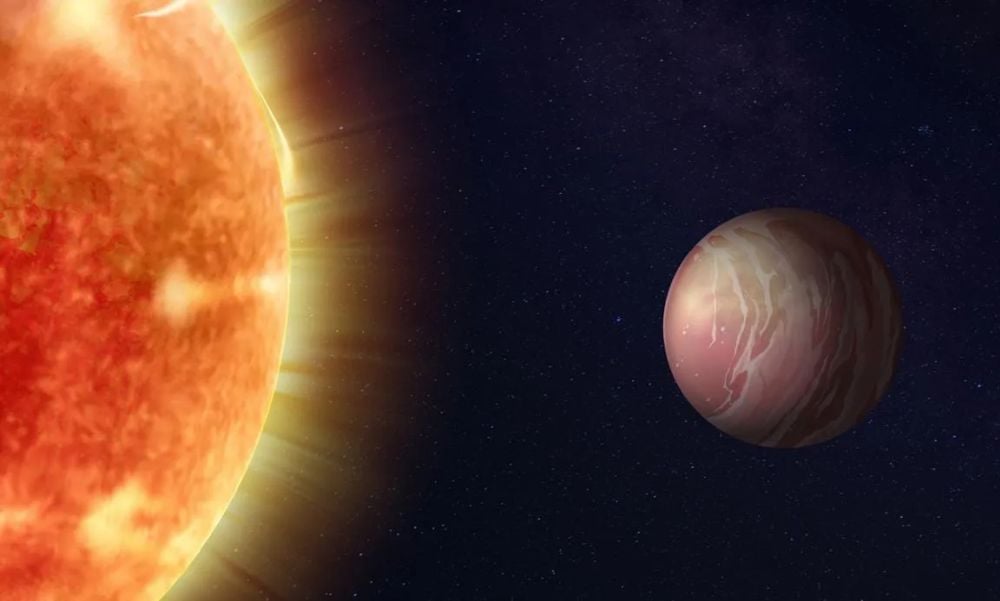
Among Kepler and TESS's many surprising exoplanet discoveries are the ultra-short period (USP) planets. These planets move very quickly and complete an orbit in less than 24 hours. Ancient astronomers thought that Mercury was so fast—it goes around the Sun every 88 days—that they named it after the Roman god Mercury, who was the fast-travelling messenger of the Gods. They couldn't have known how sluggish Mercury is compared to the USPs. Their speed is just one of their remarkable qualities. Since they're so close to their stars, USPs are exposed to the full, blazing force of their stars' powerful radiation. This means these planets should have lost their atmospheres to space. But one USP named TOI-561 b seemed to be different. Early observations detected hints of an atmosphere, and a 2025 paper baed on limited JWST observations suggested it had an atmosphere made of volatiles like water and carbon dioxide. Now, some of the same researchers revisited the exoplanet. The new work used the JWST to examine the exoplanet's atmosphere in more detail. An artist's illustration of TOI-561 b. In 2025, JWST observations showed that the exoplanet had an unexpected atmosphere. The researchers thought it had a thick atmosphere above a molten surface. Image credit: NASA / ESA / CSA / Ralf Crawford, STScI. The research is "A Highly Reflective Atmosphere on the Lava World TOI-561b Revealed by JWST/NIRSpec Phase Curves," and it's published in The Astronomical Journal. The first author is Samuel Boucher from the Department of Physics and Trottier Institute for Research on Exoplanets, at the Université de Montréal, Canada. "Our discovery challenges current theories. We would expect a heavily irradiated rocky planet like TOI-561 b to have lost its atmosphere billions of years ago." - Professor Lisa Dang, University of Waterloo. "One of the most pressing questions in exoplanet science today is whether small rocky exoplanets can host atmospheres," the authors write. If they do, scientists expect these atmosphere to be secondary rather than primordial. Some portion of the atmosphere could come from off-gassing or other exchanges with the exoplanet's interior, and that is evidence of processes that are not visible in remote observations. That has implications for understanding how rocky planets evolve, and how habitability may arise. In a twist, rocky USPs may be the best place to look for secondary atmospheres and the clues they hold to deeper planetary processes. That's because they're probably magma oceans, at least on their daysides, and they can "be in continuous exchange with and fuel an atmosphere," the researchers write. "Ultrashort period (USP) rocky planets are expected to be depleted of any substantial gaseous envelope due to the intense irradiation they receive from their host star, making the recent detection of an atmosphere around TOI-561 b particularly surprising," the authors write. "That finding was based on the planet’s bulk density and dayside emission spectrum, but full-orbit phase-curve observations offer a more comprehensive way to constrain the presence and characteristics of a planet’s atmosphere." In this work, the authors observed TOI-561 b for 37 hours, and because it completes an orbit in about 10.5 hours, 37 hours of observing time was equal to more than three complete orbits. That means the JWST got a really good look at the planet. This generated more fullsome data to understand the exoplanet, its atmosphere, and what that can tell planetary scientists about hidden processes. This graphic shows the JWST's NIRSpec spectrum for TOI-561 b from the 2025 research. Though the data was less complete than the new observations, it showed that the exoplanet likely had a thick volatile-rich atmosphere. Image Credit: Illustration: NASA, ESA, CSA, Ralf Crawford (STScI), Science: J. Teske (Carnegie Science Earth and Planets Laboratory), A. Piette (University of Birmingham), T. Lichtenberg (Groningen), N. Wallack (Carnegie Science Earth and Planets Laboratory) The observations of TOI-561 b in previous research showed that the exoplanet's dayside was much cooler than it should be for a bare rock world this close to a star. There could only be two explanations for this: either the heat it was reflected back into space, or it was carried to the nightside by an atmosphere. These new full-orbit observations gave researchers their first look at the exoplanet's nightside. They found that the nightside wasn't warm enough to have acquired the missing heat. About three-quarters of it must have been reflected into space. To try to understand what was happening, the researchers turned to a General Circulation Model (GCM) and compared it to their observations. "We conclude from the GCM simulations that heat redistribution alone cannot match the observed dayside fluxes or amplitude of the phase curve, and a high-albedo source (Ab = 0.6) indicative of clouds or haze," they write. Where did that leave them? “We measured how the planet’s brightness and heat changed throughout its orbit," said Professor Lisa Dang, project lead at the University of Waterloo, Ontario, Canada. "This technique, known as a phase curve, revealed that the planet reflects a significant amount of light from its star, and that heat is being redistributed around the planet instead of only on the sunlit side. Together, these point to the presence of an atmosphere.” They found that "multiple possible cloud species can form on the dayside including MgSiO3 and SiO2," and that SiO2 in particular could play a role. SiO2 "could help to explain the high albedo required by the GCM to match the observed dayside emission," the researchers explain. Basically, these clouds are like a sunscreen, protecting the planet from intense heat. These results are a confirmation of earlier work showing that, against all expectations, TOI-561 b has a significant atmosphere. This challenges the current understanding of how rocky super-Earth USPs evolve. "Our discovery challenges current theories," Professor Dang said. "We would expect a heavily irradiated rocky planet like TOI-561 b to have lost its atmosphere billions of years ago. Instead, the evidence suggests it still has a significant atmosphere today." "Atmospheric-escape theory suggests that strongly irradiated super-Earths should be devoid of any volatile envelopes," the researchers explain. "This is particularly astonishing given that the current JWST census of rocky exoplanets has been interpreted as suggestive of a population of bare-rock planets..." They note that most of those planets are orbiting M-dwarfs, while TOI-561 b orbits a late G/early K dwarf, a more Sun-like star. These red dwarf planets are less irradiated than TOI-561 b, so it's strange and unexpected for it to host an atmosphere. "If rocky exoplanets at intermediate irradiation are completely desiccated, even-more irradiated exoplanets such as TOI-561 b should be, too," the researchers write. The authors suggest a couple possible explanations for this. It's possible that TOI-561 b started out with a massive amount of atmospheric volatiles, meaning it began as a volatile-rich sub-Neptune and has had its atmosphere whittled away over time. It's also possible that we're seeing its secondary atmosphere, and that primary H/He atmospheres are more easily stripped away, while secondary atmospheres persist. This graphic compares Earth, Super-Earths, Sub-Neptunes and Neptune. Some sub-Neptunes may have started out with more voluminous atmospheres like Neptune, but had them whittled away by their stars' powerful radiation. It's possible that's what TOI-561 b is one of these. Image Credit: By Keith Miller (Caltech/IPAC/SELab) - https://www.ipac.caltech.edu/news/finding-patterns-in-planets-researchers-explore-the-demographics-of-alien-worlds-in-k2-data, Public Domain, https://commons.wikimedia.org/w/index.php?curid=193443844 Migration could play a role, too. If the planet was further from its star while the star was younger and emitting more powerful radiation, then moved closer as the star calmed down, it's been exposed to less radiation overall, so hasn't lost its atmosphere. Lastly, in what they call option d, the authors write that "the originally accreted atmospheric volatiles were sequestered into the interior and later outgassed." "Why TOI-561 b has an atmosphere may be due to a combination of more than one of these options," the authors write. Whatever the case, these results are extremely interesting. The fourth possibility, that the exoplanet's original atmsophere was sequestered into its interior during its magma ocean phase and released later, is particularly interesting. "It is an exciting prospect that constraining the composition of a rocky planet’s secondary atmosphere could provide insights into its geochemical evolution (option d), such as the redox state of the magma ocean," the researchers write. Whether one or more or all of the outlined explanations are responsible for TOI-561 b's atmosphere can hopefully be explained in future work. Part of that work will be comparing the exoplanet to bodies we're more familiar with. “The next big question we will seek to answer is whether TOI-561 b’s atmosphere resembles Venus or an extreme version of lo," Dang said. "Observing the planet at longer wavelengths with JWST could give us insights and help explain how a planet this hot has held on to an atmosphere for billions of years.”
This Oddbal Reflective Lava World is Challenging to Understand
Full Article
Original Source
Read the full article at Universetoday →KhanList aggregates and links to publicly available news content. We do not host full articles from third-party sources. Always verify important information with original sources.