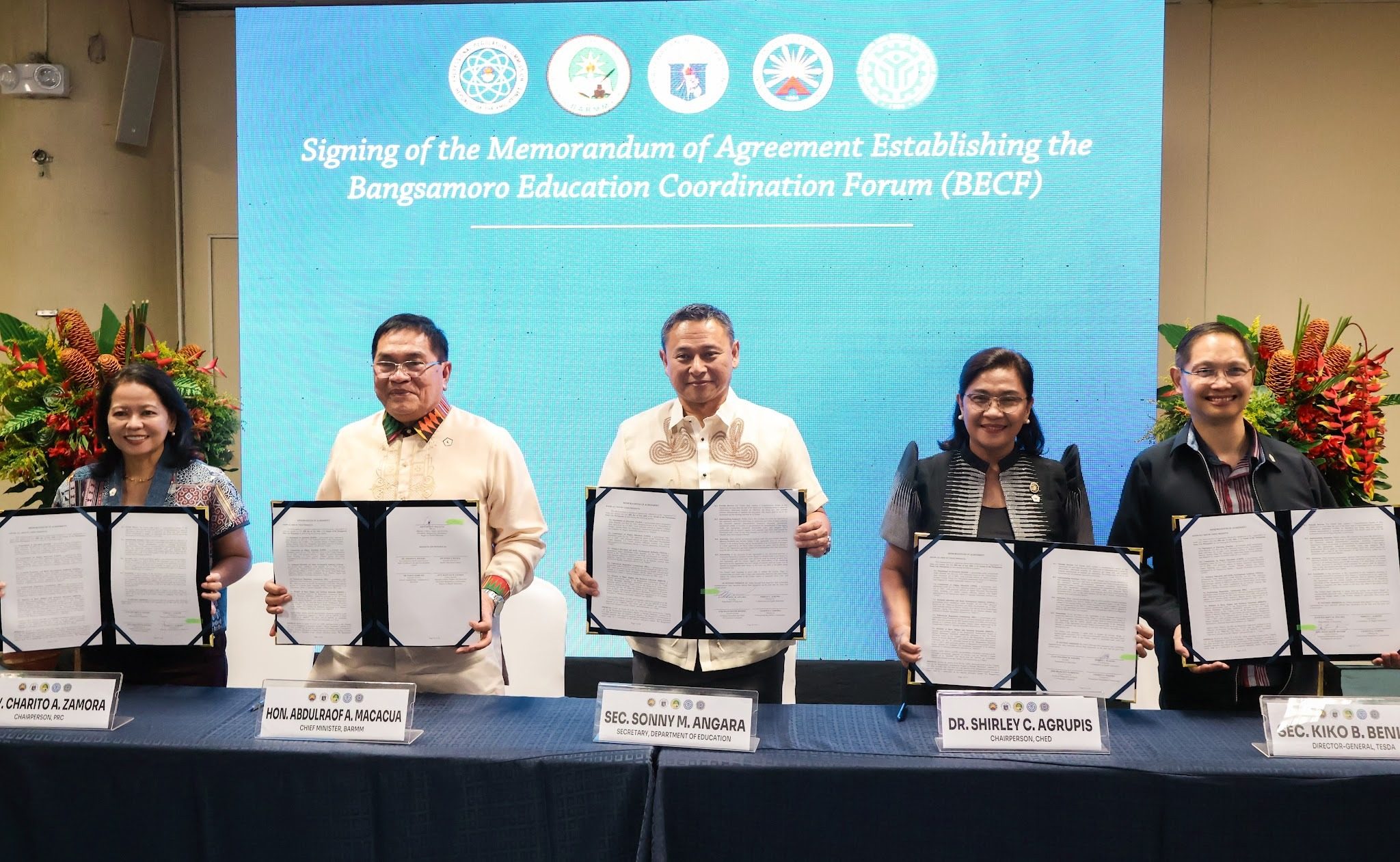
COORDINATING BODY. Heads of the Bangsamoro education ministry and various national government agencies sign a memorandum of agreement to form the Bangsamoro Education Coordination Forum on July 28, 2026. Second Congressional Commission on Education The inter-agency Bangsamoro Education Coordination Forum seeks to address the disconnect between the target policies and programs of the national and BARMM governments MANILA, Philippines – The Bangsamoro government and various national government agencies formalized a deal to enhance coordination in addressing challenges in the autonomous region’s education sector. On Tuesday, July 28, a memorandum of agreement was signed to establish the Bangsamoro Education Coordination Forum (BECF). It involves the following agencies: Bangsamoro’s Ministry of Basic, Higher, and Technical Education Department of Education Commission on Higher Education Technical Education and Skills Development Authority Professional Regulation Commission “For too long, coordination between our agencies depended on goodwill. Today, we transform this mutual goodwill into a binding commitment,” said Abdulraof Macacua, interim chief minister and concurrent education minister of the Bangsamoro Autonomous Region in Muslim Mindanao (BARMM). “We are building a permanent platform where we set shared priorities, make collective decisions, share responsibility, and answer to each other and our people for their outcomes,” Macacua said in his speech after the signing of the agreement. Bangsamoro context Under the Bangsamoro Organic Law, education in BARMM became a subsystem of the Philippine education system. The BECF came about to address the disconnect between the target policies and programs of the national and BARMM governments for the region’s education system, as authorities were confronted with unresolved questions on funding channels, eligibility, and agency jurisdiction. It was formed months after the creation of a technical working group for education within the Philippine Congress-Bangsamoro Parliament Forum in March. The coordinating body will face various challenges impacting the Bangsamoro education system, including early child development and nutrition issues. In 2025, the BARMM posted a stunting rate of 36%, the highest in the country, according to the Food and Nutrition Research Institute (FNRI). STUNTING. The Bangsamoro Autonomous Region in Muslim Mindanao had the highest stunting rate in the country in 2025, the Food and Nutrition Research Institute reports on June 17, 2026. Screenshot from FNRI presentation The FNRI said stunted children have low height-for-age, which is the result of chronic undernutrition. The Second Congressional Commission on Education (EDCOM 2) said such realities affect children’s education. It found nearly nine in 10 Bangsamoro children aged three to four are not enrolled in preschool. It also said that by Grade 4, students were lagging three to four years behind expectations in literacy and up to three years behind in mathematics. Macacua also noted that in 2022, 90% of students dropped out of college before completing their degrees. He also said many of the teachers’ education institutions in BARMM were low-performing in licensure exams, affecting teacher quality in the region. In 2024, the Philippine Statistics Authority found that only around six in 10 Bangsamoro residents aged 10 to 64 years old were functionally literate or can “read, write, compute, and comprehend.” What will the BECF do? Through the new body, the member agencies will identify education priorities, align policies and programs, and establish shared, measurable targets based on the National Education and Workforce Development Plan for 2026 to 2035. The BECF is expected to convene in August to identify its priority programs and set key education targets for 2027, according to EDCOM 2. In his speech, Macacua said strengthening early childhood development and nutrition, as well as issues surrounding program recognition, accreditation pathways, and licensure eligibility in higher education institutions are among the pressing matters for the region. Aside from pushing for a coordinating mechanism, EDCOM 2 earlier recommended that the Bangsamoro government enact a Bangsamoro Teacher Education and Development Reform Code to map out lacking specializations, invest in faculty development, and establish centers of excellence. The commission also suggested the drafting of a 10-year legislated roadmap for the implementation of Republic Act No. 12199 or the Early Childhood Care and Development System Act to aggressively recruit child development workers and build centers in the nearly 700 barangays currently without them. – Rappler.com How does this make you feel? Loading
This new coordinating body will try to improve Bangsamoro education
Full Article
Original Source
Read the full article at Rappler →KhanList aggregates and links to publicly available news content. We do not host full articles from third-party sources. Always verify important information with original sources.