
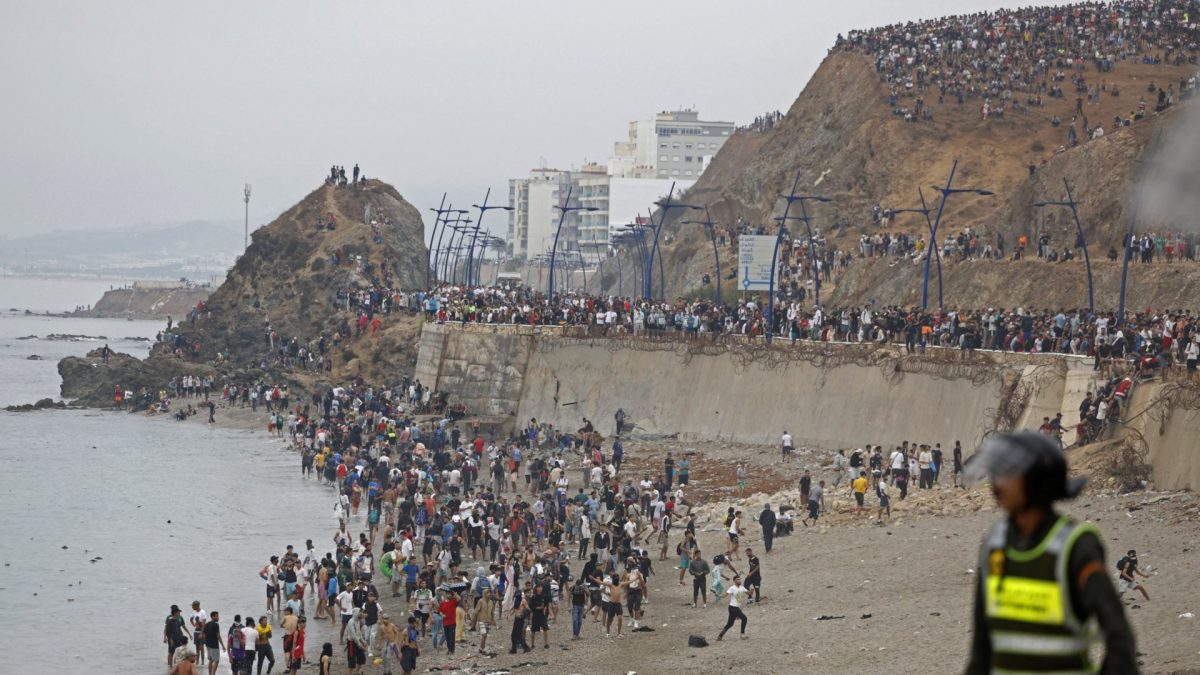
A diplomatic row has erupted in Europe after footage emerged of a deadly mass border crossing in the Spanish territory of Ceuta last week. Around 60,000 people arrived from Morocco in the largest illegal crossing in EU history, most of them swimming, with some spending several hours at sea. At least 67 people died making the journey, Spanish officials said. Ceuta, which is situated at the tip of north Africa and is one of only two EU land borders with Africa, has a population of around 83,000. One local told The i Paper she decided to flee to mainland Spain with her teenage daughter as the border collapsed and “horrible” scenes unfolded. Viral videos showed large numbers of migrants overwhelming the border and swimming up to its beaches, before many – including children – slept rough on its streets. Dozens of people drowned or died in stampedes, and clashes were reported between migrants and police. But the crisis rapidly expanded from a humanitarian crisis into a geopolitical one. Italy, which has introduced strict migration policies after receiving large numbers of small boat crossings from Libya, temporarily suspended the EU’s border-free Schengen arrangement with Spain, with Prime Minister Giorgia Meloni saying the move was necessary “for national security”. Shorts Meloni’s right-wing Fratelli d’Italia party used the incident to hit out at domestic rivals and Spanish Prime Minister Pedro Sanchez, posting photographs of migrants on the streets of Ceuta with the caption: “This is the Sanchez model the Italian left wing likes so much.” Several other European countries backed Italy’s position. Czech Prime Minister Andrej Babiš called for temporary suspension of Spain’s Schengen membership. Finnish interior minister Mari Rantanen said she had started preparations for internal border checks “if the need arises”, while Danish Prime Minister Mette Frederiksen urged the EU to “consider all options, including a suspension of Schengen co-operation”. Jordan Bardella, the far-right president of France’s National Rally, claimed that “by regularising hundreds of thousands of illegal immigrants, the socialist prime minister of Spain, Pedro Sánchez, has opened the doors of Europe to all dangers”. Migrants try to cross from Morocco into the Spanish enclave of Ceuta (Photo: AP/Antonio Sempere) Ursula Von der Leyen, President of the European Commission, described the scenes in Ceuta as “unacceptable”. Twenty-two EU countries penned an open letter expressing “serious concern” over the incident and blaming Sanchez’s move to grant legal status to 500,000 undocumented migrants as a “pull factor”. In response, Spain’s left-wing government condemned the “selfish, polarising and unlawful” response of some European countries and hit back at the claims. Ceuta is not in the Schengen zone, so Moroccan migrants were never able to travel into Italy without border checks, Spain rejected the idea that the surge in migration was linked to legal status grants, saying that none of those entering Ceuta illegally would have benefited because conditions included residency within Spain for at least five months prior to 2026, and because the deadline had closed. Sanchez pointed out that illegal migration to Italy and Greece had been far higher than Spain in recent years. By Saturday morning, Spanish authorities said they had “reversed” the situation, and almost all those who reached Ceuta had returned to Morocco. Dozens of people died by drowning or in stampedes during the mass border crossing (Photo: AP/Antonio Sempere) But it is not the first high-profile division between Spain and its European allies of late. Last year, Spain was the only Nato country that refused to increase its defence spending. Sanchez called for an urgent meeting to “reaffirm that the security of our external borders is a shared responsibility of all Member States”. EU interior ministers are set to meet on Tuesday to discuss border security. Morocco has seen protests by young people over poverty rates and poor public services, with a quarter of 15- to 24-year-olds not in education, employment or training. The sudden large movement of people appears to have been triggered by a social media phenomenon. Reporters covering the Ceuta incident were shown online posts with people shouting that “Spain is Open” as they jumped into the sea, the BBC reported. Earlier this year, Spain’s Supreme Court ruled that migrants who were stopped while trying to get to Spain via Ceuta or Melilla, an autonomous Spanish city on the Moroccan coast, could not be immediately pushed back, but would be entitled to a legal process. Sanchez said trafficking gangs “took a self-serving interpretation of [this] Supreme Court ruling”, which “spread like wildfire”. By Thursday, Spain’s Maritime Rescue Service and the Spanish Red Cross had rescued more than 100 people from the water, while the Civil Guard assisted around 200 others with patrol boats (Photo: Marcos Moreno/Anadolu via Getty Images) But there are questions over whether the crossings have been deliberately stirred up. Some migrants told reporters that Moroccan authorities had permitted their crossings, leading to speculation that Morocco was using the incident for political pressure. Lorenzo Gabrielli, a senior researcher at Pompeu Fabra University in Barcelona who researches migration in Ceuta, told The New York Times that “it is impossible for nearly 50,000 people to cross the border between Morocco and Spain in a single day without Morocco having a hand in it.” There have even been accusations of interference further afield. Ukraine’s acting minister of foreign affairs, Andrii Sybiha, claimed that Russia had launched a propaganda campaign using photographs from Ceuta to “sow destabilisation” across Europe. He said that more than 1,500 news items on the issue had been published on outlets identified as pro-Russian, and every language edition of RT had pushed more than 25 news items on the issue. Migrants gather around a torched vehicle on the Moroccan side of the border as they wait to cross to Ceuta on Friday (Photo: Reuters) This would be a textbook Russian approach, with the Kremlin accused of supporting wide-ranging disinformation campaigns designed to divide. In 2023, Finland closed its border with Russia after accusing the Kremlin of weaponising migration. Riots in the UK the following year, after the murder of three young girls in Southport, also appeared to have been fuelled by Russian-linked accounts falsely blaming the killings on a Muslim asylum seeker. “For years, Moscow has used migration and other sensitive topics to stoke fear and destabilise European countries,” Sybiha said. “This is not about the situation itself, but about the way Russia tries to exploit any topic that can benefit its agenda.” The precise cause of the surge in migration to Ceuta is not yet clear, and may never be confirmed. But if the aim was indeed to divide Europe, it has certainly worked.
The viral migrant crisis that’s splitting Europe in half
Full Article
Original Source
Read the full article at Inews →KhanList aggregates and links to publicly available news content. We do not host full articles from third-party sources. Always verify important information with original sources.