
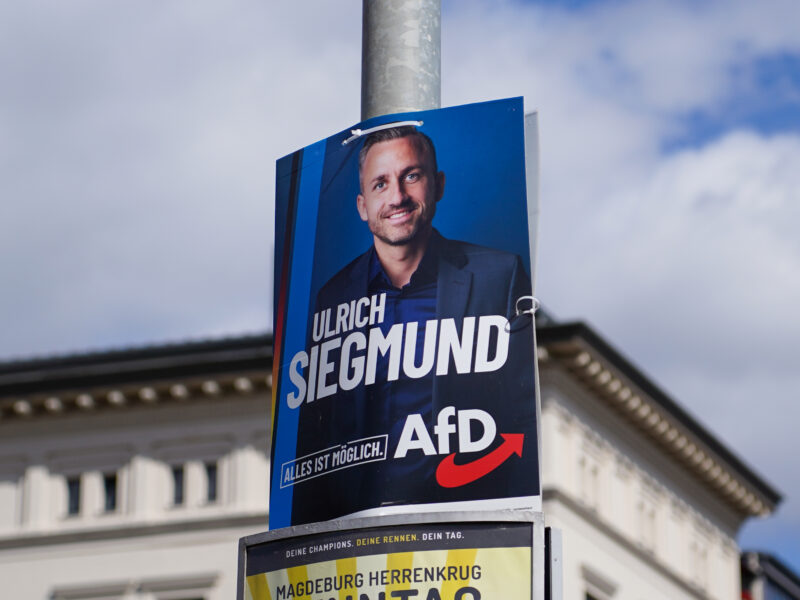
MAGDEBURG, Germany (CN) — The far-right Alternative for Germany’s triumphant result in state elections Sunday has further shaken a rocky, and deeply unpopular, German political establishment.The Alternative for Germany, or AfD, won 43.8% of the vote in the state of Saxony-Anhalt, making postwar history for the far right. It was the party’s best result in its 13-year history, and though a few seats shy of an outright majority, put the far right within grasp of governing at the state level for the first time since 1945.“We’re all deeply shocked,” said embattled German Chancellor Friedrich Merz in response to the result. His incumbent Christian Democrats only mustered 17.2%, down a whopping 19% from the previous result. The only potential majority without the AfD would require literally all five other parties in Parliament banding together.Though the AfD’s growth — especially in the former east — has continued unchecked in the last decade, and the state party which has been classified as “right-wing extremist” by German domestic intelligence has long topped polls, its election-night performance still surpassed expectations.With the vast majority of the political spectrum aligned against it, the AfD will begin a potentially lengthy process of trying to assemble an actual governing majority. Meanwhile, the rest of the country will once again have to decide between simply sounding the alarm bells or actually shifting course significantly enough to dissuade voters from drifting to the right.On the cusp of power“The coming days will show how serious the AfD is about governing — and what price it is willing to pay,” Roger Stöcker, political scientist at Magdeburg’s Otto von Guericke University, told Courthouse News.The AfD’s lead candidate Ulrich Siegmund says the returns gave him a “clear mandate to govern.” He’ll have to lure defectors away from rival parties to actually become Saxony-Anhalt’s minister president. While open to collaboration, Siegmund is unlikely to compromise too widely.Even if he were ready to, most of the other parties elected into Parliament are still — for now — committed to the “firewall,” a commitment against collaborating with the AfD that has long been under strain, and may finally be broken in the wake of this election. Only the BSW, or Sahra Wagenknecht Alliance, has signaled it’s open to working with, or at least not completely blocking, a new AfD government.“A majority without the AfD is extremely unlikely. Everyone else — Christian Democrats, Social Democrats, Greens, the Left, BSW — could in theory team up to keep Siegmund out, but that’s a lot of very different parties who’d have to agree with each other,” said Stöcker.A campaign poster for the AfD's Ulrich Siegmund in Magdeburg, Germany. (Dave Braneck/Courthouse News)Siegmund has vowed to use the state of 2.1 million as a laboratory for far-right policies, like ramping up “remigration,” instituting a “patriotic cultural policy” and cutting funding to public broadcasters.“As a non-EU person there are worries about the AfD majority, though who knows if they can really form a government,” Sasi, an Indian student studying chemical engineering in Magdeburg, told Courthouse News. “Many of my friends are scared, but personally I am not too worried because I think Germany has a strong democratic system and I think things can be fought in court if they get out of hand.”If the AfD can find the three votes it needs to govern, it will put its policies — and the strenght of Germany’s democratic institutions — to the test.Rejecting a stale status quoGermany’s struggling economy, strained infrastructure, difficulty integrating waves of refugees and a static political system featuring shared governments between the center-right Christian Democrats and their ostensible rival Social Democrats have all fueled the AfD’s rise.In Saxony-Anhalt, the AfD has proven adept at winning over both dissatisfied supporters of other parties and nonvoters.“These are people who had already turned their backs on politics. The AfD has brought them back in droves. About 157,000 former nonvoters cast their ballot for the AfD this time, way more than any other party,” said Roger Stöcker.Exit polling indicates immigration and security were AfD voters’ top concerns. Justin, a 25-year-old warehouse worker who believes the AfD can “make Germany great again” also cited immigration as his most important issue.“Germany is on a crash course right now, and if we can’t make some hard decisions and really make changes the entire country will collapse,” he told Courthouse News.Justin notes while most parties are only visible in Saxony-Anhalt in the immediate run-up to elections, the AfD have a real, regular presence on the ground. Siegmund has even cultivated a celebrity status among supporters.“He’s a really strong leader. He’s the only politician that truly goes to the people, and stands right next to us and talks with us. No other politicians are like that in this country.”The AfD also won over nearly 60% of working class voters, highlighting frustration with the economic prospects in a state with higher unemployment and significantly lower incomes than the national average.“I think the election was about the economy and jobs in Saxony-Anhalt. That’s a topic in all of Germany but it’s even more pertinent here,” Markus, a 43-year-old working in the insurance industry, told Courthouse News.A campaign poster for the Green Party in Magdeburg, Germany. The Greens outperformed expectations. (Dave Braneck/Courthouse News)Reshaping German politics from Saxony-Anhalt?Whether or not the AfD could actually improve Saxony-Anhalt’s outlook is an open debate.Gisela, a pensioner who was hoping “anyone but the AfD” would win the election, is skeptical. “I’ve read their platform and I think it will bring Saxony-Anhalt to the ground. I’m worried unemployment will rise and even more people will leave the region,” she said.Though state power in Germany is relatively limited, the AfD governing would put state and federal institutions to the test. And the election result alone could be enough to shift federal politics.The result heaps pressure onto an already beleaguered Merz government. “The election was a historic turning point, and the Christian Democrats will not be able to shift its focus to day-to-day politics,” said Stöcker.Merz has said the election “must have consequences,” but what precisely that entails is undetermined. His preferred tactic had previously been trying to ape AfD policies — like a controversial failed push for immigration reform before his government was officially instated, or engaging in right-leaning culture war talking points — to slow their ascent.Germany’s chancellor cannot change course on his own, and coalition partner Social Democrats are facing their own crisis of confidence. Leaders from all of Germany’s major parties have highlighted the AfD as the biggest threat to German democracy for years, but they appear to still be struggling to offer their own coherent alternative to the status quo. If they can’t, Saxony-Anhalt could be just the beginning.Courthouse News reporter Dave Braneck is based in Germany.Subscribe to our free newslettersOur weekly newsletter Closing Arguments offers the latest about ongoing trials, major litigation and rulings in courthouses around the U.S. and the world, while the monthly Under the Lights dishes the legal dirt from Hollywood, sports, Big Tech and the arts.Additional Reads
Historic far-right victory deepens German political crisis
Full Article
Original Source
Read the full article at Courthousenews →KhanList aggregates and links to publicly available news content. We do not host full articles from third-party sources. Always verify important information with original sources.