
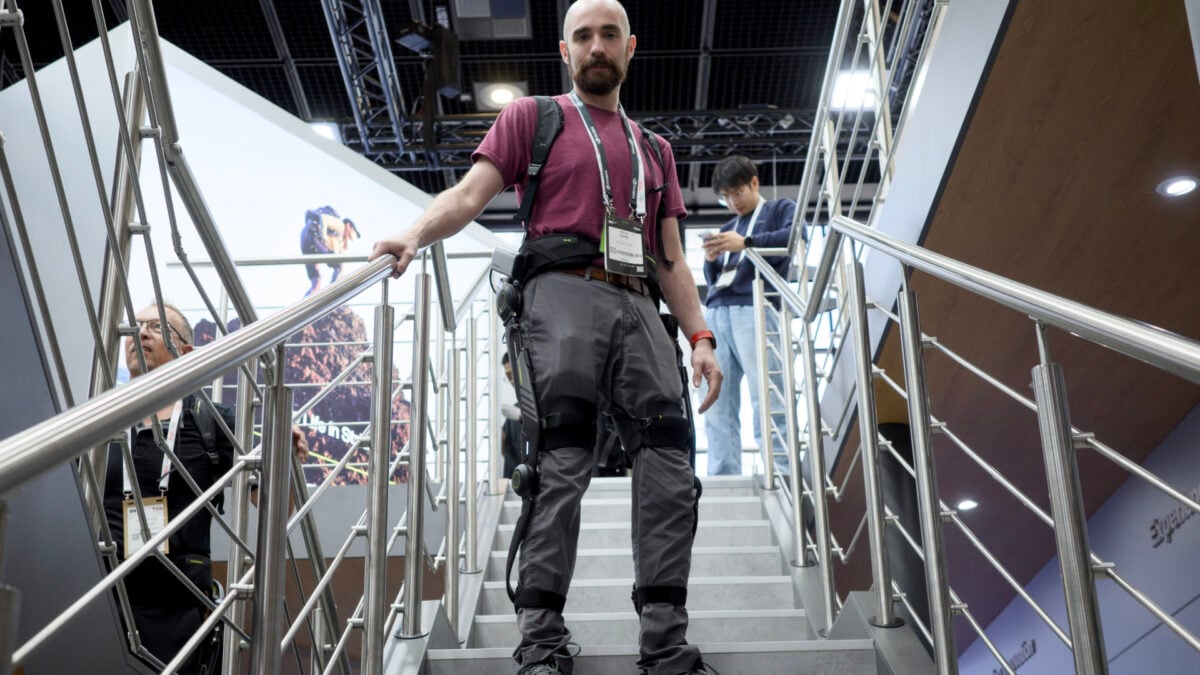
I was ready to write off the surge of exoskeletons as yet another example of cool tech without an audience to use it. Then Hypershell strapped me into its Hypershell Halo, yet another mechanical armature with servos that are supposed to “assist” your legs for every step. Finally, these exoskeletons are taking our knees into account. Hypershell Halo is much like its past hiking exoskeletons, but with a lot more on offer. The carbon fiber wearable suit sits on your hips and attaches to your thighs, then uses onboard sensors to detect your movement and kick in motors to assist your legs. The new version adds another set of motors that are meant to sit exactly at knee level with another set of straps hogtied to your calves. The entire exoskeleton operates as one, but as you step, it pulls both your thigh and lower leg, making movement feel easier, especially when climbing inclines or stairs. IFA 2026 was swarmed with exoskeletons, mostly from China-based brands, and many were promising the same thing. However, I have more experience with Hypershell than most. I’ve done multiple hikes with both the original Hypershell Pro X and several more recent jaunts with the Hypershell X Ultra S. Even with minor improvements to the exoskeleton’s ability to sense your movement, they both suffer from the same problems. © Kyle Barr / Gizmodo The big issue is how they were not built for the right audience. An experienced hiker wouldn’t necessarily want to dress up in a steel cage that only takes away the pleasurable burn and triumph of making it to the top of a mountain. Hypershell marketed its exoskeleton only to physically fit people, not the people with bad knees who could actually use assistive technology. The Halo isn’t just helping you lift your legs. It provides a cushioning sensation if you jump off a small ledge. There’s a sit-up feature that lets you take little effort from sitting to standing. Toby Knisely, Hypercshell’s director of communications, told me that the team considers Halo as a device “for everyone,” including those who are healthy and those who actually need help with mobility. “A lot of people were about asking the knees, asking for more support—especially that cushioning on the way down,” he said. There are other upgrades as well, including a new, more compact battery that sits to the side rather than behind. It’s also a more involved device, requiring several minutes of fitting to make sure your exoskeleton is positioned correctly and snug to the body. It’s more invasive, as well, and you’ll naturally look like a cyborg dressed up for Halloween in a human suit. There’s even an optional over-arm strap that can help support its weight more for when you’re going the distance. It is not a subtle device. There are several other companies at IFA trying to promote the same type of device. Dnsys rolled out its Z1, a more low-key, knee-specific ekoskeleton with only one motor that surrounds one or both legs at the joint. Then there’s Ascentiz with its “K” model exoskeleton that includes a separate attachable below-the-knee motor. I asked Ascentiz to use their K model, but the company told me only the above-the-knee “H” model was available to try on. Beyond those devices, the Hypershell Halo seems to be the most feature-rich and fully realized of its kind. That means it will cost extra. The Halo is up for preorder now, and it will cost you $2,300. Unless you can try it for yourself, there’s no way to tell if it will assist your needs or not. At least, now there’s a chance it will help.
This Hiking Exoskeleton May Actually Help Your Bad Knees, Finally
Full Article
Original Source
Read the full article at Gizmodo →KhanList aggregates and links to publicly available news content. We do not host full articles from third-party sources. Always verify important information with original sources.