
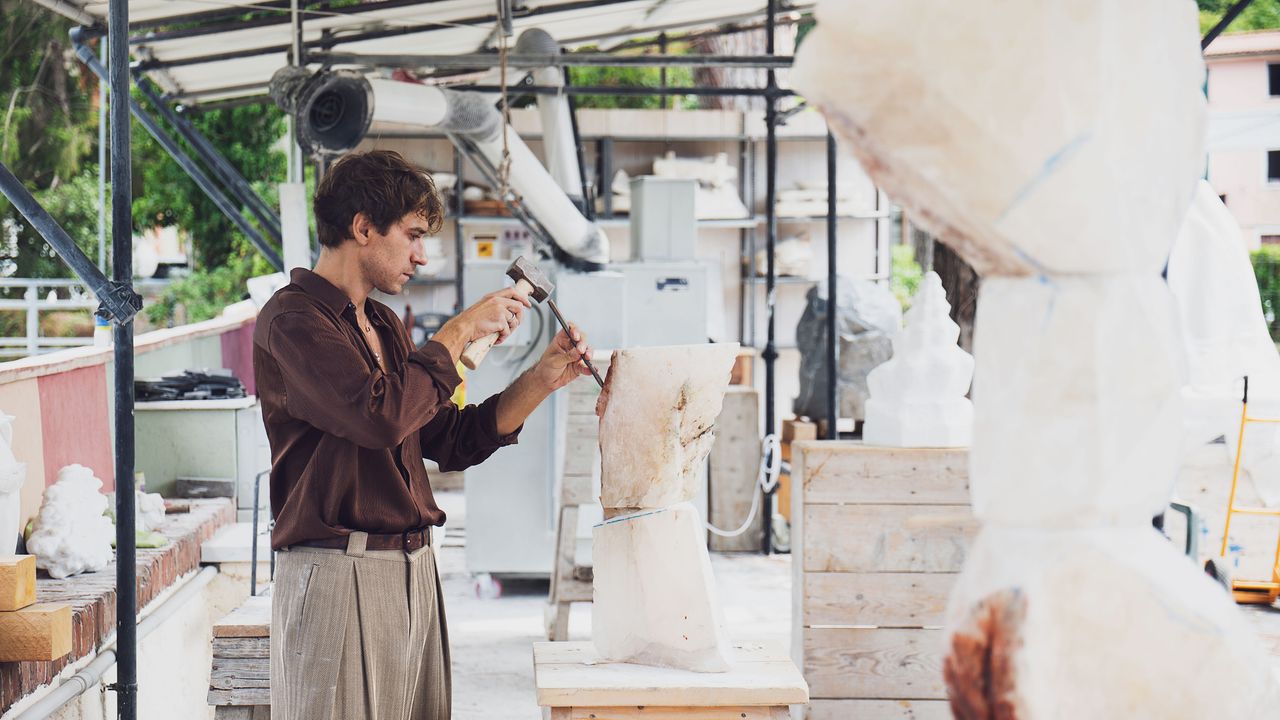
In his Carrara workshop, Daniel Kolodziejczak creates objects inspired by ancient RomeAt his workshop in Carrara, Italy, Daniel Kolodziejczak chisels a base for a side table from his tesserae series.Wandering through the ruins of Pompeii, the ancient Roman city frozen in time by the eruption of Mount Vesuvius, one is struck by that civilization’s devotion to precious materials. Surviving mosaics depict the opulence that once filled the city’s lavish homes. These fragments of classical life, and the richness with which they were rendered, captured the imagination of Polish-born designer Daniel Kolodziejczak, inspiring his upcoming Tesserae series for the New York design gallery Ateliers Courbet.A vessel in rock crystal, smoky quartz, and citrine quartz Sun hits a pendant in rock crystal and smoky quartz. Kolodziejczak creates objects in marble, precious stones, and bronze at his workshop in Carrara, Italy. Kolodziejczak, who started as a jewelry designer in Paris for brands like Givenchy and Saint Laurent, began making decorative objects and furniture after a move to Milan. His exhibition at Ateliers Courbet (on view until January 16, 2027) was inspired by fragments of leftover stone he found in the marble yards of Carrara, not far from his workshop. “Every time I go there I find myself buying new stones,” Kolodziejczak says.Kolodziejczak with two vessels from his Tesserae series A vessel in rock crystal, smoky quartz, and citrine quartz The designer polishes the base to a console from his Tesserae series. The remnants accumulated in his studio until, on a visit to Pompeii, he had “the idea to bring them together” in one exhibition. His vessel shapes, inspired by antique Roman pottery, are hand-carved in marble, along with materials like rock crystal, smoky quartz, and citrine quartz. The series will also include a monumental crystal pendant light, sconces in bronze with citrine quartz shades, a mirror, and massive stone tables. But despite the expansive scale, Kolodziejczak’s sensibility remains rooted in the concept of adornment. “I treat furniture like jewelry,” says the designer, whose Studio Daniel K is based in Milan and Paris. “These pieces aren’t meant to take up the entire room—just to be that accent of something extraordinary.”This story appears in the December issue. Never miss a story when you subscribe to AD.Not a subscriber? Join AD for print and digital access now.Sign up for our daily newsletter to get the best of design in your inbox.
This Designer Finds Unexpected Beauty in Marble’s Leftovers
Full Article
Original Source
Read the full article at Architecturaldigest →KhanList aggregates and links to publicly available news content. We do not host full articles from third-party sources. Always verify important information with original sources.