
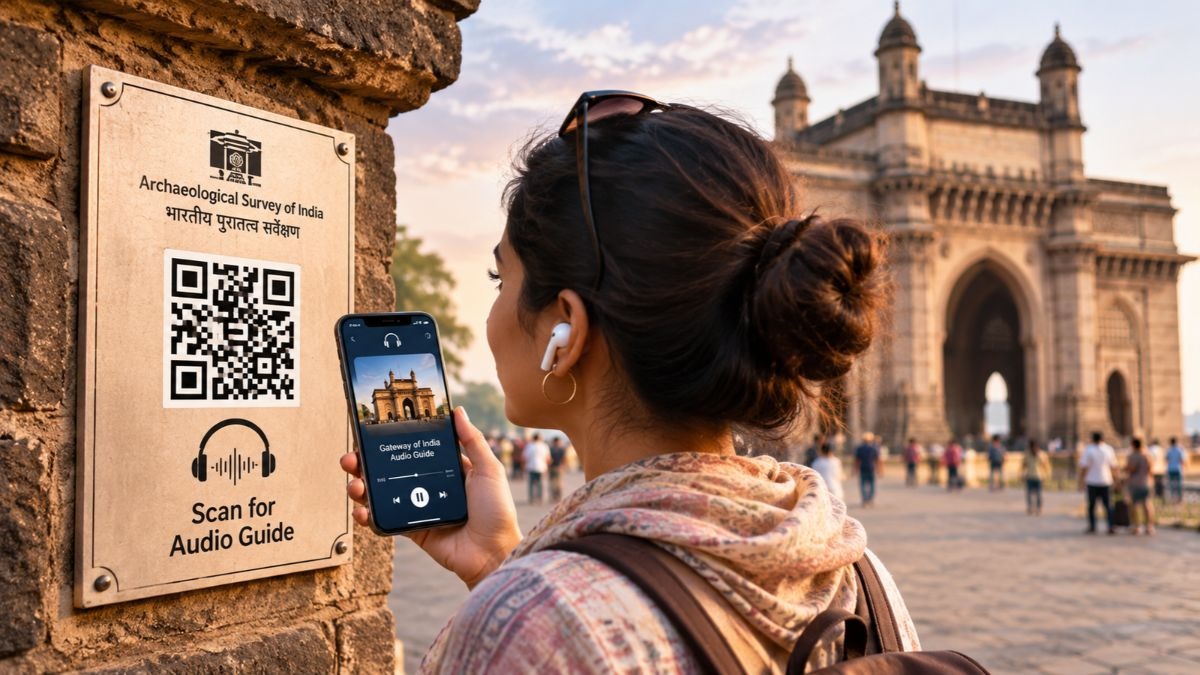
The Archaeological Survey of India (ASI)—in a move that promises visitors authentic information about monuments in Maharashtra—has rolled out an audio-guide service at 18 monuments under its ambit in the state.The initiative, which was launched during World Heritage Week (November 19 to 25), covers sites such as the Vijaydurg, Jaigad and Suvarnadurg forts in the Konkan, the Tulja and Shivneri caves in Pune district, and the Solapur fort in Solapur district. These locations fall in the ASI’s Mumbai circle and witness high footfalls.The audio-guided tours will make historically-verified information available to tourists and heritage enthusiasts. Visitors at these monuments can scan a QR code to launch the tour in online or offline mode. If they use the GPS-based system, they will automatically get information on the site, its importance, antiquity and features as they move about.So far, the system has covered 40 ASI sites in the Mumbai circle. The latest tranche covers sea, coastal, hill and land forts such as Kolaba, Korlai, Sindhudurg, Vijaydurg, Haigad, Janjira, Tala, Visapur, Suvarnadurg, Solapur, Kondhane, Gandharpale, Tulja, Shivneri, Manmodi caves, Dabhol and Dilwara mosques, and the Habshi Gumbaz at Junnar near Pune. “The knowledge dissemination initiative will help tourists visiting these sites understand their historical and architectural importance. Many of them are forced to just move around and take photographs. Now, they will be able to understand the history of these monuments in a manner and form that is scientific,” said Abhijit Ambekar, superintending archaeologist, ASI, Mumbai circle.Maharashtra has several forts that were built along the Konkan coast in the 12th and 13th centuries. These played a major role in maritime trade and coastal defence. The sea forts were strategically located on or near the coast to boost the presence of the small but effective navy developed by Chhatrapati Shivaji Maharaj in the 17th century.The Sindhudurg fort, where the audio-visual guide has been launched, stands on the rocky ‘Kurte Island’, a km away from Malvan in Sindhudurg district. It was built by Shivaji Maharaj in 1664-67 AD using the services of his architect Hiroji Indulkar and the assistance of Portuguese experts from Goa. The fort also has the ‘Shivarajeshwar temple’, which is a temple of the warrior king.Other sites covered under the initiative include the Habshi Gumbaz, which is one of the oldest monuments dating to the Nizamshahi era, the Buddhist Tulja, Shivneri and Manmodi cave complexes at Junnar near Pune, which fall on a crucial trade route linking the port heads in the Konkan to the Deccan plateau and further. Ambekar added that the Raigad fort, which was the capital of Shivaji Maharaj, and the Vasai (Bassein) fort, which was a Portuguese bastion and was taken after a tough battle by Chimaji Appa, the brother of Peshwa Bajirao-I in 1739 after the Battle of Vasai, would be covered next, with the guide being rolled out in around a month.The ASI’s Mumbai circle covers 117 monuments spread out across 13 districts. The QR code-based system was launched from Lohagad in November 2005. The content, which is available in Marathi, English and Hindi, has been developed in-house, while technical support and guidance has been provided by GunjIndia, which provides audio guide solutions.In 2023, the ASI launched its first digital heritage walks at Vadnagar in Gujarat, which has seen continuous habitation since the past 2,500 years and is the hometown of Prime Minister Narendra Modi.Subscribe to India Today Magazine- Ends
How QR-coded audio guides will enrich experience at ASI monuments in Maharashtra
Full Article
Original Source
Read the full article at Indiatoday →KhanList aggregates and links to publicly available news content. We do not host full articles from third-party sources. Always verify important information with original sources.