
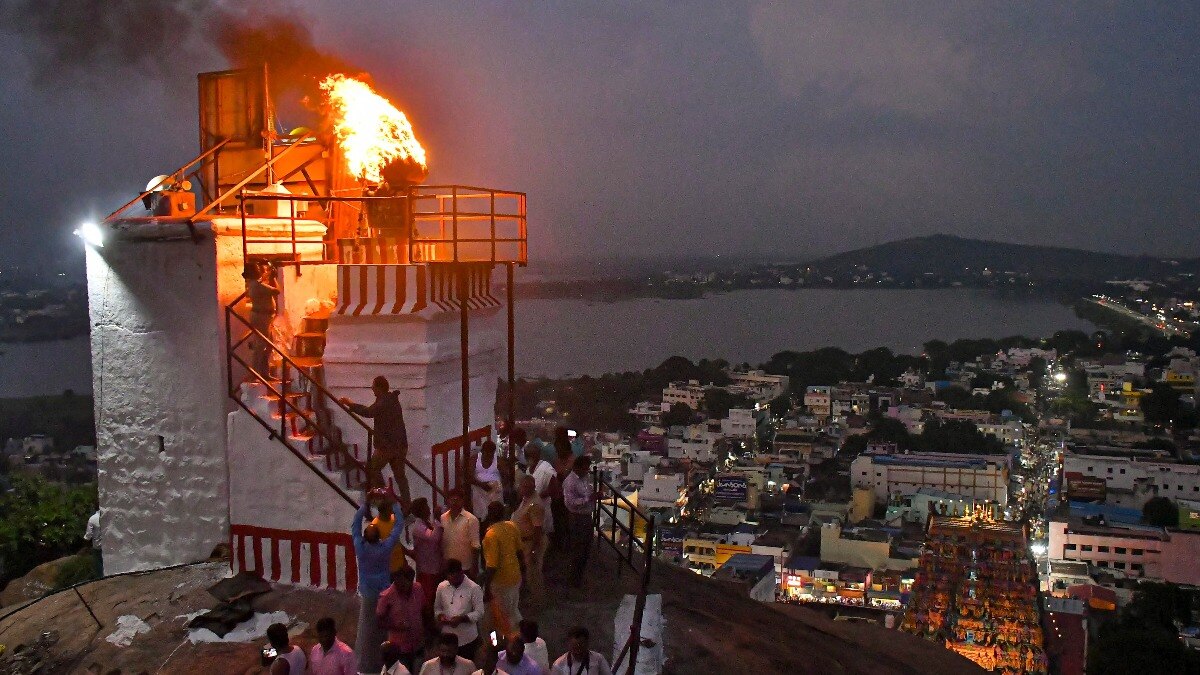
The Supreme Court on Friday stayed a wider Madras High Court ruling that permitted the Karthigai Deepam lamp to be lit every year at the Deepathoon, a stone pillar on Madurai’s Thiruparankundram hill. As a one-time measure, the Supreme Court allowed the lamp to be lit there on November 24. Only authorised temple representatives and government officials may go to the pillar for the ceremony.The dispute is over where on the hill the lamp should be lit. The Tamil Nadu government told the Supreme Court that for more than 150 years, the lamp had been lit only at the Deepa Mandapam. The petitioners who approached the High Court say lighting the lamp at the Deepathoon is a traditional practice. Representatives of the dargah near the pillar said they would seek a review of the Supreme Court’s interim order.At the foot of Thiruparankundram hill stands the Subramaniaswamy temple, traditionally regarded as the first of Lord Murugan’s six sacred abodes. Across Tamil Nadu, families light rows of clay lamps outside their homes for Karthigai Deepam. The festival takes its name from a cluster of stars that Hindu tradition links to Murugan’s birth.HOW KARTHIGAI DEEPAM GOT ITS NAMEKarthigai is the Tamil name for the Pleiades, a cluster of stars visible in the winter sky. It is also the name of the Tamil month that spans parts of November and December. The festival falls around the full moon of that month, when the moon appears near the cluster. In Hindu tradition, six stars in the cluster are linked to the story of Murugan’s birth. In one version, six sparks flew from Lord Shiva’s third eye. They came to rest on lotus flowers in a pond called Saravana Poigai, where each spark became a child. Six women cared for the infants. Goddess Parvati brought the babies together to form a single child with six faces. That child was Murugan, also called Arumugan, meaning “the six-faced one”. Another of his names, Kartikeya, comes from the women who raised him. WHY MAHA DEEPAM IS LIT IN TIRUVANNAMALAI In Tiruvannamalai, the festival is closely associated with Shiva. According to local tradition, Brahma and Vishnu were arguing over who was greater when Shiva appeared as a column of fire. Brahma took the form of a goose and flew up to find the top. Vishnu became a boar and dug down to find the base.Neither could find an end to the column. Devotees believe it took the form of Arunachala, the hill they worship as Shiva.The lighting of a flame on the summit is the main event of a festival that runs for several days. During the celebrations, a temple chariot carries the deities through the streets.On November 24, the Bharani Deepam will be lit inside the Arunachaleswarar temple at around 4 am. At around 6 pm, a wick will be lit in a large cauldron of ghee on the summit. The flame, known as the Maha Deepam, is visible from the town below and usually burns for several days.Pilgrims can also see the flame as they walk around the base of the hill. The 14-km walk, known as girivalam, draws devotees on full-moon days throughout the year. Many walk barefoot, passing shrines along the way.HOW TAMIL FAMILIES CELEBRATE KARTHIGAI DEEPAMAt dusk, families set out rows of small clay lamps, called agal vilakku, on doorsteps and windowsills. Some arrange them around a kolam, a pattern drawn at the entrance to the home.Festival offerings include pori urundai, made by rolling puffed rice and jaggery into balls. Some households also prepare a maavilakku, a lamp shaped from a mixture of rice flour and jaggery.The custom of lighting lamps in the streets appears in the Akananuru, a collection of Sangam-era Tamil poems. One poem describes an old town where people hang garlands and light lamps under a full moon. A woman hopes the man she loves will be home in time for the festival.- Ends
Thiruparankundram lamp row: What is Karthigai Deepam and why is it celebrated?
Full Article
Original Source
Read the full article at Indiatoday →KhanList aggregates and links to publicly available news content. We do not host full articles from third-party sources. Always verify important information with original sources.