
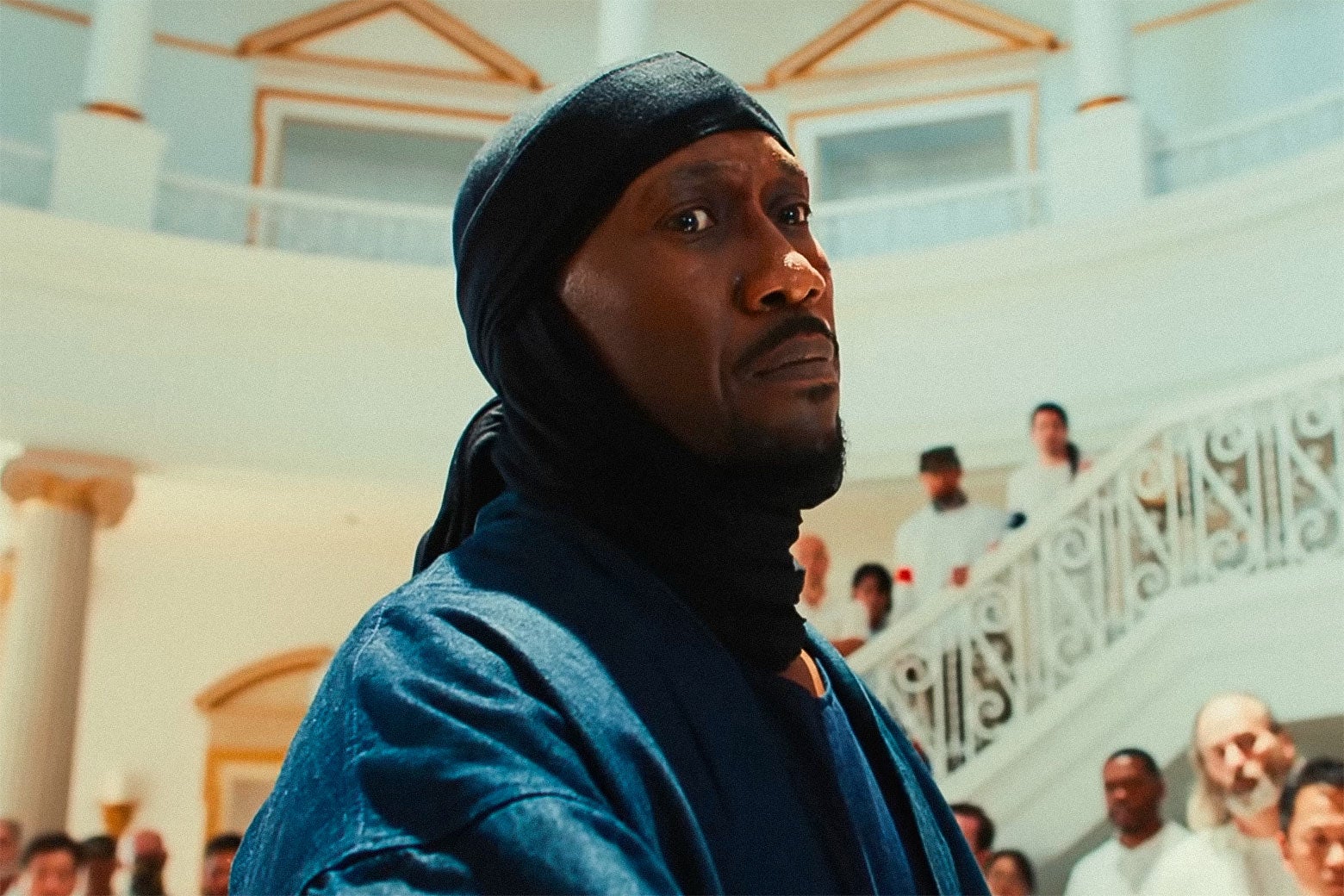
Movies Your Mother Your Mother Your Mother Is Unlike Anything I’ve Seen Before Star Mahershala Ali and director Bassam Tariq were supposed to make the new Blade. Instead, they made something better. By Enter your email to receive alerts for this author. Sign in or create an account to better manage your email preferences. Unsubscribe from email alerts Are you sure you want to unsubscribe from email alerts for Aymann Ismail? Sept 24, 20265:45 AM Amazon MGM Studios Sign up for the Slatest to get the most insightful analysis, criticism, and advice out there, delivered to your inbox daily. I have been a dad long enough now that whatever version of myself I once considered cool now feels like a total fiction. I have two young kids, so most days I’m consumed with being their butler, tutor, chauffer, chef, and more. I love being their baba. I also scroll social media and see some of my childless friends still acting wild and, uh, let’s call it irresponsible, and I wonder if I’ll ever get to have that kind of fun again. So I think of myself as something of the ideal audience member for Bassam Tariq’s new film Your Mother Your Mother Your Mother, which stars Mahershala Ali doing badass action-movie shit with a baby. The poster shows him wielding a sword with an infant strapped to his chest. When I went to an early screening in Brooklyn, I overheard someone call it something of a Muslim John Wick. But can we talk about this baby for a sec? Ali plays Latif, a Muslim in Houston who is very good at his job, which just happens to be killing people. Tariq and Ali were both attached to Marvel’s Blade reboot, which languished in development hell for years, and Ali had trained extensively for it. At times you can almost see the calm and controlled swordplay as a little bit of that project peeking through into existence. For Tariq, I’m sure the prospect of putting all that training to use was too tempting to resist. I can almost imagine myself in his head, working backward to find a way to insert swords into scenes. And I’m so glad he did. The fight scenes are fast, precise, and enormously satisfying. But the film is not at heart a shoot-’em-up or a revenge picture like John Wick or like anything else I imagined—or hoped—Blade could have been. This is a movie about family, about parents, about motherhood. The movie starts similarly enough to John Wick, with the hero burying his wife. Latif is left to raise their three children, including a nursing baby who is allergic to formula. Within minutes, Tariq has reduced this frighteningly capable man to a problem no violence or muscle can solve: His daughter’s mother is gone, and the child’s only hope is for Latif to try and fill that void. Any parent can tell you how hard those newborn months are. I will always remember how it consumed my wife, the way her body was still recovering from giving birth but had an enormous job in feeding the baby. She was barely sleeping. Our house reorganized itself around the baby’s needs. In some fundamental biological sense, it can make the dad feel useless. Tariq’s experience with his newborn was much more difficult. He told GQ that after his wife gave birth to their first child, she developed a life-threatening infection and ended up in intensive care. Their newborn would not take formula, leaving Tariq running around New York trying to find breast milk for his baby. But even after he finally got his son fed, the baby was still inconsolable. Tariq realized that his own panic was contributing to his son’s panic. When he calmed down, the baby did too. “He just needed me to be me—not supermom,” Tariq said. That is a deceptively good description of the movie. Latif spends much of the film trying to be supermom as the world spins out around him. He’s bombarded with situation after situation where he’s forced to confront the limits of his ability as a father. He can slash a roomful of armed men, but his kids are always there to remind him that’s not enough. Tariq makes the mother’s absence increasingly present as the film goes on. You encounter her through the many needs she left behind. It’s not just the hunger for breast milk. His two kids need patience, explanations, emotional consistency. They need someone who can help them make sense of their world. And when their father keeps asking them to trust their faith, they challenge him by pointing out his hypocrisy. Latif keeps learning what his wife had been holding together because he cannot hold it together himself. The title comes from a hadith most Muslims know. A man asks the Prophet Muhammad who deserves the best treatment. “Your mother,” the prophet tells him. He asks who comes next. “Your mother.” He asks for a third time. “Your mother.” Only after the man asks a fourth time does the prophet answer, “Your father.” My mother used this one on us when we were kids. “Your mother, your mother, your mother,” she would repeat in Arabic, usually as a way to tie respecting her to our obligations to God. A lot of Islam lives in Muslims that way, as some line you read or heard growing up sitting dormant until the moment something pulls it forward again. I think it’s safe to say I’ve never seen this particular idea—this almost excessive religious weight Islam gives mothers—used as the premise of an American action movie. And then there’s John Cho. Cho plays Pastor Hwan Yoon, an Iraq War veteran turned evangelical cult leader who has gathered a small militia of armed followers around his conviction that God wants him to purge the world of sexual deviance. Hwan targets a Muslim porn producer connected to Latif’s old criminal network, and Latif—desperately searching for breast milk—finds himself caught between warring factions of violent men. Hwan has gold teeth, a cowboy hat, and a big ol’ American-made gun. I kept smirking at him because I recognized the inversion. He is basically an American Christian version of the jihadist archetype Hollywood spent decades assigning to Muslims. Y’all Qaida. Yeehawdists. Vanilla ISIS, if you will. But Tariq somehow gets more out of Hwan than mere parody. There’s this mirroring between Hwan and Latif, as both are religious men who have worked out how to accommodate extraordinary violence into their moral faiths. What I found interesting was the way Tariq explores how the faith works differently for different ideologues. Hwan has collapsed the space between what he wants and what God wants. Latif is haunted by that distance and is constantly searching for opportunities for atonement. That gives the audience a much more interesting look into the characters’ spiritual lives, certainly more than any typical action hero would get. Latif’s religion doesn’t stamp him with goodness. It frustrates him. He prays, thinks of himself as a believer, teaches his children about God, and keeps running into proof that the life he has built doesn’t match the standards he claims to live by or has set for his children. Islam is everywhere in Your Mother: prayer, fasting, mercy, obligation, hypocrisy, family. (It’s not all so serious: There’s also this really small joke somewhere in one of the most intense moments of the film about Latif having “stinky Ramadan breath.” I loved that.) Tariq treats those things as ordinary features of the characters’ moral world. Nobody stops to explain Ramadan. Nobody delivers the speech that reassures the audience Islam is peaceful. Nobody is assigned the exhausting task of correcting whatever the viewer may have previously learned about Muslims from television. Years ago, when I wrote about Ramy, I admitted that I had trouble granting Muslim characters this kind of freedom. I would watch Ramy Hassan do something selfish or sexually humiliating and immediately imagine the non-Muslim viewer sitting beside me. This might be the first time someone is introduced to Islam, and is this really the image we want to invoke of ourselves? Obviously it’s unfair to assign one fictional Egyptian kid from New Jersey the responsibility of having to represent all of us. But there’s something about having so few of us in public that are normal that makes having a good example all the more important. And right now, Islamophobia is having a moment. Sitting members of Congress are literally saying that Muslims “don’t belong in American society” and that we “all have to go back.” Scores of Republicans in the House have formed a little club where they discuss foiling a Muslim-takeover plot they made up. With Islamophobia at an all-time-high, Muslims like me are once again spending time answering dangerous rhetoric about whether our religion makes us dangerous. And then Tariq goes ahead and makes a movie about a Muslim with a sword with “Die Before You Die” inscribed on it. I’m not worried about that at all. A few years ago, I probably would have watched that image through somebody else’s eyes. But between Zohran Mamdani, Abdul El-Sayed, shows like Adults, and projects like “Habibi City,” it feels as if we’re in a new moment. There is enough Muslim life in public now that every new character doesn’t have to carry the burden of explaining all of us. We can get weirder, more specific, more exploratory. It doesn’t matter what anyone else would make of the sword. It can just be awesome. After the screening, Tariq sat down with the writer and critic Hanif Abdurraqib, who made an observation I remember as something close to this: We see a lot of men in movies who are defined by their violence. Here is a man who commits violence without being defined by it. That, I think, gets at what Tariq and Ali accomplish together. Latif is extremely good at slicing and dicing. The movie is simply curious about a lot of other things too. Ali is especially good in the spaces between the big scenes. Tariq said afterward that he thought of him somewhat like Buster Keaton, a grounded figure surrounded by escalating absurdity. You can see it in the way Ali holds his composure. John Cho can show up looking like a postapocalyptic televangelist, and Ali remains a smoldering Latif. A fight can become outrageous, and he needs to keep his head steady for the sake of his family. His baby can keep crying, and somehow, that problem gets treated with even more seriousness than the people trying to kill him. One scene made the whole performance click for me. Just once, Latif loses his temper and scolds his son. It lasts a few seconds. The entire theater became quiet. Ali sits there as the anger slowly creeps away and shame takes its place. He barely moves. Ali has already won two well-deserved Oscars, and yet this still might be the performance of his career. There is some satisfying Hollywood irony in the fact that Tariq ultimately put Ali’s sword training to use in a movie where the hero is a dad trying to be supermom. I suspect I would have enjoyed their Blade. But I’m not sure I would have appreciated it as much as I appreciated this. Sitting there afterward, I started wondering what other Muslim filmmakers might now feel free to make. Marvel Religion Action Islamophobia Superheroes Islam
They Were Supposed to Make the New Blade. Instead, They Made Something Better.
Full Article
Original Source
Read the full article at Slate →KhanList aggregates and links to publicly available news content. We do not host full articles from third-party sources. Always verify important information with original sources.