
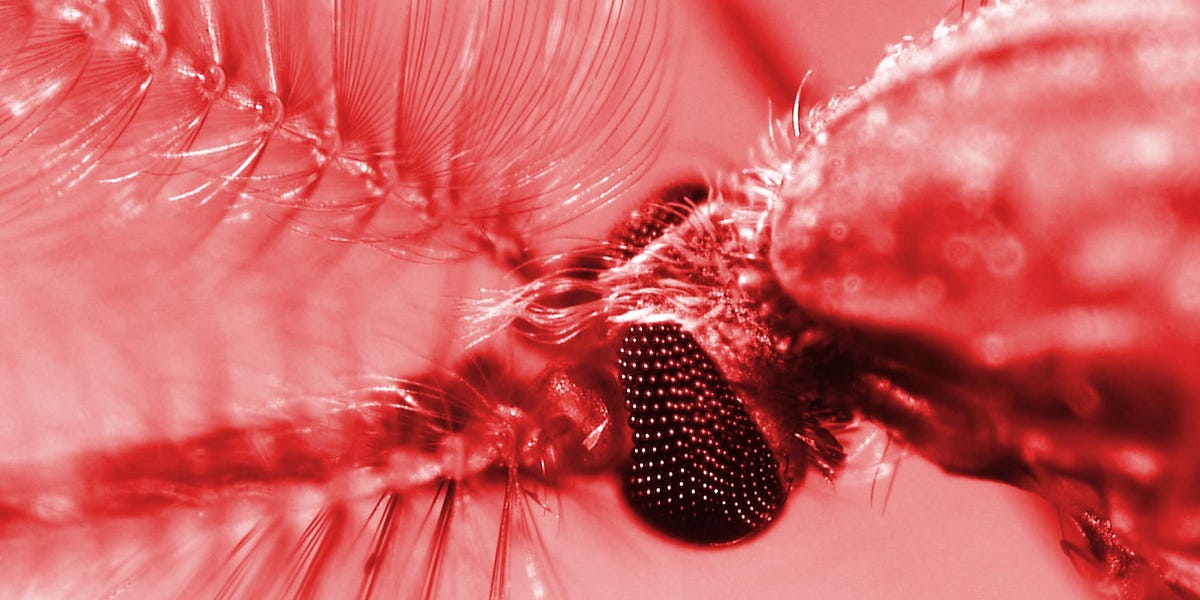
6 min readHere’s what you’ll learn when you read this story:Mosquitoes are the deadliest animal on the planet, contributing to more than one million deaths each year. Across the globe, some researchers believe that a groundbreaking gene-editing method could mitigate this high level of harm.The real question is: Do the benefits of releasing these gene-edited animals outweigh the potential risks? It sounds like something out of science fiction: laboratories filled with thousands of genetically engineered animals kept in cages, all bred for the eventual purpose of being released into the wild. But that’s exactly what is happening at research institutions across Europe and North America where scientists are racing to create custom organisms—and save millions of lives.Mosquitoes are the deadliest animal in the world. They kill around one million people every year by spreading malaria, dengue, yellow fever, and other deadly vector-borne diseases. Even as we try to protect ourselves with insect repellents, bed nets, and medications, they continue to be extremely effective at making us sick. Research suggests this problem will only get worse: rising temperatures and milder winters create the perfect conditions for the insects to increase their geographical range and active season. Meanwhile, the blood-suckers are developing resistance to many of our defenses.In the face of this growing threat, experts are racing to find new ways to combat our small-but-mighty foe. At Target Malaria, an international research consortium headquartered in London working on genetic technologies to control malaria, scientists are using a groundbreaking gene-editing method to produce sterile female Anopheles gambiae mosquitoes, the primary vector for the transmission of human malaria. Diminishing the species’ population—especially in Africa, which accounts for 95 percent of malaria deaths, mostly in children under 5—could combat the deadly disease. However, some skeptics are concerned that this may open a door that can’t be shut.Courtesy of Target MalariaWhile exact location varies depending on species, all mosquitoes lay their eggs either on or near water.To do this, researchers are using CRISPR-Cas9, which allows them to selectively modify DNA at precise locations in the genome, to induce something called a gene drive. This technology essentially bypasses the standard Mendelian system of inheritance—think back to your high school biology lecture on pea plants.Like humans, mosquitoes have two copies of every gene. Some traits are dominant, which means they’re expressed even if an individual only has one copy of the gene. Others are recessive, which means both copies of the gene must be present for the gene to express itself. The gene drive skews the usual rules of inheritance so that a targeted trait—in this case, the gene related to infertility—is inherited at a higher rate. “If you disrupt only one copy of the gene, the mosquitoes are still fertile. But when you target both copies, the mosquitoes become sterile,” explains Alekos Simoni, PhD, a molecular biologist and technical support specialist at Target Malaria.Reginald Crundall Punnett—a mathematician—created the punnett square in 1905, roughly half a century after Gregor Mendel conducted his famous pea plant experiments.The thought is that, once researchers have enough mosquitoes with single copies of the gene drive, they’ll release the insects into the wild. Then, these mosquitoes will mate and pass on the mutation. This process will repeat with each generation, eventually causing a snowball effect.“It’s a two-step process,” Simoni says. “So you first spread the gene drive, and when there are enough mosquitoes with the gene drive mating with each other, you produce sterile mosquitoes.” Eventually, “the population progressively declines,” he continues.It seems like a straightforward plan in theory—but genetically engineering mosquitoes is a painstaking process. First, the researchers use a tiny needle to introduce the mutation in a mosquito embryo under a microscope. The scientists also include a fluorescent marker within the introduced genetic material that makes the modified mosquitoes glow in the dark, allowing them to easily track the insects. Then, they breed the modified mosquitoes and keep them in carefully controlled temperature, humidity, and light conditions.“Then, we run a lot of different studies,” Simoni says. Researchers analyze how the gene drive transmits to the progeny, whether it impacts their behavior, and what the implications of releasing them into the wild might be.Using sterilization to control insect populations is nothing new. A method called the Sterile Insect Technique (SIT) has been used since the 1950s to control populations of pests such as fruit flies and screwworm flies. In recent decades, it has been used in the United States to control Aedes aegypti mosquitoes, which can spread dengue, Zika, and chikungunya. SIT doesn’t involve any genetic engineering—it uses radiation to sterilize male mosquitoes that are then released into the wild. When these mosquitoes mate with a female, she will not produce any viable offspring.Scaling SIT, however, is difficult. “You need to release 10 to 20 times as many males as the target population you want to control,” says Simoni, “and it also works very poorly in rural areas where there is very little infrastructure.” A gene drive, on the other hand, is based on releasing a relatively small number of mosquitoes, because it’s a process that spreads from generation to generation.The latter method is still in its early stages—no gene-drive mosquitoes have been released anywhere yet. The first field trials will probably take place on islands or small areas, Simoni says, and will involve the release of mosquitoes on the order of thousands. Target Malaria previously had an approved release scheduled in the West African country of Burkina Faso, but the national authorities halted the effort.Courtesy of Target MalariaMosquitoes don’t rely solely on blood as their food source; rather, they typically feed on nectar and juices. In fact, only female mosquitoes bite—not males.Still, the work shows promise. In a 2024 study published in Nature Communications, researchers used a model to simulate the release of gene-drive mosquitoes in 16 areas across West Africa, each roughly 4,630 square miles in size. (For reference, Connecticut has a land area of roughly 4,842 square miles.) The team found that these releases could reduce the abundance of disease-carrying mosquitoes by 72 to 98 percent. Meanwhile, other unrelated teams are also using gene drives to engineer mosquitoes that are resistant to malaria parasites, which are what infect the insect in the first place.Some skeptics have raised concerns over the potential use of gene-drive mosquitoes. After all, once you release a gene drive into the wild, you can’t easily reverse it. We don’t know how local ecosystems and food webs will respond to a decline in mosquito populations. Accidentally spreading organisms that carry the gene drive is also a major risk, according to a proposed code of ethics published in The CRISPR Journal. The technology also raises a more philosophical question: Is it morally acceptable for humans to potentially eradicate a species because it causes us harm?Simoni thinks about this differently. He believes that it’s also an ethical concern to not intervene when there are tools available to solve a threat as deadly as malaria. “It’s always a matter of risks and benefits,” he says. When we’re thinking about a health problem that kills hundreds of thousands of people each year, “the ethical questions are: How can we stop it? If we have something that could potentially make an impact, why not use it?”At the same time, researchers working on gene drives know that their work must be conducted responsibly. For instance, the team that wrote the aforementioned code of ethics recommends proactively incorporating ecological risk assessment into gene drive research. They also emphasize transparency, like conducting replicable studies and partnering with outside experts to mitigate any adverse effects of the work.Simoni also stresses that gene-drive mosquitoes won’t be a silver bullet against vector-borne diseases. “A gene drive is something very promising,” Simoni says. “It’s a novel technology that has a lot of potential to make an impact, but not alone. It has to be used in combination with new vaccines, bed nets, or insecticides. But it can really make a difference.”Special Digital IssuesOctober/November 2026Download HereThis issue is optimized for mobile/tablet viewing.➡ America’s Radioactive Graveyard Is Quietly Leaking. Scientists Are Racing to Defuse the Threat.➡ It Flies Like a Plane, Lands Like a Helicopter—and Left 20 Service Members Dead. Why Does This Strange Aircraft Keep Crashing?➡ The Wild West’s Most Famous Missing Treasure May Be Hidden in Texas: Inside the Search for Sam Bass’s Gold➡ After 107 Years, Explorers Found History’s Most Legendary Shipwreck Beneath the Ice. Then the Real Mystery Started.➡ The 600-Year-Old Book That No One Can Read—and How Computers May Finally Crack the World’s Most Baffling CodeAugust/September 2026Download HereThis issue is optimized for mobile/tablet viewing.It's also available on Apple News+.Featuring:➡ A Luxury Resort Hid a Secret Government Doomsday Bunker Below It for 35 Years. The Clues Were Everywhere.➡ 7 People Have Confessed to Being D.B. Cooper. Is One of Them Telling the Truth?➡ A B-52 Accidentally Lost Two Hydrogen Bombs Over North Carolina. One Nearly Detonated. One Is Still Buried.➡ The Secret Midnight Mission to Stop a 59-Story Skyscraper From Collapsing—and Save a New York City Neighborhood➡ Inside the Nightmare Scenario Where the Hoover Dam Goes Dark-and What Happens Next➡ The Deadly Steamboat Fire That Killed 1,000 People—and the Corporate Cover-Up That History ForgotJune/July 2026Download HereThis issue is optimized for mobile/tablet viewing.It's also available on Apple News+.Featuring:➡ 12 Years Ago, This Jumbo Jet Vanished Without a Trace. New High-Tech Ocean Robots May Finally Reveal What Happened.➡ No Rope. No Mistakes. No Second Chances. The Truth About Free Soloing—and the Climbers Who Never Came Back.➡ Nine Coal Miners Were Trapped Underground in a Surging Flood. "We're Going to Watch Them Die."➡ America Could Be Headed Toward a Future of Ghost TownsApril/May 2026Download HereThis issue is optimized for mobile/tablet viewing.It's also available on Apple News+.Featuring:➡ Blood Was Everywhere. Inside the Heroic Fight to Save a U.S. Nuclear Submarine After a Deadly Crash.➡ The FBI Denies Digging Up Long Lost Civil War Gold. Newly Released Records Suggest a Very Different Story.➡ The Hunt for a Deadly "Ghost Plane" Threatening the Nation's Capitol➡ This Simple Device Could Finally Defeat Alzheimer's and Safeguard Your MemoryFebruary / March 2026Download HereThis issue is optimized for mobile/tablet viewing.It's also available on Apple News+.Featuring:➡ Archaeologists Found a Skeleton Wearing a Silver Amulet. The Discovery Is Rewriting the History of Christianity.➡ The Stray Dogs of Chernobyl Are Rapidly Mutating. Scientists Are Still Trying to Figure Out What It Means.➡ New Evidence Could Upend What We Know About the Charles Lindbergh Baby Murder➡ Police Found Mysterious Notes in a Dead Man's Pocket. They Turned Out to Be Codes That Not Even the FBI Can Break.December 2025 / January 2026Download HereThis issue is optimized for mobile/tablet viewing.It's also available on Apple News+.Featuring:➡ An Angel of Death Preyed on Hospital Patients for Years.➡ How America's Most Advanced Lab Brought the Killer to Justice.➡ A 3,000-Ton Locomotive Was Loose, Unstoppable, and Filled With Toxic Cargo➡ An Underwater Cave Promised Adventure and Glory. No One Expected It to Become a Tomb.➡ Your Consciousness Can Predict the Future, Some Scientists SayOctober / November 2025Download HereThis issue is optimized for mobile/tablet viewing.It's also available on Apple News+.Featuring:➡ Inside the Secret Island Where Death Is Optional➡ A Legendary Ship Sank Without Warning. Fifty Years Later, Science Could Finally Solve the Mystery of the Edmund Fitzgerald.➡ This Tech Rebel Threw Away $900 Million in a Municipal Dump. Can Robots Find His Lost Fortune?➡ Sex Workers, LSD, and Mind Control: What Happened in the CIA's Lab of Nightmares at 225 Chestnut StreetAugust / September 2025Download HereThis issue is optimized for mobile/tablet viewing.It's also available on Apple News+.Featuring:➡ The Worst Air Disaster in American History Happened in Broad Daylight. Will More Mistakes Keep Happening?➡ NASA Has a Plan to Save Earth from Planet-Destroying Asteroids. It Sounds Even Wilder than Science Fiction. ➡ A Naval Officer Says Underwater UFOs Are Legitimate Threats. The Evidence Is Hard to Ignore.➡ When You Die, a Psychedelic Molecule Shapes Your Final Moments of Consciousness, a New Theory Reveals. Popular MechJune/July 2025Download HereThis issue is optimized for mobile/tablet viewing.It's also available on Apple News+.Featuring:➡ This Undersea Explorer Found America's Greatest Sunken Treasure. Then Things Got Really Weird.➡ Is Bigfoot Hiding in the Swamps of Florida? This Group Says It Has Proof.➡ Scientists May Have Gotten the Global-Warming Timeline Seriously Wrong.➡ A Third State Now Exists Between Life and Death, Some Scientists Now BelieveApril/May 2025Download HereThis issue is optimized for mobile/tablet viewing.It's also available on Apple News+.Featuring:➡ Scientists Successfully Revive a Dead Brain, Redefining the Boundary Between Life and Death➡ Fingerprints Keep Leading to Wrongful Convictions. Why Do Courts Still Rely on Them?➡ For 80 Years, the North Sea Held a Deadly Killer. Now Scientists Are Racing to Defuse the Threat.➡ They Built the Quietest Room in the World. Why Is Everyone So Afraid to Step Inside It?February/March 2025Download HereThis issue is optimized for mobile/tablet viewing.It's also available on Apple News+.Featuring:➡ This Guy Says He Knows the Truth About UFOs. Should We Believe Him?➡ Scientists Are Now One Step Away From Solving Nuclear Fusion—And Unlocking Unlimited Energy.➡ A Million-Dollar Heist Rocked the Art World— Then Amateur Sleuths Cracked the Case➡ A New Era of Missile Warfare Has Begun—and the U.S. Isn’t ReadyDecember/January 2025Download HereThis issue is optimized for mobile/tablet viewing. It's also available on Apple News+.Featuring:➡ A Clue Hidden in a 400-Year-Old Map Might Have Just Solved One of America's Greatest Mysteries➡ Inside the Deranged Plot to Smuggle Cocaine With an Armed Soviet-Era Submarine➡ This Brilliant Engineer Helped Build the B2 Bomber—Then He Sold America's Stealth Secrets to China➡ Your Consciousness Can Connect With the Whole UniverseOctober/November 2024Download Here This issue is optimized for mobile/tablet viewing. ➡ Untold Secrets Reveal How the Castle Bravo Test Became America’s Worst Nuclear Disaster➡ This Body Was Found Preserved on a Block of Ice in a Colorado Shed. It Had Been There for 30 Years. ➡ It Was Supposed to Be America's Greatest Victory in Space—Then It Became NASA’s Worst Nightmare➡ The Sidewinder Missile Ruled the Air—Then the Soviets Stole the DesignAugust/September 2024Download HereThis issue is optimized for mobile/tablet viewing.It's also available on Apple News+.Featuring:➡ This Man Knows the Truth About Amelia Earhart. Why Doesn't Anyone Believe Him?➡ The Army's Machine Gun Is No Match for Cheap Chinese Body Armor. So It's Making a New One.➡ Russia Built a Stunning Rival to the Supersonic Concorde—and Then It Fell From the Sky➡ A Navy Admiral Says Underwater UFOs Are a Threat—and the Pentagon is Withholding SecretsJune / July 2024Download HereThis issue is optimized for mobile/tablet viewing.It's also available on Apple News+.Featuring:➡ 4 Black Eggs Have Surfaced From the Depths of the Ocean— and the Mysterious Creatures Inside Are Baffling Science➡ A $2 Million Treasure Appeared in a Kentucky Cornfield. No One Knows Where It Came From.➡ A Million-Dollar Heist Rocked the Art World— Then Amateur Sleuths Cracked the Case➡ A New Era of Missile Warfare Has Begun—and the U.S. Isn’t ReadyApril May / 2024Download HereThis issue is optimized for mobile/tablet viewing.It's also available on Apple News+.Featuring:➡ The Man Who Knows Too Much About Area 51➡ How the FBI Took Down the Internet's Most Dangerous Website➡ A Staggering New Clue Emerges in the D.B. Cooper Hijacking Mystery➡ The Wildest Prison Break in U.S. History➡ The Secret to a Perfect Lawn Lies in One of These 10 Electric LawnmowersFebruary / March 2024Download HereThis issue is optimized for mobile/tablet viewing.It's also available on Apple News+.Featuring:➡ The Incredible Mystery of NASA’s Missing Moondust➡ Inside the Final Fiery Minutes of the East Palestine Train Wreck➡ Scientists Believe They’ve Unlocked Consciousness—and It Connects to the Entire Universe➡ Why This Unstoppable Stealth Bomber Will Rule the Skies➡ America Is Developing a New Nuclear Bomb—But Can’t Test Whether It Works➡ The 8 Best, Expert-Recommended Solar-Powered Generators Special Issue: NukesDownload HereThis issue is optimized for mobile/tablet viewing.It's also available on Apple News+.Featuring:➡ How Deadly Nuclear Waste Is Menacing This St. Louis Neighborhood➡ The Terrifying History of Russia's Nuclear Submarine Graveyard➡ Strange Mutations in Stray Dogs Near Chernobyl Suggest They Are Rapidly Evolving➡ America Dumped 56 Million Gallons of Radioactive Material Along the Columbia River—Then It Started to LeakDecember 2023 / January 2024Download HereThis issue is optimized for mobile/tablet viewing.It's also available on Apple News+.Featuring:➡ A New Clue In Amelia Earhart's Disappearance Emerges From the Ocean➡ How an Alleged Water Bandit Stole $25 Million in Water from Thirsty California Farms➡ A Coal Mine Exploded and 300 Miners Died. What Went Wrong?➡ China Just Built a Terrifying New Aircraft Carrier and May Soon Dominate the SeasOctober / November 2023Download HereThis issue is optimized for mobile/tablet viewing.It's also available on Apple News+.Featuring:➡ How Rats Took Over Our Cities—And Why We Can't Stop Them➡ This Language Is on the Verge of Extinction. Can It Be Saved?➡ America's Deadliest Warplane Returns in a New Doomsday Role➡ This Amateur Diving Group Kept Solving Cold Cases. Then Its Own Skeletons Surfaced. ➡ The Scientific Breakthrough That Could Put an End to Gray Hair. August/September 2023Download HereThis issue is optimized for mobile/tablet viewing.It's also available on Apple News+.Featuring:➡ Immortality Is in Reach. But It’s Not What We Imagined.➡ Your Next iPhone (and Nuclear Subs) Will Be Powered By Space Metal➡ Scientists Now Think We Can Build a Warp Drive➡ China and Russia Have Cracked the Stealth Code. Can the U.S. Regain Air Dominance?June/July 2023Download HereThis issue is optimized for mobile/tablet viewing.It's also available on Apple News+.Featuring:➡ The CIA’s Secret Plan to Build a Laser Beam Powered by the Human Mind➡ The 747 Ruled the Skies—Then One Slammed Into a Mountain➡ The Race to Contain AI Before Singularity➡ These Florida Homes Aren’t Just Hurricane-Proof—They’re Blueprints for the FutureApril/May 2023Download HereThis issue is optimized for mobile/tablet viewing.It's also available on Apple News+.Featuring:➡ AI Is on the Cusp of Taking Control—This Is How It May All Go Wrong➡ There’s No Weapon Russia Fears More Than the HIMARS Rocket Launcher➡ The Nuclear-Submarine Arms Race Is Getting Intense, and the U.S. Just Took a Massive Leap Forward➡ Iran Is Becoming a Drone Superpower—By Stealing American TechnologyFebruary/March 2023Download HereThis issue is optimized for mobile/tablet viewing.It's also available on Apple News+.Featuring:➡ The Greatest Treasure Hunt in American History Ended—and Then Things Got Weird➡ These Are the High-Powered Weapons Ukraine Needs to Send Russia Running➡ The Secret War to Take Out Iran’s Fleet of F-14 Jets➡ Russia Is Trying to Intimidate the U.S. with Hypersonic Missiles and Big, Scary Nukes—And It's More Than a ThreatDecember 2022/January 2023Download HereThis issue is optimized for mobile/tablet viewing.It's also available on Apple News+.Featuring:➡ Is Death Real? ➡ China and Russia Are Dominating the Hypersonic Arms Race—And It’s Not Even Close➡ When the South Fork Dam Broke, a Pennsylvania City Washed Away. Which Town Is Next?➡ The Navy’s New $13 Billion Aircraft Carrier Is Already Obsolete. This Weapon Can Save It.October/November 2022Download HereThis issue is optimized for mobile/tablet viewing.It's also available on Apple News+.Featuring:➡ Can America's M1 Abrams Still Compete With China's and Russia's Latest Battle Tanks?➡ Inside the Final Minutes of the Concorde Disaster—and How It Doomed Supersonic Travel for Decades➡ How the Massive Cargo Ship Felicity Ace Sank, Taking $400 Million Worth of Exotic Supercars With It➡ I Turned My Old Gas-Guzzler Into a Zippy EV for $15,000August/September 2022Download HereThis issue is optimized for mobile/tablet viewing.It's also available on Apple News+.Featuring: ➡ Cosmic Secrets of the 17 Most Powerful Mega-Telescopes on Earth—and Beyond➡ Can the Air Force's Secret, Hypersonic Jet Reclaim the Skies From Russia and China?➡ For 50 Years, the Zodiac Killer's 340 Cipher Stumped the FBI—Then Three Amateurs Cracked the Code➡ America's Most Fearsome Howitzer Has Entered the War in UkraineJune/July 2022DOWNLOAD HEREThis issue is optimized for mobile/tablet viewing.It's also available on Apple News+.Featuring:➡ Every Single Drone Fighting in the Skies Over Ukraine➡ How to Buy a New Car in 2022 Without Getting Fleeced➡ This Megastructure Could Keep Us Alive Forever➡ The Race to Revolutionize EV BatteriesSara Hashemi is a Brooklyn-based journalist covering environmental justice, climate, and the intersection between science and society. Her work has appeared in The Guardian, Smithsonian, Sierra, Live Science, and more.
They Want to Gene-Edit the World’s Deadliest Animal and Release It Into the Wild. What Happens Next Could Save Millions of Lives.
Full Article
Original Source
Read the full article at Popularmechanics →KhanList aggregates and links to publicly available news content. We do not host full articles from third-party sources. Always verify important information with original sources.