
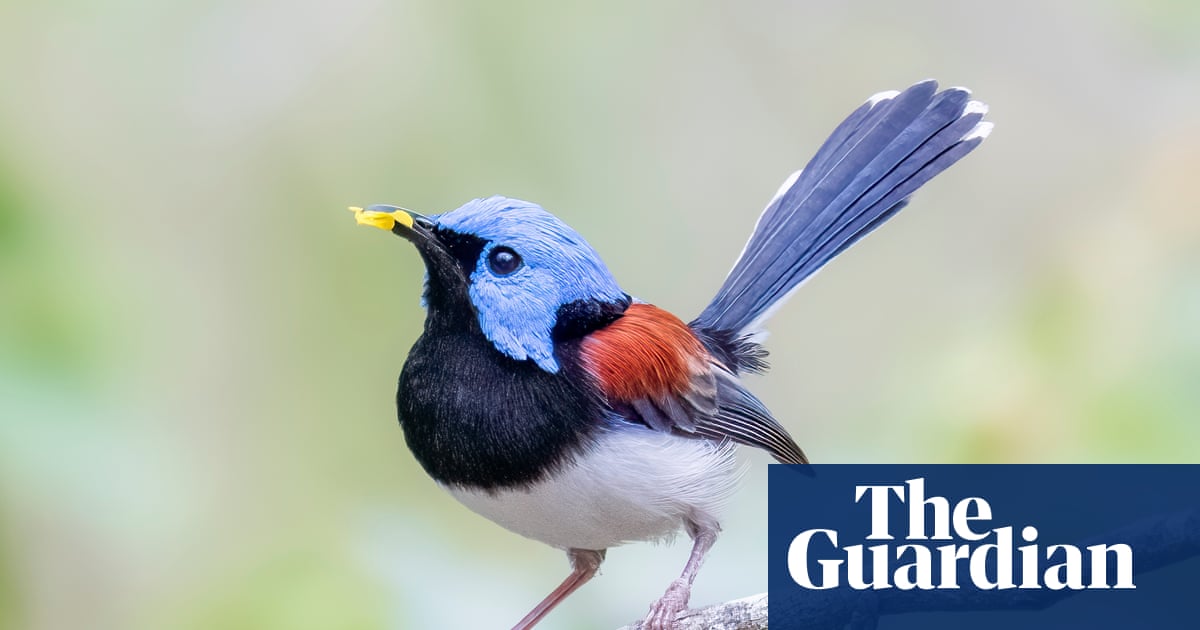
Howard Loosemore, alongside a few talented photographer friends, spent 15 years capturing every Australian fairywren species and plumage in vivid detail that’s been published in a new book about the small and colourful lives of fairywrensLovely fairywrenThe lovely fairywren is endemic to the Cape York peninsula in Australia. Photograph: Howard LoosemoreRed-backed fairywren male in moulting plumageFairywrens feed mainly on insects and other small invertebrates, which they glean from foliage, bark and the ground. They may also eat small amounts of seeds and fruit, particularly when insect prey is scarce.Photograph: Michael ChayPurple-crowned fairywren male in nuptial plumage ‘In late 2022, I was searching for purple-crowned fairywrens near Fitzroy Crossing. In pre-wet season temperatures above 40C, I dug a small waterhole in the dry creek bed near a family of purple-crowned fairywrens and replenished it from a jerrycan, hoping the birds would discover it. I then waited for hours beneath camouflage, lying on a bodyboard to protect myself from the scorching rocks and wearing an ice vest kept frozen in my car freezer.’Photograph: Howard LoosemoreSplendid fairywren male in nuptial plumage In nine of the 10 Australian fairywren species, sexually mature males replace their dazzling nuptial plumage with a much duller brown-grey eclipse plumage after breeding. The eclipse plumage makes them much less conspicuous to predators.Photograph: Jan WegenerRed-winged fairywren male in nuptial plumageRed-winged and some other species of fairywrens possess ultraviolet sensitive vision and can perceive UV reflections invisible to us. The red-winged male’s blue plumage may therefore appear even more brilliant to a female than it does to us.Photograph: Howard LoosemoreSplendid fairywren male in nuptial plumageWhen the time comes to construct their nests, in all fairywren species this task falls exclusively to the female. In some fairywren species, males help by gathering or delivering nesting material but they do not take part in weaving or building of the nest itself.Photograph: Howard LoosemoreRed-backed fairywren male in nuptial plumageThe male red-backed fairywren is the only male to lose all his brilliant breeding colours (including his tail feathers) in full eclipse, changing from striking red and black to brown and even changing his bill from black to reddish or pale pink. It’s a miraculous and unrecognisable transformation, making him very difficult to differentiate from females of the same species in eclipse.Photograph: Jan WegenerSuperb fairywren male in nuptial plumageAll fairywrens form long-term social partnerships, and defend territories together, but both sexes may also mate outside the social pair. In superb fairywrens this extra-pair paternity has been recorded in up to 95% of broods.Photograph: Darren StephensPurple-backed fairywren femaleFairywren subspecies usually look broadly similar. Across Australia the female nominate subspecies of purple-backed fairywrens are grey, brown, tan and cream-coloured. Two subspecies, Malurus assimilis rogersi and Malurus assimilis dulcis (seen here), however, are entirely different, an unusually dramatic difference within a single fairywren species.Photograph: Laurie RossLovely fairywren – a pair of females Two beautiful female lovely fairywrens. Unlike males of the other nine Australian fairywren species, mature adult male lovely fairywrens retain their brilliant nuptial plumage colouration throughout the year rather than moulting into a dull eclipse plumage.Photograph: Laurie RossBlue-breasted fairywren male in nuptial plumageOne of the real photographic challenges of making the book Fairywrens of Australia was that Loosemore wanted the book to show each species in each stage of plumage development. This meant that it took him over a decade to collect and shoot each species at different times of the year. After many years trying and many trips into the West Australian wheatbelt, on his 15th trip to Dryandra Woodland he was able to capture a number of images of the male blue-breasted fairywren in his vibrant nuptial plumage.Photograph: Howard LoosemoreWhite-winged fairywren male in nuptial plumageThe white-winged fairywren is the most widely distributed of all fairywrens. The cobalt-blue plumage of this mainland subspecies of the male white-winged fairywren is created not by blue pigment but by microscopic structures within its feathers that scatter light. A layer of melanin beneath helps intensify the brilliant blue colour.Photograph: Howard LoosemorePurple-crowned fairywren male in nuptial plumagePurple-crowned fairywrens are unusually faithful for fairywrens, with extra-pair paternity recorded at rates as low as 5%, far lower than in most other species.Photograph: Howard LoosemoreRed-backed fairywren male in nuptial plumageThree key ideas to try and keep in mind to improve your bird photos: 1) try and shoot the bird at eye height; 2) place yourself between the sun and the bird to avoid shadows on the bird; 3) try and move your position so you can compose for cleaner, less cluttered backgrounds where possible.Photograph: Howard LoosemoreSplendid fairywren male in nuptial plumageUnlike most birds, fairywrens are cooperative breeders. Young birds may remain with their parents after reaching maturity and act as ‘helpers’, feeding nestlings and fledglings and defending the territory. Some helpers eventually replace a breeding bird when a vacancy arises.Photograph: Howard LoosemoreVariegated fairywren male and femaleThe variegated fairywren (Malurus lamberti) is now recognised as separate from the purple-backed fairywren (Malurus assimilis).Photograph: Jan Wegener
The tiny world of Australian fairywrens – in pictures
Full Article
Original Source
Read the full article at Theguardian →KhanList aggregates and links to publicly available news content. We do not host full articles from third-party sources. Always verify important information with original sources.