
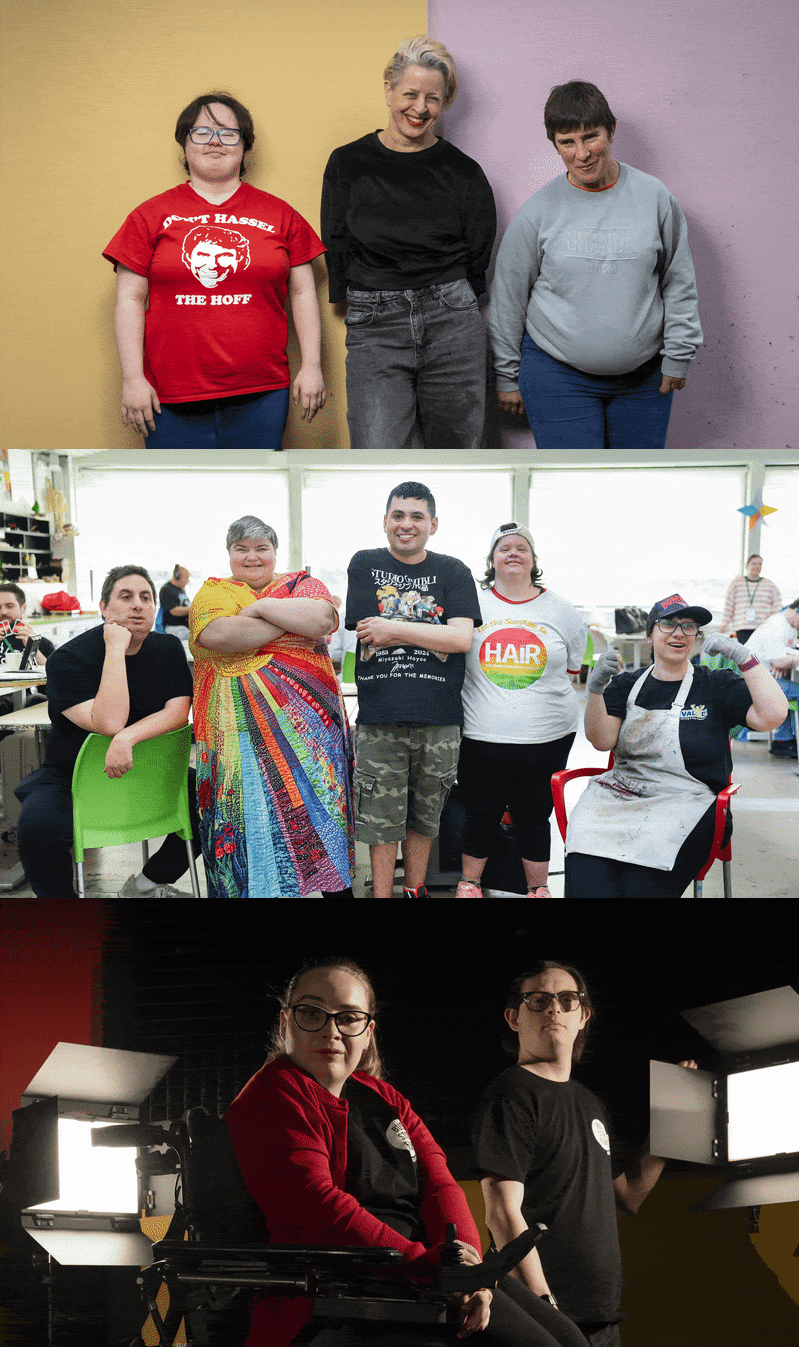
Abbey Faulkner once asked the prime minister for a job. Now she is out of work.On the ABC’s hit series The Assembly, where a collective of autistic journalism students interview high-profile Australians, Faulkner’s pitch to the prime minister seemed poised to launch a promising media career. Through the employment arm of disability screen organisation Bus Stop Films, she had already begun parlaying that broadcast visibility into commercial screen work.That momentum vanished in October. A federal overhaul of the National Disability Insurance Scheme stripped Faulkner of the weekend transport and support workers that she says made her job possible.“The irony is I asked our prime minister, Anthony Albanese, for a job on The Assembly, and now with the NDIS cuts I can’t even go to work safely,” Faulkner says.“What normal 23-year-old gets told they can no longer go to work, go out with their friends, and be able to live an independent life? I’m not asking for special treatment. I just want the opportunity to work, make friends, and have a future. Please don’t take away the support I need to live my life.”Faulkner’s experience is not an isolated one. Her precarity is the first tremor in a funding crisis threatening to destabilise Australia’s renowned disability arts sector – compounding an entrenched employment gap that disproportionately excludes Australians with disability from the workforce.Paul Hodges, Monica Lazzari, Diego Pizarro, Robyn Doherty and Rebecca Scibilia are among the many artists who work in the Arts Project Australia studio.Simon SchluterOver the past five decades, Australia has challenged that disparity through a radical ethos across visual art, stage and screen. Centring the legitimacy of disability arts careers, organisations like Melbourne’s Arts Project Australia, Geelong’s Back to Back Theatre and Sydney’s Bus Stop Films have never traded in charity or art therapy. Instead, they have built professional incubators – spaces where artists with disability work not as clients in need of care, but as cultural producers driving contemporary art.At Bus Stop Films, headquartered in Sydney’s Hurstville, more than 250 young adults with intellectual disability work across 22 national workshops each week. In Melbourne’s inner north, Arts Project Australia’s Northcote studio represents more than 120 resident artists. And in Geelong, Back to Back Theatre’s six-strong ensemble of actors has commanded the stage for over 30 years.Today, this thriving landscape is colliding with government austerity.Under recent federal legislative amendments to the NDIS, some individual funding packages are being cut during routine plan renewals and reassessments – with allocations slashed by up to 50 per cent for Social, Economic and Community Participation supports and 10 per cent for Improved Daily Living Skills. For artists who rely on these budgets to hire support workers, cover travel costs and access therapy services, the cuts pose a barrier to public life and paid work.Industry leaders contend the policy shifts reflect a fundamental legislative blind spot: a failure to understand what these supports mean for Australians with disability.“I think it’s quite targeted,” says Tracey Corbin-Matchett, chief executive of Bus Stop Films, of the cuts. “It’s a little bit ableist.”Among veteran artists, the policy shifts are disillusioning and destabilising. Colourist and draftsman Paul Hodges has developed his practice at Arts Project Australia since 1998, building an international exhibition profile.That artistic ambition is echoed on the gallery’s walls. In the two years following Arts Project Australia’s 50th anniversary, artist Terry Williams was named a Wynne Prize finalist, Miles Howard-Wilks exhibited in the 36th Ljubljana Biennale of Graphic Arts, and Adrian Lazzaro partnered with cult knitwear label WAH-WAH.Paul Hodges at work in the Arts Project Australia studio.Simon SchluterTo Hodges, NDIS funding is no trivial subsidy; it covers the healthcare and psychological support required to live and work with stability.“The government keeps cutting the arts,” Hodges says. “I was expecting the NDIS to be better, and it’s not very good. The promises need to be more honest. People’s needs and their abilities need to be respected more.”That anxiety reverberates across the APA studio floor.For Monica Lazzari, whose vibrant abstractions have travelled from the Northcote studio into national and international collections, a two-decade artistic practice suddenly feels precarious.Monica Lazzari in the Arts Project Australia studio in Northcote, where she creates art – and where she found love.Simon Schluter “I’m really hoping that it doesn’t take away from my funding,” Lazzari says. “I really hope I get the money to come here.”Her concern quickly turns outward.“I’m scared for people who are not as independent as me. I’m scared about their future. If they’re cutting, then how would somebody who’s not so independent be able to participate in their everyday life?”Asked about the federal government’s changes to NDIS funding, the National Disability Insurance Agency said they were being introduced gradually over 12 months as participants’ plans were created or reviewed.Back to Back Theatre’s associate director Ingrid Voorendt (middle) with ensemble members Grace Kenny (left) and Sarah Mainwaring.Jason South“NDIS participants have choice and control over how they use their budgets to purchase the disability supports they need,” a spokesperson said. The office of Minister for Disability and the National Disability Insurance Scheme Mark Butler was also contacted for comment.While those changes start taking effect in Australia, and artists fight to protect basic daily supports, the work of some is reaching a pinnacle of international acclaim.In Geelong, the world-renowned Back to Back – which won the prestigious Ibsen Prize for theatre in Norway in 2022 and the Venice Biennale’s Golden Lion in 2024 – is preparing for another major milestone.The ensemble has been selected as the “Portrait” artist at France’s prestigious Festival d’Automne, a historic first for Australian theatre. Over seven weeks, the company will present six works spanning its 30-year repertoire across multiple Parisian venues, anchored by its seminal 2008 performance piece Food Court.Sarah Mainwaring has worked with the critically-acclaimed Back to Back Theatre for two decades.Jason SouthFor ensemble member Sarah Mainwaring, who has spent nearly two decades co-authoring works with the company, the Paris tour serves as a powerful testament to years of collective labour.“I feel they’ve made me a whole lot stronger, and helped me through my writing and creating works,” Mainwaring says, pointing to the collective process behind each piece.“Performing, coming here, it really excites me. Travelling and touring, I just love it.”The Back to Back legacy also offers a transformative career horizon for the sector’s rising talent. Full-time actor and rapper Grace Kenny, who performs under the alias “Greatest Known”, joined the ensemble last year.Grace Kenny is about to go on tour with Back to Back to France.Jason South“I love my job. I love the people I work with, and I just love who I am as a person now,” Kenny says. “Back to Back have really been my biggest supporters … helping me become the best actor I know I am.”Virginia Lovett, director of performing arts at the University of Melbourne and an Arts Project Australia board member, points to the creative autonomy behind the sector’s achievements.“Australia has been a leader,” Lovett says. “Artists with a disability make a significant contribution to the sector. They have agency in their practice and the companies that have been going for many years play an important role in promoting and nurturing that practice.”“This place isn’t a school,” Lazzari says of APA’s Northcote studio. “There’s no teacher up front telling you what to work on. They divide the materials, you do what you want, and then they help you get out and let the community know what you can do.”Top-down direction is similarly rejected at Back to Back. Rather than working from a pre-written script, its ensemble uproots conventional theatre hierarchies.“The ensemble are devisers and dramaturges; they create their own roles in collaboration with the director,” says associate director Ingrid Voorendt. “Their perspectives, life experiences, language and imaginations shape the work.”For Nathan Basha, an executive producer on Bus Stop’s debut feature film Boss Cat (about to screen in cinemas across Australia) true representation demands authority. With 17 years of industry experience – including credits on Thor: Love and Thunder and Shang-Chi and the Legend of the Ten Rings – Basha validates that autonomy is the catalyst for genuine achievement.“I often say that I have Down Syndrome but that is not who I am. I am a filmmaker, a speaker, an advocate, and someone who is following my passions,” Basha says.Nathan Basha (left, with Abbey Faulkner), has been making films for 17 years.Janie Barrett“We aren’t just participants in a program. We are filmmakers, writers, directors, producers, actors and crew members. To me, having agency means having a real say in the creative process. It means people listening to my ideas and taking them seriously.“Inclusion shouldn’t just mean having a person with disability on screen.”Arts Project Australia executive director Liz Nowell agrees.“Meaningful representation starts with taking disabled artists – and their work – seriously,” she says. “It means moving beyond sentimental or tokenistic narratives and not treating disability or inclusion as the most important thing about the work.“Inclusion is being invited into an exhibition, art institution or conversation. Agency goes further: it means having genuine choice and control over your career, from how your work is developed and presented to the opportunities you pursue.”For Nowell, that philosophical shift fundamentally alters the terms of engagement.“Expectations change,” Nowell says. “The conversation moves from care and limitation to ideas, ambition and contribution. Artists are recognised as cultural producers with intellectual property, professional relationships and the right to make choices about their careers. That does not erase disability or support needs; it means support exists to enable agency rather than define identity.”On the ground, the threat posed by funding cuts extends beyond derailed careers. For many, it strikes at basic human connection.“Some of our participants have been doing the program for 17 years,” Tracey Corbin-Matchett says. “Bus Stop is a critical part of their social connection. It’s the only time they leave their house.”For Corbin-Matchett, technical craft is inseparable from human impact. Over the years, she has watched non-verbal participants begin to speak, celebrated a marriage between two members, and seen emerging talent step into paid careers across the Australian screen industry.“The Down syndrome community, their life expectancy has grown significantly in the last 20 years because of the social connections that they are now having,” Corbin-Matchett says.“Our program helps keep people alive. It is profoundly life changing.”Find out the next TV, streaming series and movies to add to your must-sees. Get The Watchlist delivered every Thursday.
They are some of Australia’s most successful creatives. But these cuts threaten their careers
Full Article
Original Source
Read the full article at Smh →KhanList aggregates and links to publicly available news content. We do not host full articles from third-party sources. Always verify important information with original sources.