
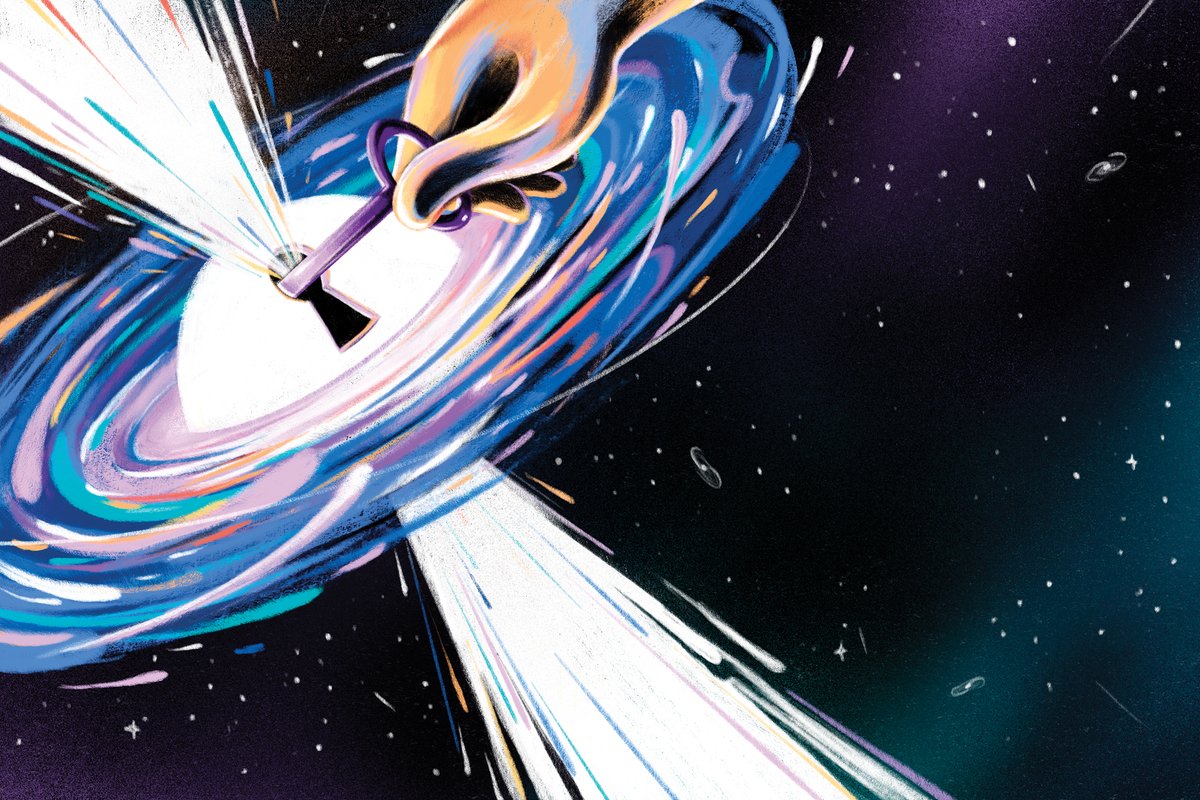
Astronomers have seen things you wouldn’t believe. Diaphanous auroras on other planets. Collapsing stars off the belt of Orion. The fringes of black holes seemingly on fire. But nothing has ever compared to the almighty force of what one astrophysicist calls “the energy monsters of the universe.”Every now and then, observatories catch strange flashes lighting up the far-flung reaches of the cosmos. These cataclysmic explosions spray intense radiation and beams of energy through the universe at close to the speed of light. After the initial blast, which spews out gamma rays, a storm of radiation pours into the surrounding galaxy, creating a ferocious afterglow that burns in every part of the electromagnetic spectrum.Although these events have much in common with various science-fiction superweapons, they are entirely natural eruptions known as gamma-ray bursts, or GRBs. They are by far “the most extreme things in the universe,” says Eric Burns, an astrophysicist at Louisiana State University.On supporting science journalismIf you're enjoying this article, consider supporting our award-winning journalism by subscribing. By purchasing a subscription you are helping to ensure the future of impactful stories about the discoveries and ideas shaping our world today.Supernovae, the deaths of the most massive stars, are terrifically energetic. But they’re like firecrackers compared with GRBs, which typically emit energy equal to something like “a million, trillion, trillion times the Hiroshima bomb,” says Brendan O’Connor, an astrophysicist at the University of Maryland, College Park. “In a few seconds they radiate the amount of energy that the sun produces over its entire lifetime.”These horrifying yet beguiling events might just hold some secrets to understanding the universe. “The physics involved is extremely exotic,” says Charlie Kilpatrick, an astrophysicist at Northwestern University. Certain GRBs produce some of the heaviest elements in the periodic table, including gold. And their extreme, alien physics may help scientists elucidate how the first generation of stars and the first galaxies came to be. Their outpourings of light can be “used as probes of the distant universe,” says astrophysicist Peter Blanchard of the Center for Astrophysics | Harvard & Smithsonian.Astronomers are puzzled about how GRBs work. In the decades since the objects were first discovered, scientists knitted together a picture that they thought handily explained them. But in the past few years the yarn has begun unwinding. Two recently discovered long-lasting GRBs, which were thought to arise from massive explosions, seem to lack the traditional signs of a blast. Another GRB, by far the brightest one ever observed, did not appear to make any of the expected heavy elements.And then a seven-hour-long GRB came along—acting like a Death Star whose planet-destroying beam refused to switch off—that defied all explanation. “This is sort of breaking everything we thought about what produces gamma-ray bursts,” says Jillian Rastinejad, an astrophysicist at the University of Maryland, College Park.Despite detecting around one of these blasts a day, scientists are scrambling for answers. If they can’t find a way to make sense of these detonations, they may discover that GRBs are exposing deeper flaws in our understanding of the universe than we realized.Gamma-ray bursts are a relatively recent discovery. During the cold war, the U.S. wanted to know whether the Soviet Union was sneakily test-firing nuclear weapons. In the 1960s America launched the Vela fleet of satellites, whose sole task was to look at Earth’s surface and search for any telltale neutrons, x-rays and gamma rays—extremely high-energy particles—coming from a nuclear explosion.Worryingly, on July 2, 1967, two Vela satellites recorded something that certainly looked like it came from a nuclear bomb. But on closer inspection, the radiation pattern didn’t seem to quite match that of a nuke. Weirder still, it appeared to be coming from space. From July 1969 to July 1972 scientists found 16 of these events buried in the Vela satellite data, all rich in gamma rays. The data, which confounded experts, were initially classified. In 1973, once officials were confident the radiation wasn’t coming from a secret, terrifying Soviet weapon, they released the results to the public—but scientists couldn’t figure out what was causing the explosions, which they named gamma-ray bursts.That same year one of the scientists who first uncovered the existence of GRBs, Ray Klebesadel of the clandestine Los Alamos National Laboratory, gave a talk at a meeting of the American Astronomical Society. A journalist from the National Enquirer approached him afterward, asking whether it was possible the GRBs were coming from alien civilizations nuking one another. Charles “Chip” Meegan, a NASA researcher, started to hear about GRBs from concerned members of the public. “I got a phone call once from a guy who said that he not only knew what was causing the bursts but how to stop them,” he recounted in a 2002 PBS documentary. “And I just said, ‘I’ve got to go to a meeting now.’”Scientists may discover that gamma-ray bursts are exposing deeper flaws in our understanding of the universe than we realized.To discover the truth, space agencies launched observatories to study (among other things) GRBs, including NASA’s Compton Gamma Ray Observatory and the European Space Agency’s Integral observatory. NASA followed up in the 2000s with its Fermi Gamma-Ray Space Telescope and the Swift observatory. Together they found that GRBs are coming not from warring aliens but from cosmic destruction derbies.By the 2000s scientists had detected thousands of GRBs, and researchers suspected they were being created by two classes of objects. The first was collisions of neutron stars—very dense, rapidly spinning orbs just a dozen or so miles across, made from the left-behind cores of massive stars that had died. The second was collapsing supermassive stars, which end their lives as supernovae. Both events are thought to generate black holes, at least most of the time.GRBs coming from these monstrosities aren’t firing gamma rays out in all directions—they are mainly shooting unfathomably powerful jets of radiation in concentrated beams. “It’s really, really hot plasma and particles moving out at basically the speed of light,” Burns says. The composition of these jets isn’t crystal clear, but scientists suspect electrons, positrons (the antimatter versions of electrons) and perhaps protons are pulled along swirling magnetic lines before being sent out from the black hole’s poles. “You get two jets,” O’Connor says, “but we only see one.”If one of the jets happens to be pointing toward Earth, that’s when we detect a GRB. In most cases, we probably miss them entirely because the beams are pointed elsewhere. And when one does head toward us, it’s usually coming from billions of light-years away, so our planet is hit by only a modicum of this annihilative radiation. When the jets fly out, they smash into the interstellar matter around them, causing a menagerie of radiation—from x-rays and visible light to radio waves—to stream into space, creating an eerie afterglow that can persist for hours, months or even years.By the 2000s scientists had split the explosions into two broad categories: short-duration GRBs (let’s call them shorties), which lasted for no more than two seconds, and long-duration GRBs (longies), which could endure for tens of seconds. Longies, which make up the majority of GRBs, are associated with collapsing supermassive stars, whereas shorties are linked to crashes between two neutron stars.The difference between shorties and longies comes down to mass. In both cases—when neutron stars merge and when supermassive stars collapse—stellar matter is ejected into space as a black hole is born. And in both cases, that material eventually falls onto the black hole, and some gets launched out of both its poles as jets, causing the phenomenon we call a GRB. But collapsing supermassive stars are, as the name suggests, behemoths: they have plenty of mass, which allows their beams to fire for a while. Neutron stars have less mass, so when they crash together, the resulting GRB is briefer. “The amount of mass accreted onto the black hole is really the driving factor in how long the jet is going for,” Rastinejad says.But even when GRBs last just a few milliseconds, they are, in those moments, “the most energetic thing in the universe,” says Yvette Cendes, a physicist and astronomer at the University of Oregon. And that does make them superweapons—just not the kind commanded by any galactic empires.The U.S. launched the Vela satellites in the 1960s to search for signs of nuclear detonations. They found the first indications of gamma-ray bursts.U.S. Department of EnergyScientists have previously speculated that a GRB would vaporize anything caught in its death rays up to 200 light-years from the source. Fortunately, the explosions seem to take place in very remote galaxies undergoing intensive star formation and not—as far as we have seen—in our more mature Milky Way. But if Earth did somehow get supremely unlucky, and we were directly hit by a jet even a few thousand light-years away, our situation would be grim.Brian Thomas, a physicist and astronomer at Washburn University in Kansas, investigated what might happen. Earth wouldn’t completely melt. But at this distance the jet’s energy wouldn’t have dissipated much during its voyage through space. It would crash into our planet’s atmosphere and break apart oxygen and nitrogen molecules, causing a flood of nitrogen oxides to form. These compounds quickly destroy the stratospheric ozone, the gas that filters out harmful ultraviolet radiation from the sun. For approximately a decade, Thomas estimates, Earth’s surface would face a far stronger UV bombardment than it does today. Organisms not resistant to this onslaught—anything from microbes and crops to whales and humans—would experience an almost violently severe sunburn. The event might beget an ecological collapse or perhaps a mass extinction event. “It’s going to be bad,” Thomas says, putting it mildly. But the chances of such a strike are so vanishingly small that we need not worry. Instead scientists see GRBs not as destroyers but as ways to clue in to the evolution of the universe.Gamma-ray bursts could be the key, in fact, to understanding the origins of the building blocks of the cosmos.The big bang flooded the universe with hydrogen and helium, plenty of which fused together within stars to create many heavier elements right up to iron. But that’s where stars’ output stops. Forging the rest of the elements took something much more extreme.Many of the heaviest elements arise only in environments where lots of free neutrons crash into atomic nuclei at great velocities. This is called the rapid neutron-capture process, or the r-process for short. About half the elements heavier than iron are thought to be created through the r-process—including materials such as gold, platinum, thorium, uranium and iodine. “A huge fraction of the elements in the periodic table are produced by the r-process,” Blanchard says. “We find them on Earth. But they weren’t formed here.”Iodine is an essential element for animals: it is a crucial component of thyroid hormones, which regulate metabolism. Uranium is one of the key elements giving Earth’s geological heart its heat, allowing everything from plate tectonics to volcanism to happen. Gold is a precious commodity in plenty of cultures, as well as in electronics. The r-process elements, then, help to “make life what it looks like,” Rastinejad says.Neutron star mergers and collapsing supermassive stars are both perfect settings for the r-process. That means studying GRBs may tell us about how these elements originated. Their afterglows are like “lightbulbs,” Kilpatrick says, illuminating the faraway, ancient galaxies they emerged from, even those that existed just a few hundred million years after the big bang.In 2017 an extraordinary event provided the smoking gun for this theory of element creation. That year scientists running the U.S.-based Laser Interferometer Gravitational-Wave Observatory (LIGO) experiment and Virgo, a similar facility based in Italy, were looking for ripples in the fabric of spacetime created by clashes between celestial titans. On August 17 the Klaxons rang: something in NGC 4993, a galaxy 130 million light-years away in the constellation Hydra, was throwing out intense gravitational waves. By measuring those waves, scientists determined the mass of the two objects involved, which revealed their identity: colliding neutron stars. Shortly afterward NASA’s Fermi space telescope detected a burst of gamma rays coming from the same spot in the night sky. They named it GRB 170817A. GRBs are designated by streams of numbers and letters like this one. For the sake of narrative ease, let’s give it a nickname: Lightbulb.Lightbulb was also accompanied by a kilonova, a bright surge of radiation involving oodles of neutrons—the very kind that could kick-start the r-process and forge all those heavy elements. One calculation suggested Lightbulb made so much gold and platinum that the shiny pile would be 10 times as massive as Earth. The observation seemed to cap off the tidy understanding of GRBs and the two processes that create them. In 2021, back when Rastinejad was a fairly novice Ph.D. student, she was told that the story of GRBs “had, for all intents and purposes, played out.” But that December a new light glimmered in the heavens. The universe had just thrown astronomers a curveball.The new firestorm, NAMED GRB 211211A—detected by Fermi and Swift in a galaxy 1.1 bil-lion light-years away—lasted for 50 seconds. This event was a classic long-duration GRB caused by a supernova, right?Wrong. When Rastinejad and her colleagues used telescopes in Hawaii and Arizona to look at the source, they expected to find the brilliant glow of a dying star. Instead they saw space soaked in a blood-red hue. “We were really shocked,” Rastinejad says. It appeared as though the bluer photons of an explosion were being absorbed by a huge cloud of electrons, then reemitted as red light. Such a cloud is typically linked to an eruption of heavy elements—those created during a neutron star collision and its resulting kilonova. “Holy moly, this is crazy,” Rastinejad recalls thinking at the time. “We all got very excited.”Their research, published in 2022, confirmed that there was no supernova and no collapsing supermassive star. Even now nobody can confidently explain what happened. It looked like two neutron stars collided and produced a rather long GRB. But how could two tiny neutron stars provide enough mass to fuel a 50-second-long pair of jets? “People will debate for a long time as to what actually produced that,” O’Connor says. “We know something weird happened.” But what?A kilonova doesn’t need two neutron stars to form. Only one is required if a black hole is also involved. At the time, Rastinejad and her colleagues wondered whether a black hole’s gravity had ripped up a companion neutron star, as if unseen godly hands had pulled it apart like dough. This action would have triggered a kilonova while also liberating a lot of material, stuff that would take its time falling onto the black hole and fueling longer jets.The Brightest of All Time (BOAT) gamma-ray burst, which erupted in October 2022, is circled in this image from the Hubble Space Telescope.NASA, ESA, CSA, STScI, A. Levan/Radboud University Nijmegen; Image processing: Gladys KoberBut lately Rastinejad’s team has been working with a new theory. The scientists suspect that two neutron stars did collide but that that wasn’t all: a huge disk of stellar matter also formed around the merger, which meant there was a lengthy chain of fuel spiraling downward and powering the jets for a longer period. “That’s, at least in my mind, the best model we have,” says Kilpatrick, a member of the team.Others, including Burns, aren’t convinced. Ejected material falls onto a dense neutron star in around one one-hundredth of a second. The jet should always be brief. Scientists saw a kilonova, so most of them suspect at least one neutron star was involved. But “I think the second object is a white dwarf,” Burns says. A white dwarf is the dead heart of a modestly sized star, such as our sun, that has since been extinguished. Being considerably larger than a neutron star, “a white dwarf takes much longer to eat.” That, he says, could produce a longer GRB. Suffice it to say, GRB 211211A—let’s call it Dynamite for blowing up everything we thought we knew—left everyone bewildered.Then, in 2023, Fermi detected another event—one that lasted for 200 seconds and also lacked a supernova. GRB 230307A, or Bonfire, “is basically a twin” of Dynamite, O’Connor says. By this time the James Webb Space Telescope (JWST) had been launched. As soon as the blast was spotted, astronomers pointed the telescope at Bonfire and, using its infrared scope, detected light emitted by tellurium, an r-process element—making it very likely that Bonfire involved neutron stars and, somehow, made a long-duration GRB.Both events revealed that the old models of long- and short-duration GRBs had holes in them. And definitive explanations for Bonfire and Dynamite aren’t forthcoming. During both, the LIGO and Virgo gravitational-wave detectors were down for maintenance. If they had been on, the identity of the second colliding objects, whatever they were, might have been revealed. “It was a total bummer,” Rastinejad says.This astronomical misfortune, though, was mitigated by an event sandwiched between Dynamite and Bonfire: GRB 221009A, the Olympic champion of GRBs. On October 9, 2022, something exploded 2.4 billion light-years away from Earth. Despite the distance, its jet sucker-punched our planet. For more than 10 minutes we were hammered with gamma rays. The upper atmosphere recoiled so violently that radio communications were disrupted. Lightning detectors in India lit up because of it. And various gamma-ray observatories in orbit were saturated and blinded by the torrent of incoming radiation.The event’s jaw-dropping radiance stunned astronomers, who think that a GRB of this strength strikes Earth only once every 10,000 years. Even its afterglow was so absurdly incandescent that JWST was able to locate the source supernova only several months later. “It was mind-blowing,” Kilpatrick says. It was the most intrinsically energetic event ever seen.We don’t need to conjure up a nickname for GRB 221009A. Astronomers did it themselves, calling it the Brightest of All Time, or the BOAT. And its origin is pretty clear. Eons ago a star up to 30 times the mass of our sun collapsed and perished, forming a black hole. Aside from its brightness, everything else about the BOAT fits the model of a typical long-duration GRB. That, along with its proximity, has allowed scientists to test out another theory about GRBs.R-process elements certainly come from neutron star mergers. But these mergers are far too rare to explain the abundance of heavier elements in the universe. Could collapsing supermassive stars forge the remainder? The BOAT, scientists thought, would reveal the answers. So they trained JWST on the blast, hoping to see evidence for at least some of those heavier elements. “We didn’t see any,” Blanchard says—not a smidge. That seems to leave astronomers with a serious accounting problem. They would love to see several more BOAT-like events close to home to test out this elemental theory on more than one occasion. “If these all happened in the Milky Way, we would have all of the answers,” O’Connor says. “If we didn’t die.”By last year astronomers knew they were in trouble. “We know that our classification scheme has been wrong for 30 years,” O’Connor says, “or simplified.” That’s when another event, GRB 250702B, revealed itself in all its relentless, savage glory.On July 2, 2025, a burst with energy equivalent to 1,000 suns blazing for 10 billion years lit up Fermi’s detectors, heading from a dusty galaxy about eight billion light-years from Earth. It was potent but not as bright as the BOAT. But whereas the BOAT lasted for 10 minutes—quite persistent for a GRB—this event endured for at least seven hours, easily earning the new record. Let’s call this bringer of light Lucifer. And its duration wasn’t all that was notable about it. Lucifer also seemed to pulse—to dim, then reignite—three times. “You can’t have a star explode three times in the space of a day,” Rastinejad says.“We know that our classification scheme has been wrong for 30 years—or simplified.” —Brendan O’Connor University of Maryland, College ParkAstronomers suggested a range of scenarios that could explain the three pulses, including one in which the jet is wobbling. From Earth’s perspective, we’d see it go “on” and “off” as it beamed right at us, then listed ever so slightly away before coming back into view again, says Eliza Neights, a graduate student at the George Washington University. Other GRBs are also thought to pulse, so this feature of Lucifer hasn’t thrown too many astronomers for a loop. Its duration, though, was utterly perplexing. “It was flagged immediately as being something strange,” Neights says. “For the first month or so following it, we had no idea what it was. There were all these crazy hypotheses thrown out there.”One way to increase the duration of a GRB’s jets would be to slow down the collapsing star’s ingestion of ejected matter. To do that, you could spin the object faster, which would make it harder for the eventual black hole to hastily gobble up its entire meal. But spin the collapsing star around too fast, and it “will literally just fall apart,” Burns says, preventing the rest of the cataclysm. That limitation nixes this option: nothing could be spinning fast enough to explain the jet’s duration.Astronomers were left with the troublesome task of pairing up two weird objects, smushing them together and hoping to get Lucifer as a result. Neutron stars certainly don’t work. An elephantine star becoming a black hole doesn’t explain it either. “There are not many things that could look like this,” O’Connor says. There’s even a chance it’s not a GRB at all, traditionally speaking. A study led by Neights and Burns describes what could be a potentially winning duo. The first part is a minuscule black hole, roughly three times the mass of the sun and only about 10 miles across. The second is a similarly lightweight star. And billions of years ago, long before our solar system existed, they might have been locked in a deadly dance.The black hole is so small that it wouldn’t engulf the star in the blink of an eye. Instead it would peel off its hydrogen fuel, leaving behind a remnant helium core. Nothing especially ruinous happens during this theft—until the black hole plunges into the burgled star. There “it starts rapidly consuming material and shredding it from inside,” Neights says. The stellar core implodes into the black hole, and a GRB fueled by a vast amount of material from all around it is born. When the jets fire out of its poles, they puncture through the ailing star’s shell, causing it to explode as a supernova. The process is baroque—complicated and messy. “That’s the best explanation we’ve been able to find,” Neights says. It might be the correct one. But Lucifer remains a puzzle with no clear answers.Cendes says she wouldn’t bet on anything right now, but it’s “something wonky with a black hole.” It’s hard to prove any theories, she says, “when you have a sample size of only one.” Lucifer is, for now, a one-of-a-kind event. Perhaps it always will be. Either way, along with Dynamite, Bonfire and the BOAT, Lucifer demonstrates that our comprehension of GRBs isn’t as solid as we once thought.Are scientists hindered by a weak grasp of the physics driving GRBs? Do they not have enough advanced space observatories seeking out fainter, perhaps stranger GRBs? Or are astronomers hampered by nothing more than chance in that they just haven’t seen the particular GRBs that will allow them to solve their mysteries? “It’s all three,” O’Connor says.The energy monsters of the universe will probably remain somewhat unknowable well into the future. But astronomers will persist in their quest to understand them—not just because they are curious but because GRBs are perfect for impatient scientists. The universe is rife with galaxies, stars and worlds that change very little during an astronomer’s brief time on Earth.“So much of the universe is happening on these billion-year timescales,” Rastinejad says. But nearly every night we see a GRB’s furious ignition somewhere far from home. “I think it’s very fun and very cool to be working with things that are happening on human timescales,” she says. Blink, and you’ll miss them.
These extreme cosmic explosions are breaking physics
Full Article
Original Source
Read the full article at Scientificamerican →KhanList aggregates and links to publicly available news content. We do not host full articles from third-party sources. Always verify important information with original sources.