
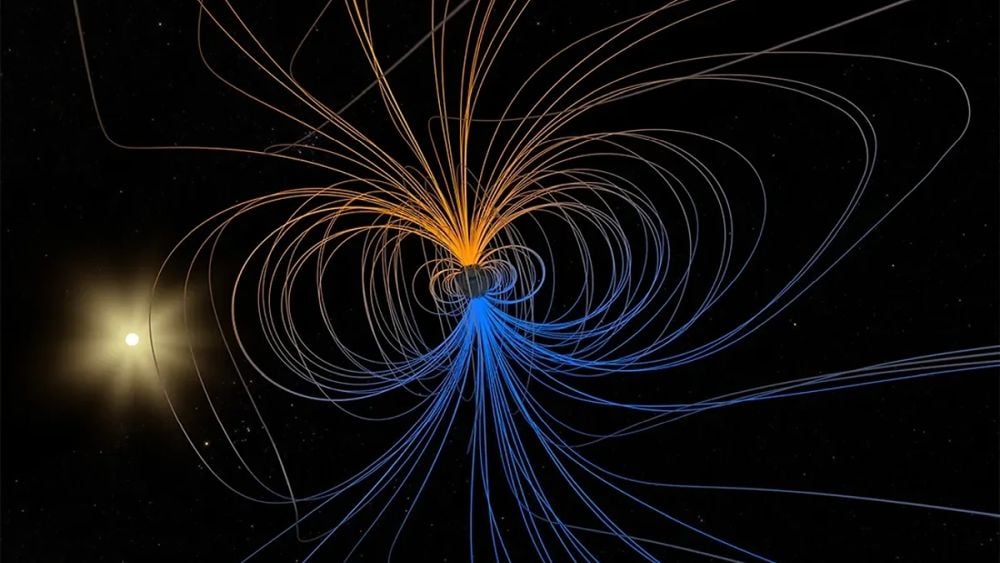
Is there a link between Earth's geomagnetic reversals and extinctions? Nobody has proven it, despite their efforts. But the idea just won't go away. The Earth's magnetic poles haven't remained consistent over the planet's 4.5 billion year history. It's experienced multitudes of pole flips, or geomagnetic reversals, where its north and south poles swap positions. Scientists rely on paleomagnetism to detect them. Paleomagnetism detects the orientiation of Earth's poles across geological time in lava and sediments. The orientation of magnetic minerals in lava and ancient sediments record the locations of the poles at the time they solidified or accumulated. Scientists think reversals are triggered by changes in the heat that flows across Earth's core-mantle boundary, but finding a pattern in geomagnetic reversals is a daunting task. They seem to occur about once every 450,000 years; evidence shows 183 of them in the last 83 million years. The last one was about 780,000 years ago, so by that measure, we're overdue for the next one But the 450,000-year average is kind of a mathetmatical abstraction. There's no indication of a periodic cycle. Determining when a reversal happened can be difficult, and determining how long the reversal took to complete is likewise challenging. Predicting one is next to impossible. Lava and sediments present a tangled history that needs to be painstakingly untangled. Deciphering the history of these reversals is made more difficult because sometimes there are long periods of stability punctuated by shorter periods of rapid multiple reversals. To add to that, individual reversals are chaotic events. These images are form a NASA simulation of geomagnetic reversals. Simulations show that reversals aren't simple, tidy affairs. Instead, they can be a chaos of magnetic field lines. Image Credit: Public Domain, https://commons.wikimedia.org/w/index.php?curid=1546763 New research in the National Science Review presents evidence of one period of geomagnetic chaos that the authors say could be tied to an extinction. It's titled "Geomagnetic instability as a potential deep-Earth forcing factor in the Permian environmental and biotic crisis," and the lead author is Min Zhang. Zhang is from the Key Laboratory of Planetary Science and Frontier Technology at the Institute of Geology and Geophysics, at the Chinese Academy of Sciences in Beijing. "The Permian witnessed profound geomagnetic, environmental, and biotic upheavals, yet high-resolution paleomagnetic constraints across critical transitions remain sparse," the authors write. In this work, the authors present a magnetostratigraphic record from what's called the Fengshan section in South China that covers 3.75 million years. The record spans what's called the Guadalupian-Lopingian transition (end-Guadalupian extinction), which occurred from 262.5-258.75 Mya. "It yields extreme geomagnetic instability, characterized by 29 magnetozones and an unprecedented reversal frequency of 11 reversals/Myr – one of the highest records in Earth’s history," the researchers explain. "These features are temporally correlated with the end-Guadalupian extinction (∼261 Ma), suggesting a potential deep-Earth force contributing to surface ecosystem collapse, though the causation remains unproven," the authors write. It's tempting to tie geomagnetic reversals in with extinctions. So far, that's unproven, but the implication has staying power. "This implies that, together with other global forcing factors, geomagnetic instability might have influenced late Permian climatic and biotic upheavals," the researchers write. Not only did this period see frequent reversals and an extinction, but the appearance of Large Igneous Provinces (LIP) were also altering Earth's atmosphere. LIPs are associated with mantle plumes and coincide with extinctions and rapid changes in Earth's climate. LIPs are wholly unlike any modern type of volcanic activity, supporting the idea that they're causal to extinctions. Adding to the idea is that the Earth's magnetic shield may weaken during pole reversals. This could let in more radiation, but that isn't clear. "The geomagnetic instability may have amplified upper atmospheric ionization through increased flux of galactic cosmic rays and solar wind particles, potentially promoting ozone depletion, increasing atmospheric oxygen loss, and elevating ultraviolet radiation (UVR) on Earth’s surface," the authors write. But most scientists seem to question this idea. There's a lot of information packed into this figure from the research, but it merits a careful look. The x-axis on the bottom shows age across all of the individual figures. In (a) Polarity reversal frequency is shown with a blue line and Paleointensity data is also shown. The y-axis shows the frequency of geomagnetic reversals. (b) shows volcanic activity, with dark red denoting the major phase of large igneous provinces (LIPs). (c) shows sea-level fluctuations, along with the configuration of the supercontinent Pangaea. The blue line again shows polarity reversals. (d) shows the profile for atmospheric carbon. (e) shows species diversity trends and the End-Guadalupian mass extinction and End-Permian mass extinctions. It's hard to ignore the correlations. Image Credit: Zhang et al. 2026. National Science Review, nwag647. If geomagnetic reversals, LIPs, and extinctions all roughly coincide, there could be a causal link. The period of frequent reversals identified in the research could be the key to it. 11 geomagnetic reversals per million years indicates that something remarkable was going on inside Earth. "This observation indicates a period of geodynamo instability, which may have been associated to various deep Earth processes. The temporal association of deep Earth processes, geomagnetic instability with major environmental and biotic changes is intriguing," the authors write. The correlation between these factors certainly deserves more study, that much is obvious. But is it too soon to declare causality? Yup. "Our findings highlight the potential strong influence of deep-Earth processes, and geomagnetic variations, on Permian surface conditions and biotic crisis," the authors conclude.
Magnetic Field Reversals and Extinctions: The Correlation Won't Go Away.
Full Article
Original Source
Read the full article at Universetoday →KhanList aggregates and links to publicly available news content. We do not host full articles from third-party sources. Always verify important information with original sources.