
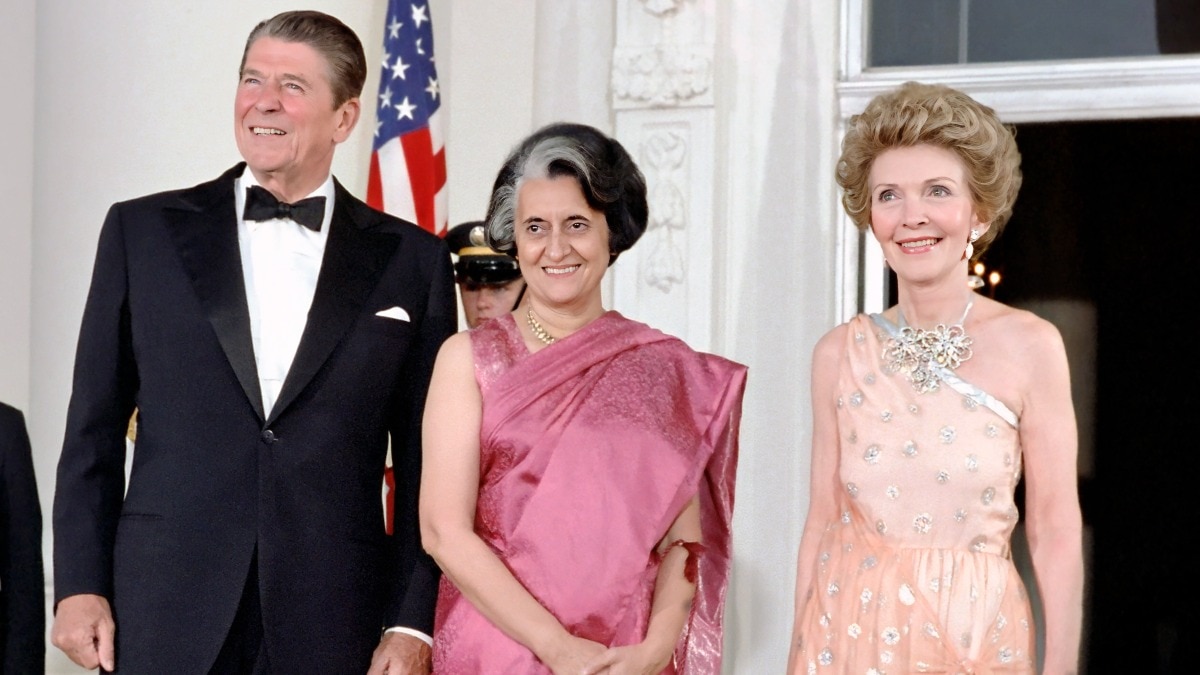
Rahul Gandhi shared an anecdote from Indira Gandhi's 1982 US visit while he attacked PM Modi's foreign policy. While it was intended to take a dig at PM Modi, the episode underlined the turbulent India-US tensions under Indira Gandhi.Former US President Ronald Reagan, Nancy Reagan, with Indira Gandhi at the White HouseWhile taking a swipe at Prime Minister Narendra Modi's "hug diplomacy" with foreign leaders, Congress MP Rahul Gandhi shared an intriguing anecdote from Indira Gandhi's 1982 state visit to the US. The anecdote by Rahul was intended to give a glimpse into how Indira viewed diplomacy. However, his recollection seems to have inadvertently brought to the fore the turbulent India-US ties during Indira's era.Rahul said he was about 12 then, and accompanied his grandmother to the US. During the visit, Rahul recounted an instance when a furious Indira returned from a state dinner that was hosted by then US President Ronald Reagan and his wife Nancy. "These Americans take me for a complete fool," Rahul recalled Indira telling his mother, Sonia Gandhi.The reason? Indira believed that the US First Lady had deliberately worn a dress that was the same colour as her saree."You aren't just visiting a friend's house. In this role, the Prime Minister of India doesn't engage in mere friendship. They have no interest in friendship; their job is to protect the country," Rahul emphasised. Now, whether Nancy's dress was the same colour as Indira's saree is a different story for another day.THE TURBULENT INDIA-US TIES UNDER INDIRA GANDHIWhile Rahul's anecdote was intended to take a dig at PM Modi, the episode underlined the India-US tensions under the Indira era. It would be, however, wrong to say that India-US ties were uniformly hostile. Stay with us till the end, and we will explain why. When Indira first became the prime minister in 1966, India was grappling with a severe food crisis. The economy was under strain. Just two months after taking over, Indira made her first visit to the US as prime minister.The then US President Lyndon B Johnson offered India wheat shipments under its PL-480 program. However, in exchange, Washington wanted Delhi to align more closely with US strategic priorities. The Cold War with the Soviet Union was at its peak. The demand by the US was a tough call for India, which has always adhered to a strict Non-Aligned Movement (NAM) policy.For Indira, the whole experience was deeply humiliating. "I don't ever want us to have to beg for food again," Indira reportedly told her press adviser.India's open criticism of the US during the Vietnam War further sowed the seeds of friction.It was under Richard Nixon that the India-US relationship entered into a more turbulent phase. Nixon viewed Pakistan as strategically important, particularly due to its overt support for the US during the Cold War. Crucially, Pakistan also became a secret back channel for the Nixon administration to open relations with China. Indira Gandhi with US President Richard Nixon during her Washington visit in 1971 INDIRA AND THE NIXON-KISSINGER ERAAt the centre of the Nixon administration's South Asia policy was Kissinger, who greatly influenced global affairs at that time.Pakistan's role played a large part in the US standing by it even as Islamabad carried out a brutal crackdown in East Pakistan in 1971. It sent thousands of refugees streaming into India and eventually triggered the Bangladesh Liberation War.Indira spent much time trying to persuade Nixon to act against Pakistan by pointing to what was unfolding on India's eastern border. When Kissinger met her in New Delhi on July 7, 1971, Indira reportedly told him that she wanted to give diplomacy a chance, and did not want to use force. However, the US turned a blind eye.The Nixon administration suspected that India was preparing for military intervention. A leaked tape from a May 1971 conversation saw Nixon complaining that the "goddamn Indians" were promoting another conflict.In between, India signed a treaty with the Soviet Union for strategic cooperation in August 1971. It angered the US further, even though India assured the US that it was not directed against Washington.Indira travelled to Washington that year in November for a last-ditch effort. It turned out to be unproductive.However, taped conversations between Nixon and Kissinger, after Indira left, reflected the deep hostility of the US towards India. The conversations were declassified by the US in 2005.Nixon and Kissinger are heard engaged in a heated conversation about Indira. While Nixon refers to Indira as an "old witch", Kissinger is heard calling her a "b**ch". "The Indians are b***ards anyway. They are starting a war there," Kissinger further says.In 2005, Kissinger expressed his regret over the foul language. Indira, however, died in October 1984 when she was assassinated by her Sikh bodyguards.The war eventually broke out in December. As Indian forces closed in on Dhaka, Nixon ordered the deployment of the USS Enterprise carrier group in the Bay of Bengal. While the US framed it as a move to evacuate American citizens, it was viewed as a show of force to unsettle India.It failed to deter India. Pakistan's forces eventually surrendered on December 16, 1971. While India emerged victorious, it left a deep scar on Delhi-Washington ties. The relationship deteriorated further after India's first nuclear test in May 1974.The bitterness of the Nixon-Kissinger years cast a long shadow on India-US ties. However, things started to improve gradually in the first half of the 1980s. The 1982 Reagan state dinner that featured in Rahul Gandhi's anecdote was itself billed as an attempt to repair India-US ties.Indira herself told reporters upon her arrival in Washington that she had come precisely to better the ties. However, it would take until the late 1990s and the early 2000s - well after Indira's murder in 1984 - for India and the US to decisively move beyond the mistrust of the troubling Nixon-Kissinger era. It was China's rise that eventually shaped the strategic partnership that exists today.- EndsPublished By: Abhishek DePublished On: Aug 14, 2026 17:54 IST
These Americans take me for a fool: Inside Indira Gandhi's stormy US ties
Full Article
Original Source
Read the full article at Indiatoday →KhanList aggregates and links to publicly available news content. We do not host full articles from third-party sources. Always verify important information with original sources.