
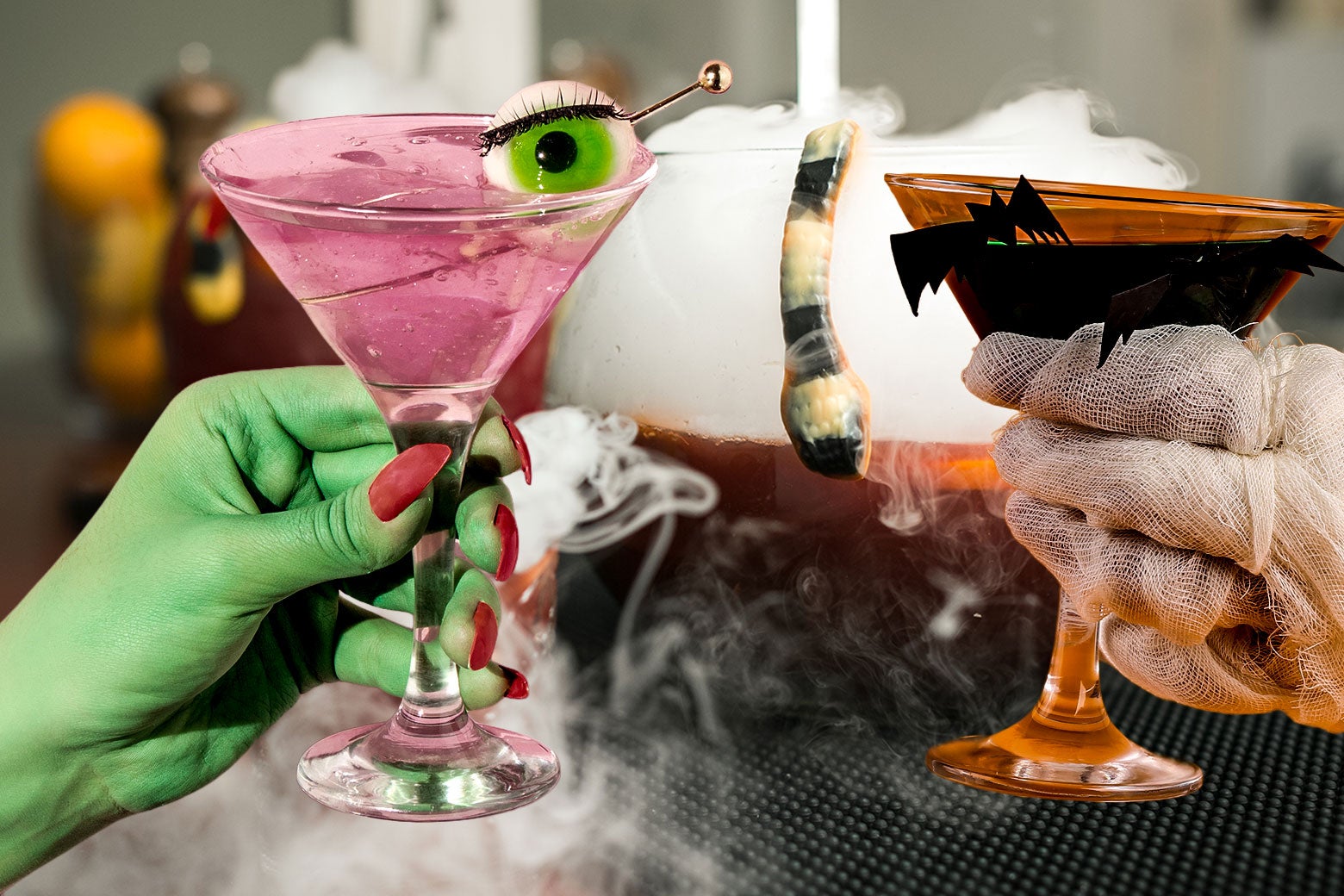
Drink The Horrors of the “Halloween Cocktail” Goofy names, lurid liquors, and gummy-worm garnishes haunt these often-ghastly drinks. Is there any hope of conjuring brews that actually bewitch? Photo illustration by Slate. Photos by Getty Images Plus. Sign up for the Slatest to get the most insightful analysis, criticism, and advice out there, delivered to your inbox daily. Classic eggnog, mulled wine, and coquito; Christmasy flavors like cinnamon, pine, ginger, and cranberry—from cocktails passed around holiday parties to themed pop-up bars sweeping the nation, no one is surprised to see a festive adult beverage in December. But more recently, there’s another holiday trying to elbow its way into the seasonal cocktail camp, and it’s not quite as natural of a fit: Halloween. Bars and brands are ever in search of fresh ways to engage potential customers, and it makes sense to chase that Christmas shine. But Halloween-themed cocktails just don’t spring from ingredients and flavors as organically as December drinks do. As a drinks writer, here are just a few “Halloween cocktails” I’ve been pitched: a “Haunted Emerald Martini,” with gin, crème de cacao, vanilla, oat milk, matcha, and mint … in other words, it’s green; a “Crimson Curse,” with gin, vermouth, and bitters … so … a martini; a “Spookito,” with rum, lime juice, simple syrup, grenadine, mint, and soda water, which is … a mojito with grenadine; and, my personal favorite, the “Boo Bag,” which serves up tequila, blood orange, lemon, lime, and triple sec in an IV bag. Halloween’s time of year does have signature flavors, like pumpkin and apple, but these tend to distinguish autumnal cocktails, not Halloween ones. December is widely considered “the Christmas season,” so pine, cinnamon, ginger, cranberry, etc. feel “Christmasy,” not just “wintery.” October isn’t as commonly thought of as “Halloween season,” as it is simply “fall,” so its flavors are fall flavors, not specifically Halloween flavors. Also, one would think that “Halloween flavors” should taste, well, like death. When cocktails do try to incorporate more on-the-nose Halloween ingredients, things can get gross fast. Take the Black Lagoon from MarthaStewart.com: vodka, rosemary-lemon syrup, lemon juice, and licorice ice cubes. I’d rather drink the goo oozing out of the Thing. Or the Candy Corn Colada, a tropical drink layered to look like candy corn with the controversial sweets sprinkled on top; Delish promises that “even haters will love” it, but I respectfully disagree. No one wants a cocktail with a ham-fisted candy element squeezed in. And pouring a regular, year-round cocktail into a skull glass, naming it after a horror movie, or incorporating stunt ingredients does not a Halloween cocktail make. “Most Halloween cocktails are lazy,” says third-generation bartender Sean Kenyon. “You put a gummy eyeball, activated charcoal, or dry ice in a bad drink, and suddenly it’s a ‘Halloween special.’ ” “I worked at a bar that did a cocktail called ‘Black Magic’ that had squid ink in it, and it was legitimately terrifying,” says New Orleans–based bartender James Jordan. When he hears the words Halloween cocktail, he thinks “marketing and menu changes, which honestly gives me anxiety, because I am normally the one either tasked with coming up with a new menu item or pushing back on drinks that sacrifice integrity for marketing gimmicks.” Is that what defines Halloween cocktails? They give you a fright—but because they’re shockingly bad or an evil twist of marketing? If that’s the case, shouldn’t we all just agree to accept that there’s no such thing as a Halloween cocktail? We might, but that wouldn’t stop them any more than thoughts and prayers can halt an approaching zombie horde. Halloween pop-ups are following in the footsteps of Christmas ones, and while there’s no “Halloween season” stretching as long as the Christmas season, there’s room for “sPoOkY sZn” to grow, which translates to potential for boosted bar sales. “Over the last decade or so, Halloween weekend has truly become the biggest going-out weekend in New York, so I think it’s a big misstep to not treat Halloween like we do Christmas,” says Natasha Van Duser, beverage director at Bateman’s in New York City, adding that she develops a Halloween cocktail menu for the bar each year. Bateman’s is a lauded cocktail spot, and, fittingly, Van Duser walks a fine line between elevating Halloween-esque ingredients into something just as intentionally composed as you’d find at the bar any other time of year, and having some fun with the Halloween of it all. “Halloween is a campy holiday, so I think the gimmick aspect works, but I also think you need to respect the gimmick and that it deserves as much attention as a December holiday menu would,” she notes. Halloween cocktails at Bateman’s have niche connections, like last year’s Sea Urchin Ceviche Pisco Sour, nodding to a dish in American Psycho (Bateman’s itself is a loose wink to the film). That drink, as well as Van Duser’s Hotel Transylvania, transcended “gimmicky” Halloween cocktails: They were so popular they’ve become fixtures on the year-round menu. This year, Van Duser created Children of the Corn to evoke the feeling of walking through haunted corn mazes; it features a house-made candy corn syrup with Brucato Fields amaro that tastes like hay, plus Nixta Licor de Elote. Bateman’s Halloween cocktails aren’t the only more thoughtful Oct. 31–geared drinks appearing in the past few years, with more bartenders proving that maybe the crucial step is taking these beverages a bit more seriously. Halloween is fun, spooky, silly, sure—but with some creativity to push these drinks past vampire-fang-garnished swill, you can have a cocktail that actually embraces holiday-appropriate flavors and tastes good. We might just be at the very beginning of Halloween cocktails’ coming-of-age—who knows, in 10 years, maybe they’ll be as classic as Christmas cocktails, and not some hack job with squid ink and glitter. What excites some bartenders is the very fact that this is all-new territory. “Unlike Christmas, which has its traditional drinks like eggnog, Halloween doesn’t really have one signature cocktail,” says mixologist and author of Beautiful Booze Natalie Migliarini. “And I actually think that’s what makes it so fun.” Kitty Bernardo, bar manager of Paradise Lost, in New York City, notes that “though there is a history to Halloween, those origins have become far removed from the way most folks in America celebrate the holiday today.” She adds: “So Halloween really is what you make of it. For me, I miss those early-’90s school-sponsored Halloween night experiences where we gathered in a dark room and passed around a bowl of wet spaghetti said to have been freshly dug worms from a graveyard, or a latex glove filled with gelatin that was said to be a severed hand.” Bernardo thinks it can be fun to (safely) jazz up a cocktail with dry ice, or bright blue curaçao, or gummy-brain candy garnishes. Although her own Halloween cocktails at Paradise Lost skew a bit more sophisticated, she says, “just get silly with it. Lean into unexpected textures like soaked basil/chia seeds for a slimy frog-egg-like consistency or go for maximalism in your garnishes by putting some blueberry-lychee ‘eyeballs’ in your Jell-O shots.” Better ingredients that lend themselves well to spooky-season cocktails but are also quality things you want on your bar cart are emerging too. “Gin already feels like a witch’s brew,” Kenyon says, “roots, herbs, flowers, and berries brought together and transformed into something intoxicating. … Add citrus to something like Woody Creek Mary’s Select gin [with butterfly pea flower], and the color changes right in the glass, which gives the drink a little magic without relying on a gimmick.” On that note, Midori is kind of cool again, so it’s not instantly cringe to make a slime-colored cocktail. This leaves Halloween cocktails in two camps. In one are the lazy drinks: completely regular, year-round cocktails with party-store glasses or garnishes, as well as established classics like Death in the Afternoon or Corpse Reviver, co-opted for late-October menus. In the other are the cocktails that gracefully juggle fun and nostalgia with craft and balance: naturally purple gin, lychee eyeballs, candy corn elevated into a house-made syrup. The former category is trick, the latter treat. But if you’re dying for a sparkly black concoction, go for it. Just know it won’t become a classic that returns year after year. The “treat” category, meanwhile, has more staying power that could evolve in spooky seasons to come. If you’re itching to make your own Halloween cocktail, one that could become an annual go-to, Migliarini’s incorporation of hyper-seasonal flavors into accessible but upgraded margaritas presents a strong case. She makes an Apple Cider Hot-Honey Margarita with tequila, apple cider, fresh lime juice, and hot honey syrup, as well as a Coconut-Pumpkin Layered Margarita. The layers are a margarita with tequila, cream of coconut, and fresh lime juice alongside one with a pumpkin-pie-spice syrup, tequila, and more lime juice (recipe below). Whichever you choose, remember that gummy body parts are totally optional. Natalie Migliarini/Beautiful Booze Coconut-Pumpkin Layered Margarita Coconut margarita layer 1 oz. tequila½ oz. cream of coconut½ oz. fresh lime juice Pumpkin margarita layer 1 oz. tequila½ oz. pumpkin-pie-spice syrup (such as Torani, or make your own)½ oz. fresh lime juice Optional garnishes: Toasted sweetened coconut flake rim, cinnamon stick. Prepare a serving glass with ice (if using, apply the coconut flakes with a little lime juice now as you would salt). Combine ingredients for each margarita with ice in two separate shakers and shake well. Strain in the coconut margarita first, then the pumpkin margarita layered on top. If you like, garnish with a cinnamon stick. Cooking Food Halloween Holidays Drink
There’s No Such Thing as a Good “Halloween Cocktail.” But Could There Be?
Full Article
Original Source
Read the full article at Slate →KhanList aggregates and links to publicly available news content. We do not host full articles from third-party sources. Always verify important information with original sources.