
India’s latest GDP estimates have opened a wider debate on the credibility of official statistics, methodology, data quality and the interpretation of economic growth. While the government has defended the revised numbers citing improved coverage and methodological changes, questions remain over transparency and the sharp revisions in the size of the economy. In written responses to The Hindu, Former Finance Secretary Subhash Chandra Garg discusses the government’s defence of India’s economic estimations, his concerns over data quality, alleged political interference in the country’s statistical inquiry, policy implications and the credibility challenges surrounding India’s growth narrative. India has historically linked new GDP series to old ones through splicing, re-estimation and back-series construction. Why shouldn’t MoSPI construct a transparent bridge between the 2011–12 and 2022–23 series before asking the public to accept the growth rate? What would that bridge need to show? Perfectly valid demand. MoSPI must announce a time-table of bringing out the back-series data from 2011-12 to 2021-22. It seems the government is not very serious about it as no such programme has been announced so far. The government could have preempted much of this controversy by releasing a transparent decomposition of the roughly ₹6 lakh crore revision in Q1 FY26 GDP. Why wasn’t that done, and what would you expect such a decomposition to show? The question of reduction in nominal GDP of ₹6 lakh crore traces back to 2022-23 to 2024-25. For 2024-25, the GDP has been reduced by as much as ₹12.70 lakh crore. The government has not explained why the reduction had to be made. It has tried to brush it under the carpet by taking refuge under the generic argument that it was due to the new data generated by new methodology, wider coverage, new indices etc. This argument is egregious as any better coverage leads to nominal GDP getting increased, not decreased. Why the government has not done it perhaps lies in the enormous difficulty it is facing in explaining this. In my assessment, there are only two possible explanations. One, the system had goofed up which resulted in overstatement of GDP on account of double counting, counting mistakes etc. Second, the GDP was deliberately overstated to claim higher growth rate and when the job was done, taking the opportunity of the new series, was quietly written down. Incidentally, the reduction in GDP helps in generating higher than actual growth rates in future as well. If economists, rating agencies and fund managers had built their India growth narrative around earlier GDP estimates, who bears responsibility when a major statistical revision alters the measured size and trajectory of the economy? I don’t think anyone accepts responsibility in the government. The businesses and investors suffer on account of consequential rupee depreciation and lower or negative stock market returns. If GDP deflation is ultimately a measure of prices, how confident are you that India’s current price architecture captures the prices actually faced by producers — particularly in services, informal activity and value-added chains — rather than relying on price indices that are easier to observe? Could a GDP deflator be statistically internally consistent and still systematically understate the inflation experienced by firms and households? While there is some welcome movement in the matter of adoption of best international practices in measuring deflator, the current situation has thrown up an apparent irreconciliation outcome. When the consumer price inflation is over 4% and producer price inflation is 9%, the rest of goods and services (still to be publicly disclosed) cannot generate such negative or low inflation that the deflator becomes 2.5% in the first quarter. There is definitely serious internal inconsistency, which needs to be transparently explained. If double deflation is a globally accepted methodology, should the debate focus on the principle of the method, or on whether India possesses sufficiently granular and reliable output, input and price data to implement it with statistical confidence? Like CAS in the stock markets, not every international best practice can be easily and painlessly institutionalised in India. One has to prepare the system granularly and create reliable output, input and price data to implement it. In the time interval till the new practice stabiliaes and generates credible data/output, it makes sense to run two systems parallely and use the deflator from the older period. Does double deflation solve the manufacturing measurement problem — or can it create a new problem if the output and input price indices are themselves poorly measured? What empirical evidence would convince you that the new price architecture is actually improving manufacturing GVA rather than increasing its sensitivity to measurement error? I don’t think it solved the matter of manufacturing deflator measurement satisfactorily. Curiously, if it is applied only for some select sectors and ignored for the rest, it may throw up distortionary overall results as the input inflation for the outputs of other sectors which become input for manufacturing will not be captured correctly. Economic estimation is only as reliable as the data behind it. Looking back, would you concede that the real vulnerability was not necessarily in the GDP formula but in India’s failure to invest early enough in the data infrastructure required to measure an increasingly complex and informal economy? I think our system would still generate reliable data if there is no political interest to produce results in a certain direction. Of course, it needs massive modernisation and also independence of statisticians from political control in collecting, analysing and producing data-sets. A high-growth economy can coexist with weak household sentiment, but given the size of India’s unorganised sector, how should the statistical agency explain a divergence between strong measured GDP growth and weaker signals from household incomes, employment, consumption and economic sentiment? I think there is a large inconsistency between GDP and other data series. In normal circumstances, it might happen sometimes for extraneous reasons. However, if certain data series outcomes become politically sensitive and the system struggles to produce those outcomes, the consistencies cannot be explained away to extraordinary circumstances. Are we measuring economic welfare when we measure GDP growth — and if not, what complementary variables should we put alongside GDP before concluding that the economy is actually doing well? If GDP is growing 7.8% but real household purchasing power and employment are growing much more slowly, should an economist describe that as a high-growth economy? We don’t produce the third leg of the GDP — the income leg i.e. the income distribution between the three recipients of the GDP value added: labour (salary and wages), corporates (profits) and government (product taxes). Until that is done, economic welfare can only be measured very broadly: in the form of growth in per capita GDP. India’s GDP per capita is very low. Logically, we should grow at a very high rates (9-10%), redistribute income (by taxing the wealthy and enlarging the income tax base), and reduce the government’s highly unproductive investment expenditures to nudge the GDP growth towards the people. The responses from MoSPI and the Finance Ministry appear to be technically defensible, but do they close the credibility gap? What, in your view, would actually close that gap? Response on the issue of GDP reduction is only officialese and obfuscatory. It sheds no light. What would falsify your argument? What evidence would make you change your mind about the 2022–23 GDP series — and, conversely, what evidence would convince you that the official 7.8% growth figure is substantially overstated? The GDP reduction/loss is real and put out by the government itself. Nothing can falsify my argument. The GDP growth was 2.6% in nominal terms and nearly 0 in real terms if the GDP was ₹86 trillion in the Q1 2025 as stated by the Government. The loss of GDP can only be explained by either bringing out the overstatement or admitting that it was done to artificially jack up the growth in earlier years.
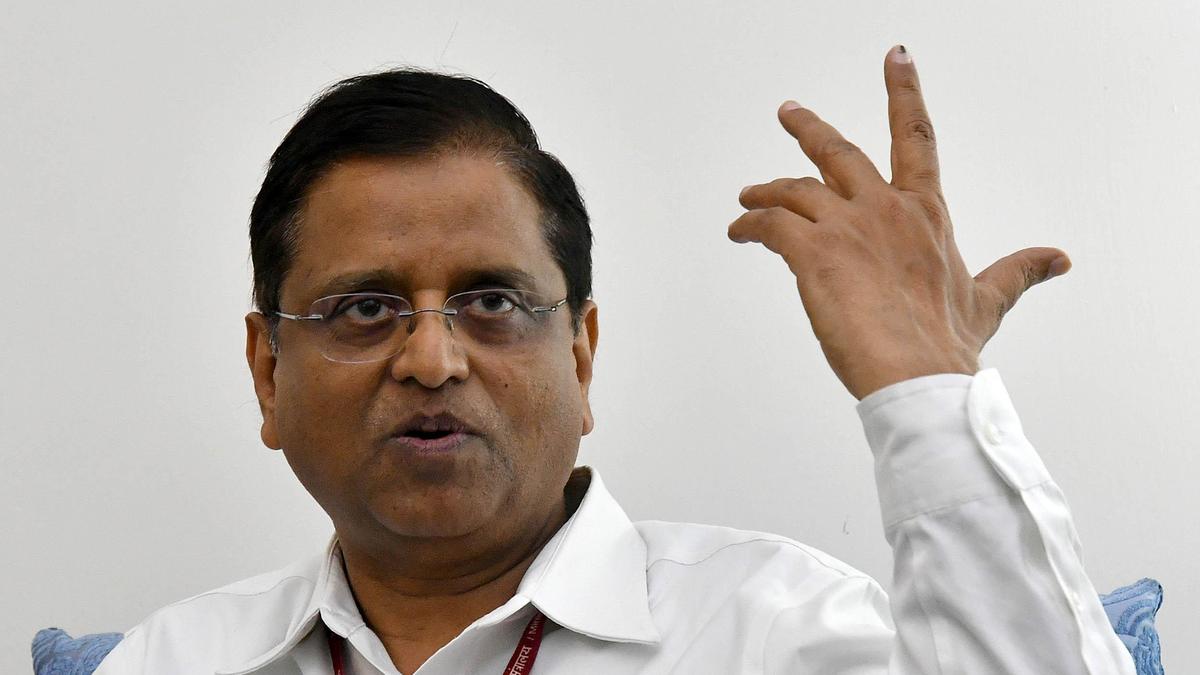
There is a large inconsistency between GDP and other data series: Former Finance Secretary Subhash Chandra Garg
Full Article
Original Source
Read the full article at Thehindu →KhanList aggregates and links to publicly available news content. We do not host full articles from third-party sources. Always verify important information with original sources.