
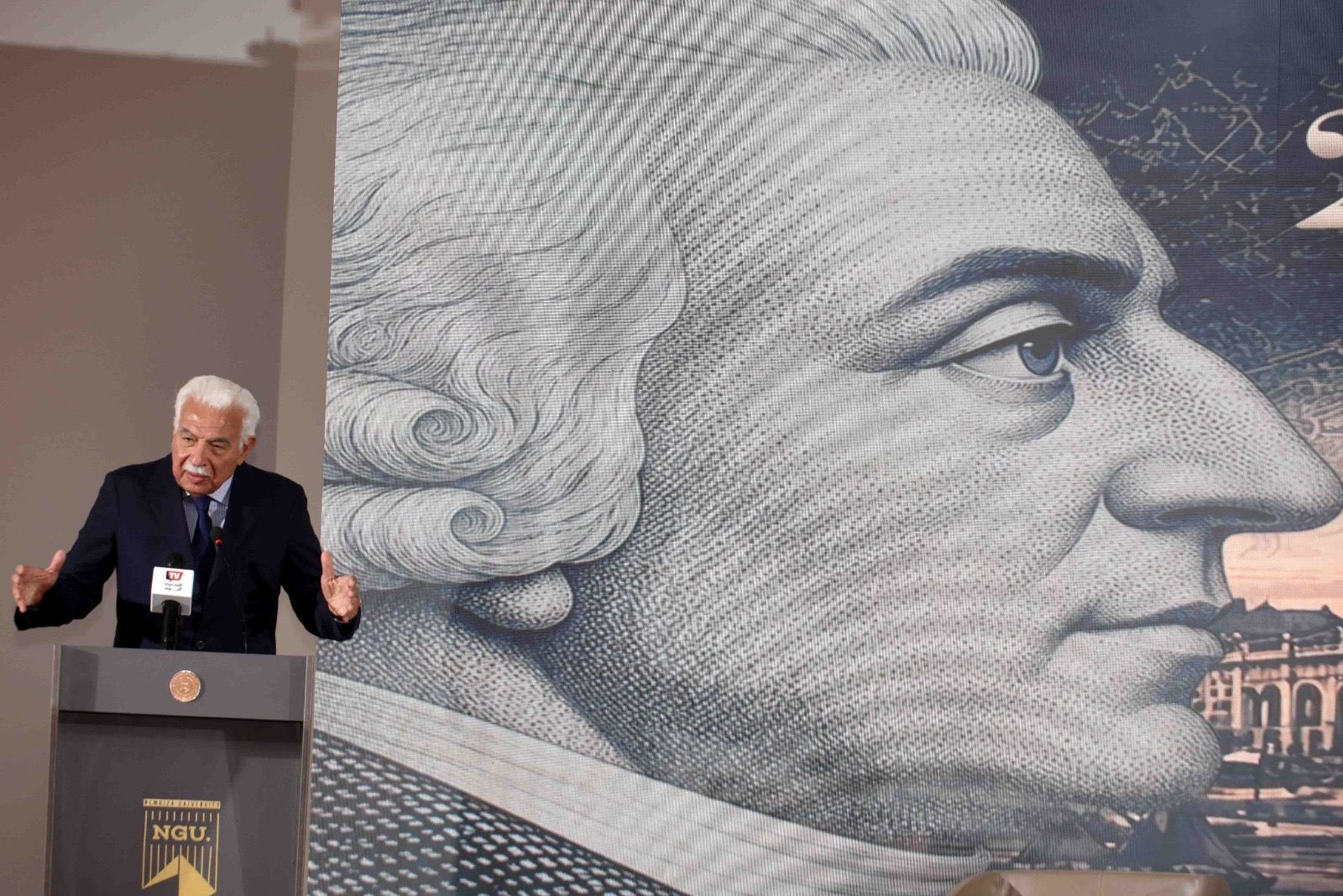
Technology and the struggle for global influence have become increasingly intertwined at a time when Artificial Intelligence (AI) has grown from a mere economic tool into a defining component of national power and countries’ capacity for strategic deterrence. This has made the development of AI capabilities and the regulation of their use matters of national security, particularly amid the growing military applications of these technologies and documented evidence of their use in the genocidal war waged in the Gaza Strip. Against this backdrop, New Giza University, in collaboration with the University of Glasgow, hosted a conference titled “The New Wealth of Nations: AI Is Fundamentally Reshaping the Global Economy.” The event, bringing together a distinguished group of diplomats and academics, examined the implications of the technological revolution for the global balance of power, the future of the economy, and the development of ethical and institutional frameworks to govern the use of intelligent technologies. Egypt emerged prominently in the conference discussions as a country well positioned to play an influential role in the emerging international order. This potential stems from its geographic location, strategic weight, and role in managing Middle Eastern crises, as well as opportunities to expand its presence in global trade, investment, and production chains, and contribute to shaping the rules governing cybersecurity and artificial intelligence. Amid competition among the United States, China, and the European Union, alongside the rise of blocs such as BRICS, participants raised questions about Egypt’s ability to help move countries across the region from a position of vulnerability to international conflicts and transformations to that of active partners in shaping their future. They stressed that stability in the Middle East remains contingent on a just settlement of the Palestinian issue, while shifts in the global economy are creating new opportunities for Egypt, provided it develops the technological and institutional capabilities needed to compete. The forum marked the 10th anniversary of New Giza University and the 250th anniversary of the publication of The Wealth of Nations by Scottish economist Adam Smith, widely regarded as the “father of modern economics.” His ideas on the division of labor and free trade laid important foundations for understanding the growth of production, wealth, and societal prosperity. The opening session featured discussions among leaders, officials, and academics who drew on Smith’s intellectual legacy to interpret contemporary transformations. They warned of technology becoming an instrument of conflict among major powers and highlighted the risks of wealth and influence becoming concentrated in the hands of a limited number of companies and countries. They also underscored the need to redefine the role of the state in regulating markets, protecting people, and ensuring a fairer distribution of the benefits of technological progress. Adly: AI is a new arena of conflict among major powers, with Egypt at the heart of a changing international order Egypt’s former ambassador to the European Union in Brussels, Raouf Adly, said that AI had become a new arena of competition among major powers, as international rivalry shifts from traditional military capabilities towards technological ownership, knowledge production, and data processing. He described the ongoing cyber confrontation as a “Third World War” being waged through different means, warning that the region risks being left out of this equation. He further cautioned against the use of these intelligent technologies without ethical safeguards to protect humanity. Adly ruled out the possibility that international relations would remain confined to a bipolar framework dominated by major powers. Instead, he predicted a growing role for regional blocs and cross-regional alliances, potentially creating opportunities to reinvigorate European partnerships with the Middle East amid tensions between Washington and Brussels. He stated that Egypt was well positioned to occupy a pivotal place in these emerging dynamics. Adly based his assessment on the historical turning points that followed the two world wars, noting that the First World War led to the establishment of the League of Nations, while the Second World War gave rise to the United Nations. Major wars, explained, have historically transformed the structure and institutions of the international system, raising the possibility of another reshaping of international relations in the near future. Adly also discussed his experience in negotiations over the Egypt-European Partnership Agreement, which was linked to the Madrid Peace Conference and aimed at building economic and trade relations that would pave the way for a broad free-trade area. However, the stalled peace process prevented this vision from fully achieving its objectives, leaving the agreements closer to a model of “managed free trade” than to the complete liberalization of commercial exchange. He argued that tensions between the US and Europe could prompt European capitals to redirect part of their economic and strategic relationships towards regions beyond the continent, particularly the Middle East, Africa, Asia, and Latin America. This, he said, would give Egypt an opportunity to strengthen its partnerships, given its geopolitical position and its role in managing regional crises. Adly added that developments in the Middle East since October 7, 2023, had once again highlighted the importance of Egypt’s role in containing crises. Cairo’s influence, he said, rests on a measured and precise diplomatic approach, as well as international recognition of its position in regional stability calculations. He stressed that any vision for the region’s future would remain incomplete without a just settlement of the Palestinian issue. On economic transformations, Adly cautioned against reducing BRICS to an alliance seeking to overthrow the dollar or confront the United States. Instead, he viewed the bloc as reflecting a broader shift towards international multipolarity and creating opportunities to redirect trade and cooperation across regions. He cited the dollar’s continued dominance in approximately 80 percent of global transactions and China’s foreign exchange reserves, estimated at around $3.2 trillion, arguing that these figures do not support simplistic assumptions that Beijing intends to abandon the US currency. Concluding his remarks, Adly linked current transformations to the legacy of economist Adam Smith, arguing that the rise of protectionist policies had harmed international trade and that the global economy was moving towards a more regulated model, which he described as “managed free trade.” This, he said, reflects a shift away from the concept of the market’s “invisible hand” towards a greater role for the “visible hand” of government policies and organized intervention. Nazif: Egypt must establish ethical rules governing the use of AI Former Egyptian Prime Minister Ahmed Nazif linked the transformations that AI is bringing to the global economy with the future of development in Egypt. He stressed that the diversity of the Egyptian economy and the country’s location at the crossroads of three continents offer opportunities to attract investment and strengthen its presence in international production and trade chains. He explained that artificial intelligence is not merely an advancement in production tools, but a transformation that is redefining wealth, economic value, and competitiveness. This, he said, makes it necessary to establish ethical rules governing its applications and protecting people from potential harm. Nazif called for subjecting AI applications to what he described as “meta-rules”: fundamental ethical principles that should precede the rules governing machines and prevent them from killing, lying, or cheating. He stressed that any program violating these principles should be stopped. These rules, he argued, should govern the relationship between AI systems, human beings, society, and the environment, regardless of differences in economic and political systems. He recalled beginning his studies of AI in 1976, when the field was known as “expert systems.” His doctoral dissertation focused on developing such systems, with particular emphasis on meta-rules. The current challenge, he explained, lies in transferring the hierarchy of human rules to machines, enabling them to distinguish between fundamental principles designed to protect life and changing economic rules. Nazif also reviewed his experience in developing Egypt’s telecommunications sector during his tenure as minister, highlighting the establishment of an independent regulatory authority, market liberalization, and opening the sector to private-sector investment. He considered reducing the government’s direct role in production and service delivery, while strengthening regulation and oversight, an application of free-market principles. According to his assessment, foreign direct investment in Egypt increased tenfold over a period of five or six years. He noted that approximately half of the investments he referred to came from Egyptian investors, including expatriates and entrepreneurs. Globally, Nazif said wealth was no longer confined to labor and capital, but had expanded to include intellectual property, brands, quality, and competitiveness. He cited automotive production chains, whose components and manufacturing stages are distributed across dozens of countries. He described AI as a new phase following the agricultural, industrial, and digital revolutions, and therefore requiring regulatory frameworks that maximize its benefits while limiting its risks. He called for strengthening Egypt’s position in this competition. University of Glasgow Vice-Principal: Egypt featured in Adam Smith’s analysis of national prosperity In a historical assessment of the foundations of Egypt’s economic prosperity, the Vice-Principal of the University of Glasgow Graeme Roy, said that Egypt occupied a prominent place in Adam Smith’s analysis of the factors behind the prosperity of nations. He noted that Smith discussed the role of the Nile and irrigation projects in supporting agriculture and manufacturing and strengthening Egypt’s position as an international trading center. Roy explained that Smith referred in The Wealth of Nations to Egypt’s early advances in agriculture and manufacturing, linking them to major irrigation projects that enabled the distribution of Nile water and supported agricultural and commercial activity. This historical experience, he said, highlights the importance of infrastructure and institutions in transforming geographic advantages and natural resources into economic opportunities — a principle that remains relevant to Egypt’s development prospects. Marking the 250th anniversary of the book’s publication, Roy stressed that Smith’s concept of wealth was not limited to gold, silver, or financial indicators. Rather, it was connected to the extent to which economic activity improved people’s lives. He emphasized that economic performance should not be assessed solely through gross domestic product, stock markets, or individual fortunes, but also through the impact of growth on society as a whole. Roy noted that prosperity is closely linked to international production and trade networks, citing mobile phones and medicines whose production involves institutions and individuals from multiple countries. Such examples, he said, demonstrate how the division of labor has expanded into cross-continental production chains. He warned against US President Donald Trump’s calls for imposing tariffs and trade restrictions, arguing that addressing inequalities associated with globalization does not require abandoning the benefits of international cooperation. This is particularly important for economies seeking to attract investment and expand their trade presence, including Egypt, he said. Regarding AI, Roy stressed the need to prioritize ethics, education, and a deeper understanding of inequality, highlighting the role of universities in knowledge exchange and multidisciplinary cooperation. Adam Smith’s legacy, he argued, does not provide ready-made answers to the challenges of 2026, but raises a fundamental question: how can societies be empowered to prosper, and how can the benefits of that prosperity be distributed? Heba Nassar: Combating digital monopolies and reskilling workers are essential to protecting Egypt’s economy From the perspective of economic justice, Professor of Economics at Cairo University, Heba Nassar stressed the need to combat digital monopolies and prevent major technology companies from imposing their dominance on markets and extracting economic rents at the expense of delivering genuine value to consumers. She emphasized that rejecting excessive trade protectionism does not mean eliminating the role of the state. Rather, it requires strong institutions that protect property rights, ensure cybersecurity, and invest in reskilling workers to help them adapt to the transformations driven by algorithms. Without such measures, she warned, the most vulnerable groups risk being excluded from the development process. This vision is particularly relevant to Egypt, which faces the challenge of balancing the benefits of emerging technologies with the protection of employment opportunities and the promotion of competition. Such a balance is essential to ensuring that the technological revolution does not become a tool for concentrating wealth and influence in the hands of a limited number of companies. New Giza University President: Technological shifts and trade wars require Egypt to rethink its economic future In a broader assessment of international transformations, the President of New Giza University, Ahmed Sameh Farid, described the global economy as going through an exceptionally complex period, driven by the intersection of rapid technological change and geopolitical instability. He stressed that addressing current crises requires moving beyond conventional patterns of thinking, citing Albert Einstein’s famous observation: “We cannot solve our problems with the same thinking we used when we created them.” Farid explained that supply chain disruptions, rapid advances in artificial intelligence and e-commerce, escalating trade wars, and military confrontations have made it increasingly difficult for policymakers to predict the trajectory of the global economy and develop sustainable growth strategies. He noted that the contemporary economy has become so complex that traditional models alone can no longer explain movements in international markets. Nevertheless, he said, Adam Smith’s contributions to productivity, exports, the division of labor, and free markets remain relevant, despite the 250 years that have passed since the publication of The Wealth of Nations. Farid also pointed to the emergence of new variables, including structural inflation and the impact of technology on employment rates, as evidence of the scale of transformation in the global economy. He cited the contributions of mathematician and economist John Nash to game theory and negotiation theory, emphasizing the importance of thinking beyond conventional and ideological frameworks when responding to economic and geopolitical shocks. Farid concluded by stressing that bringing together academic, executive, and diplomatic expertise aims to develop practical solutions that can help governments and institutions restructure their tools and build more resilient economies. The conference discussions reveal that Egypt’s position in the emerging international order will not be determined solely by its geographic advantages or political weight, but by its ability to translate these assets into productive and technological power, develop its infrastructure and institutions, reskill its workforce, and participate in establishing rules for the responsible use of AI. Amid opportunities for European partnerships, the growing multipolarity represented by BRICS, and transformations reshaping the global landscape of wealth and trade, Cairo appears to have an opportunity to strengthen its position as an influential partner in shaping the future of the global economy, rather than merely a recipient of its consequences. Five Recommendations to Harness AI for Egypt’s Economy At the conclusion of the conference, the Dean of the School of Business at New Giza University and Secretary-General of the conference, Khaled Abdel Aziz Hegazy, presented five key recommendations on behalf of the conference, drawing on the discussions from its two sessions. The recommendations aim to harness artificial intelligence to support Egypt’s economy while balancing technological innovation, economic fairness and the protection of individual rights. Hegazy opened his closing remarks by revisiting the question posed by Adam Smith in The Wealth of Nations in 1776 – “what makes a nation wealthy?” Smith’s answer, he noted, was not the gold held in national treasuries, but the productive capacity of its people. The conference revisited the same question in the age of algorithms. He explained that the first session challenged common misconceptions about Smith’s economic philosophy. Smith did not advocate the absence of the state or praise greed; rather, he envisioned a vital, albeit limited, government that regulates markets, safeguards rights and protects vulnerable groups, ensuring that economic growth translates into broader social well-being. The second session examined the changing composition of national wealth, which increasingly encompasses data, computing power, AI models, skilled talent and public trust. Hegazy described these elements collectively as instrumental capital, arguing that the state’s role has also evolved: it is no longer merely a referee in the marketplace, but increasingly an investor and strategic actor in developing technological capabilities. He stressed that Smith’s principles remain relevant but must extend further in the age of algorithms. Fair markets, he argued, must now include fair algorithms, the protection of rights must encompass data and human dignity, and social safety nets must evolve into springboards that enable people to participate in the emerging economy. Public investment in AI, he added, must be assessed against the principles of competition, fairness and genuine public benefit. The first recommendation called for AI regulation that enables innovation rather than merely restricting it. This includes governance frameworks that protect consumers, competition and financial stability while allowing room for innovation. It also calls for expanding regulatory sandboxes, drawing on the experience of Egypt’s Financial Regulatory Authority, to test new applications before imposing restrictions. Citizens should also have the right to understand and challenge significant decisions made about them by algorithms. The second recommendation focused on turning social safety nets into springboards through workforce development. It called for a national partnership between government, employers and universities, with shared responsibility and funding for upskilling programs. Particular attention should be given to young people entering the labor market, whose entry-level jobs are especially exposed to automation. Alongside technical capabilities, education should strengthen human skills that machines cannot readily replace, including sound judgment, ethics, creativity and empathy. The third recommendation urged businesses, particularly small and medium-sized enterprises, to pursue focused and realistic AI adoption. Rather than relying on scattered pilot projects, companies should move towards specific, measurable applications, beginning with data readiness, identifying high-value uses and measuring actual economic returns rather than simply the scale of technological activity. Priority sectors identified for Egypt include financial services, agriculture and water management, logistics, healthcare and government services. The fourth recommendation called for directing public investment towards public goods that markets cannot provide on their own. These include shared computing infrastructure, open and responsibly governed data, scientific research and the development of Arabic-language AI capabilities. Such investments should be transparent, competitive and open to private-sector participation, helping build an integrated national ecosystem rather than concentrating the benefits among a limited number of companies or privileged beneficiaries. The fifth recommendation emphasized making universities active partners in technological transformation. Universities should work alongside government and industry on research, policy advice and the responsible use of AI, while updating their curricula to prepare graduates for the emerging economy rather than the one being left behind. Hegazy concluded by quoting Adam Smith: “No society can surely be flourishing and happy, of which the far greater part of the members are poor and miserable.” He described this principle as the real test of the AI age, arguing that the central question is no longer how much AI a nation possesses, but how wisely and fairly it deploys it to improve the well-being of all its people.
The world is waging a “Third World War” through Artificial Intelligence – what role can Egypt play?
Full Article
Original Source
Read the full article at Egyptindependent →KhanList aggregates and links to publicly available news content. We do not host full articles from third-party sources. Always verify important information with original sources.