
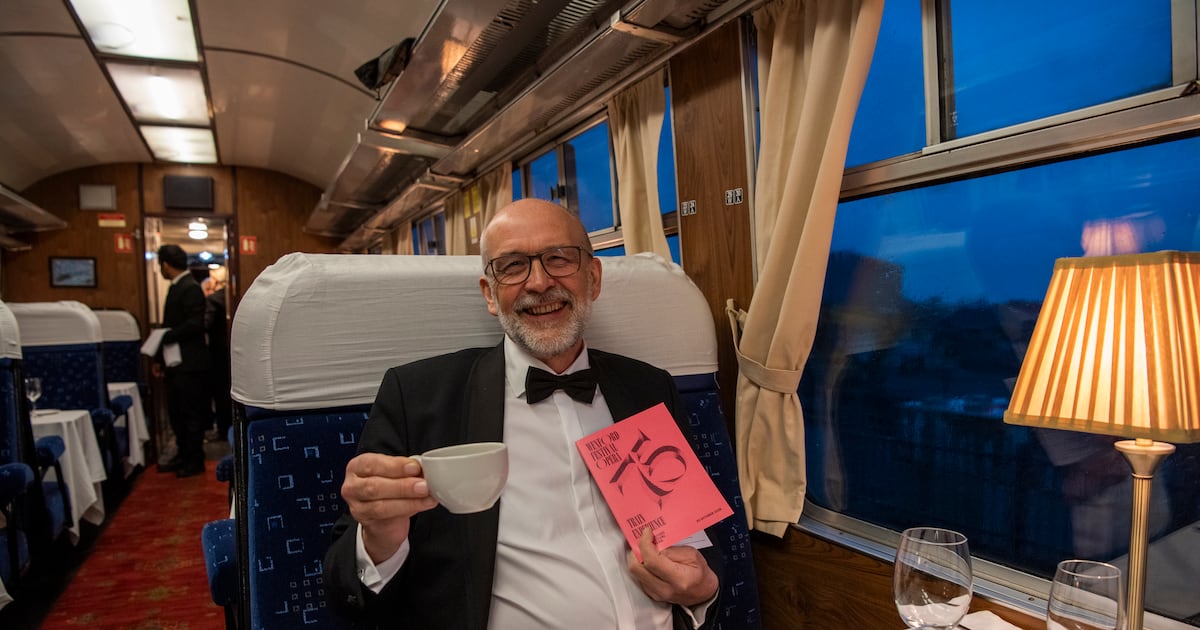
Champagne, plentiful wine, rich food and the gentle rhythm of the restored carriages on the way to see The Gambler: it’s all dangerously soporificWexford Festival Opera: Pat Doyle on the opera train. Photograph: Pádraig Grant A train full of operagoers is making its way from Dublin to Wexford. Everybody is smoking copiously as a journalist moves through the carriages, asking pointed questions.How does the opera crowd compare with regular passengers? The main difference, a waiter explains in this RTÉ news clip from 1973, is that they require a more complicated meal. Otherwise they’re a very nice, older, more sedate group.The journalist moves on to the diners. “Do you think there’s a certain amount of pretension in dressing up and going down to Wexford for the opera?”“No,” comes the reply. “It’s a great occasion.”READ MOREI’m all for a great occasion.It’s 3pm on a sunny October afternoon, and my friend and I are standing on platform 5 at Dublin Connolly in gowns and furs. We’re the first to arrive, and for a few minutes we feel a little self-conscious. Then a man in black tie appears.“Are you going on the opera train?” my friend asks.Her wild guess is correct: he is, like us, here for the return of the Wexford Opera Train, which is running for the first time in almost two decades as part of Wexford Festival Opera’s 75th-anniversary celebrations. By coincidence, tonight’s production is The Gambler, the opera those travellers were on their way to see in that 1973 newsreel.As the crowd gathers, it becomes clear that we are the youngest passengers by about 40 years. The only exception is a group of students who arrive shortly afterwards: the Choral Scholars of University College Dublin, for whom tonight is part of their scholarships.Our departure is delayed by animals on the tracks, which adds to the faintly circus-like, storybook quality of the afternoon. Nobody seems particularly put out, as there’s no hurry.Wexford Festival Opera: the opera train. Photograph: Pádraig Grant Wexford Festival Opera: Michelle Hoctor and Olive Braiden on the opera train. Photograph: Pádraig Grant When it finally pulls into the station, the train is a dark-green relic of the 1970s, preserved by railway enthusiasts and brought out for this occasion. It’s true that everything was better made back then. The seats are plusher, the carpets thicker, and the whole thing feels designed for a time when travelling was more of an event.The tables are laid with white cloths. We settle into our seats and are offered champagne.As we roll out of Dublin, the city gives way to the coast, with views of the Poolbeg towers and the suburbs.Dinner begins with a salmon and prawn salad, followed by seared hake and a selection of desserts. The waiters are generous with the wine, and the mood grows increasingly festive. At one point the Choral Scholars are brought out to sing Happy Birthday in the festival’s honour.Wexford Festival Opera: Ruby Eastwood (right) and her friend on the opera train Wexford Festival Opera: the Choral Scholars of University College Dublin on the opera train. Photograph: Pádraig Grant By the time we reach Wexford, night has fallen and a storm has blown in. We emerge from the station into the rain, where people are waiting with umbrellas to shepherd us on to buses to the National Opera House.Tonight’s production of The Gambler is staged in a striking black-and-white world, complete with ballerinas in red tutus. Michael Dervan, The Irish Times critic, gives the opera five stars. Hassan, an Egyptian-born theatre critic I chat to during the interval, says it’s a work of genius, a musical depiction of the paranoia of the upper classes.[ The Gambler review – Challenging Prokofiev comes to life in five-star productionOpens in new window ]In truth, I fell asleep. Between the wine, the rich dinner, the rhythmic movement of the train and the general excess of pageantry, I’m ready to curl up and sleep.On the way back to the train an older gentleman turns to me cheerfully.“How was your nap?”I’m mortified. Had everyone seen me sleeping? Worse, had I been snoring?“I wasn’t snoring, was I?” I ask my friend. But she can’t tell me. She was asleep too.Fortunately, it transpires that the man hasn’t singled me out. He turns to another passenger and asks the same question. This person cheerfully admits to having had a snooze as well but says the second half was a good deal more lively than the first.I had imagined the train would be populated by opera fanatics, people riveted by Prokofiev – a breed I rarely encounter in my daily life. Instead they’re happy to admit the experience was a little soporific, if entirely pleasant.At €479 a ticket, however, it’s a very expensive nap.This is what I’m trying to work out on the train home. The atmosphere has loosened considerably. The card-and-cash bar is open, with proceeds going to the Railway Preservation Society of Ireland, and passengers are moving between tables and making friends.I get talking to Ultan Herr, who tells me he is one of the Palatines, descendants of the German-speaking settlers who came to Ireland in the 18th century.[ The Irish Palatines: Frank McNally on a forgotten immigrant communityOpens in new window ]For him the opera train is actually the economical option. If he and his wife had driven to Wexford independently, stayed in a hotel, gone out for meals and bought opera tickets, he reckons they could easily have spent €700 each. At €479, the train represents a saving.For other passengers the appeal is the romance of the whole thing: the vintage carriages, the dressing up, the champagne, the sense of occasion. “It’s an escape,” one woman says. “A lovely escape from ordinary life.”IN THIS SECTION
The Wexford opera train returned for one night only. At €479 a ticket here’s what you got
Full Article
Original Source
Read the full article at Irishtimes →KhanList aggregates and links to publicly available news content. We do not host full articles from third-party sources. Always verify important information with original sources.