
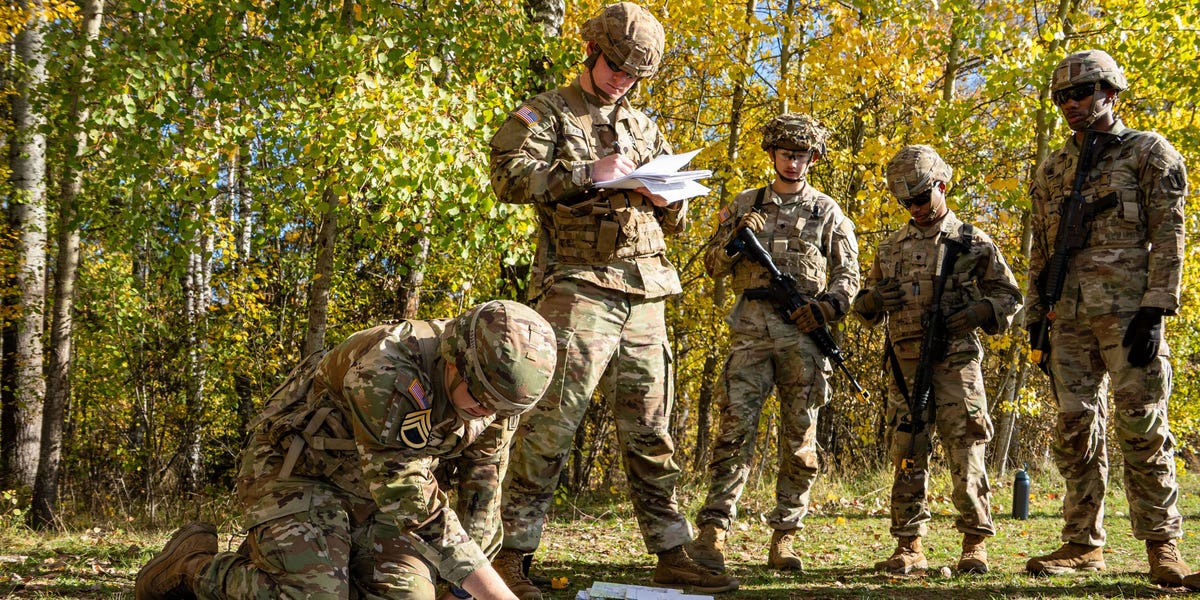
The US Army wants to stop wasting soldiers' time by cutting wait times for training and job assignments Soldiers at the 7th Army Noncommissioned Officer Academy's basic leaders course in the Grafenwoehr Training Area, Germany, Oct. 27, 2026. Sgt. Collin Mackall/US Army The US Army wants to streamline how it trains new soldiers and places them into roles, part of a larger push to cut bureaucratic delays that can leave recruits waiting months for training and create logjams down the line.Service leaders want to cut the time soldiers spend waiting between recruitment, training, and assignments, while also ensuring specialties are consistently filled by personnel who are prepared for and interested in the jobs.At the Association of the United States Army conference in Washington, DC, earlier this month, leaders from Army Human Resources Command discussed how they're modernizing personnel management to get soldiers trained into the jobs where they're needed faster.The data-driven approaches are aimed at connecting what have long been separate processes to better match soldiers to specific locations and jobs based on the Army's needs and scheduling.Part of the challenge for the service is getting "hundreds of disparate systems" to talk to each other, said Lt. Gen. Charles Lombardo, who's overseeing the effort.The Army is tackling that problem through a broader technology overhaul touching systems spanning from personnel management to battlefield operations. The Army has described its wider human-resources overhaul as an effort to replace fragmented, paper-based processes with a unified data environment. It says that the effort is intended to improve forecasting, resource management, and real-time personnel services.For training, Army leaders want better scheduling with an approach they're calling People Supply Chain Management.Rather than handling enlistment, basic training, and advanced training as separate events, the service is examining how to better coordinate these processes to reduce downtime and fill empty training seats.The Army announced the initiative last year, saying it recruits, trains, and assigns tens of thousands of people annually across more than 200 specialties. Some of the Army's most in-demand technical specialties, such as military intelligence and air defense, are top of mind because they have more specialized recruiting and training requirements. Without synchronization, bottlenecks can leave recruits waiting months for training or leave too many soldiers in particular job fields. With this approach, if two dates are available for advanced training, the system would route soldiers graduating from basic training to the class that best fits their schedule or redirect soldiers to fill seats that open up if someone can no longer attend.It's still early days for the program, and it remains to be seen whether the new approach can meaningfully reduce wait times, fill more training seats, and get qualified soldiers into units faster.The service also hopes overhauls will improve assignments for families with members requiring special medical care or specific childcare by matching them with bases that have the necessary services and providers.The aim is to account for those needs before assigning soldiers to duty stations, rather than after a job match has been made. Read next Business Insider tells the innovative stories you want to know Business Insider tells the innovative stories you want to know Business Insider tells the innovative stories you want to know Business Insider tells the innovative stories you want to know Chris Panella is a defense reporter for Business Insider. He covers technological transformations in the US military with focuses on US military modernization, US Army transformation, and emerging technologies like artificial intelligence and drones. Globally, Panella reports on China's military and Taiwan. Panella has embedded with the Army in Alaska, interviewed special operators learning to fly drones, and flown with US Coast Guard helicopters practicing drug interdictions. If you have a tip related to these areas or broader defense coverage, Panella can be reached at cpanella@businessinsider.com or on Signal at cpanella.85. Kelsey Baker is a military affairs reporter with Business Insider. She joined in 2025 and covers military personnel issues and how the military is overhauling how it prepares for future conflicts.Prior to joining BI, she worked at The Washington Post as a Military Veterans in Journalism Fellow covering human interest stories and international news and at The Chronicle of the Horse magazine covering horse sports. She holds a graduate degree in Journalism from Northwestern University, a degree in Diplomacy from Norwich University, and an undergraduate degree in History from the University of Denver. She previously served in the Marine Corps as a logistics officer, and later in the reserve.Contact her via email at kbaker@businessinsider.com, or via Signal at KelseyBaker75.75. Use a personal email address, a nonwork WiFi network, and a nonwork device; here's our guide to sharing information securely. Defense
The US Army wants to stop wasting soldiers' time by cutting wait times for training and job assignments
Full Article
Original Source
Read the full article at Businessinsider →KhanList aggregates and links to publicly available news content. We do not host full articles from third-party sources. Always verify important information with original sources.