
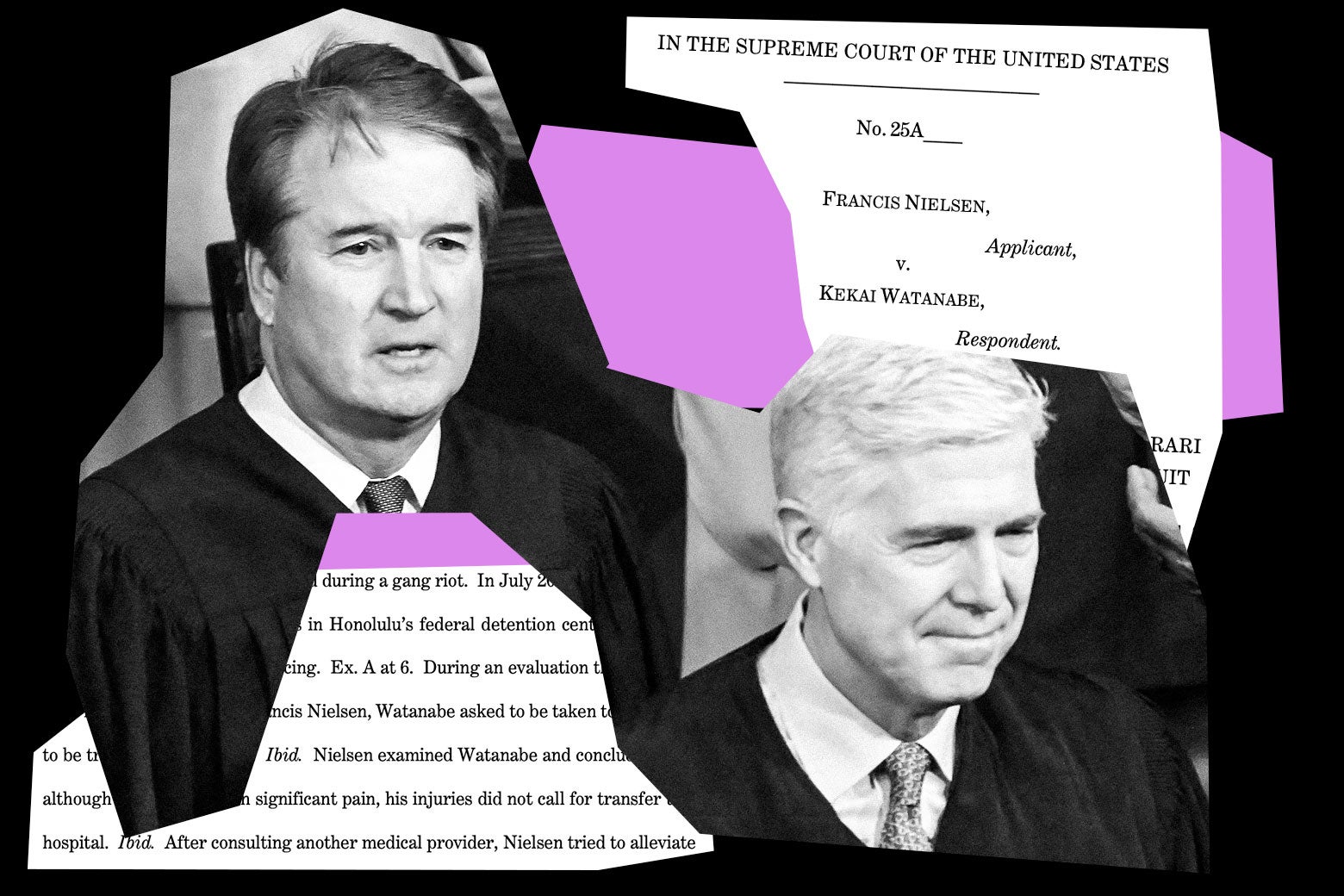
Jurisprudence New leaf? Photo illustration by Slate. Photo by Andrew Caballero-Reynolds/AFP via Getty Images. Sign up for the Slatest to get the most insightful analysis, criticism, and advice out there, delivered to your inbox daily. On July 21, 2021, a riot erupted at the Federal Detention Center in Honolulu. During the chaos, at least four gang members jumped another incarcerated man, Kekai Watanabe, and brutally beat him with an improvised weapon—a combination lock placed in a sock. When Watanabe saw the prison nurse a few days later, he described his pain as a 10 on a 1-to-10 scale. But nurse Francis Nielsen told him to “stop being a crybaby.” Watanabe asked to go to the hospital. But Nielsen told him he was “not going.” For months, Watanabe begged for real medical attention. But Nielsen just gave him over-the-counter medication. The following year, an X-ray revealed that Watanabe’s tailbone was fractured, and bone chips had become lodged in the surrounding soft tissue. Only then did the prison agree that he could see a medical specialist. But the prison never made good on that agreement: Watanabe was released from federal custody in 2024 without ever receiving treatment. Today, Watanabe is still in extreme pain. And he is still seeking a remedy for the physical and legal injuries that he suffered during his incarceration. On Monday, the Supreme Court heard oral argument in Nielsen v. Watanabe, a case that will determine whether Watanabe and anyone else harmed by federal agents—whether in prisons, in immigration detention centers, or on the streets—can sue those agents for money damages, and hold them personally liable for violating constitutional rights. In theory, this should be an easy question. Over 50 years ago, in a case called Bivens v. Six Unknown Named Agents, the Supreme Court recognized that the Constitution inherently empowers people to sue federal agents who violate the rights that the Constitution protects. A few years later, the court held that prison officials violate the Eighth Amendment’s protection against “cruel and unusual punishments” when they are “deliberately indifferent” to an incarcerated person’s “serious medical needs.” And by 1980, the Supreme Court explicitly put the two cases together, ruling in Carson v. Green that a grieving mother could bring a Bivens lawsuit against federal prison officials whose deliberate indifference to her son’s asthma attack caused his death. However, as its ideological makeup has lurched to the right, the court has become increasingly hostile to attempts to hold government agents accountable for misconduct, no matter how egregious. In a 2022 majority opinion, for example, Justice Clarence Thomas stressed that courts may not extend Bivens to any “new contexts” if there is “any rational reason (even one)” to think that Congress was “better suited” to create a damages remedy itself. In doing so, Thomas both broke with precedent and slammed the courthouse doors on countless people harmed by federal agents. Thomas presented the court’s capriciousness as humility, writing that “prescribing a cause of action” is almost always “a job for Congress, not the courts.” Yet it was not clear why redress for violating the Constitution should be dependent on Congress passing a statute. And it was all too clear that Congress—basically a vestigial organ in the modern era—was not about to pass any such statute anytime soon. But that was before last week’s midterm elections. In the new year, Democrats will have sizable majorities in both chambers of Congress. And Monday’s oral argument was colored by both awareness of what past Congresses failed to do and what the new Congress could actually do soon. Justice Brett Kavanaugh, for instance, was cautious when the attorney for the prison nurse pushed the court to move on from its incrementalist attacks on Bivens and Carlson and overrule the cases outright already. Kavanaugh pointed out that Congress has “left Bivens and Carlson where they stood” for half a century, passing legislation “against that backdrop,” and that overruling the cases would be “pulling the rug out” from the legislature. The attorney, Lucas Walker, largely did not share Kavanaugh’s concern—and suggested that the justices didn’t really share it either. “This court has not hesitated to overrule past decisions,” said Walker, even though Congress “could have” chosen to legislatively override them. Furthermore, Walker said, if Congress does have a problem with the court ending Bivens, then Congress could pass a statute codifying the Bivens remedy. Justice Ketanji Brown Jackson picked up on that answer in a back-and-forth with Department of Justice attorney Vivek Suri, who appeared as amicus supporting the prison nurse. Jackson asked Suri if he agreed that Congress could “respond to whatever we do here” and “reinstate the Carlson remedy” if the court were to overrule it. Suri said, “Of course.” Justice Elena Kagan then pressed Suri further still on a potential congressional response. “Typically,” Kagan said, the Justice Department considers whether “what we’re asking the court to do” is “essentially a dare to Congress.” Perhaps, then, the other branches of government can only say “Congress can do something” so many times before Congress calls their bluff and does something. “Have you thought about that?” Kagan asked. Suri replied that he could not “get into our internal deliberations” about “what we think Congress might or might not do.” For years, the Supreme Court has been invoking hypothetical congressional action as an excuse to ignore the very real harm that federal agents inflict on people like Watanabe. According to the court, they shouldn’t create consequences for constitutional violations, because if Congress wanted consequences, Congress could provide them. The incoming Congress has the chance to call the court’s bluff. Congress Jurisprudence Police Violence Supreme Court Brett Kavanaugh Judiciary 2026 Midterms
The Supreme Court Is Already Rethinking Things in Light of the 2026 Election
Full Article
Original Source
Read the full article at Slate →KhanList aggregates and links to publicly available news content. We do not host full articles from third-party sources. Always verify important information with original sources.