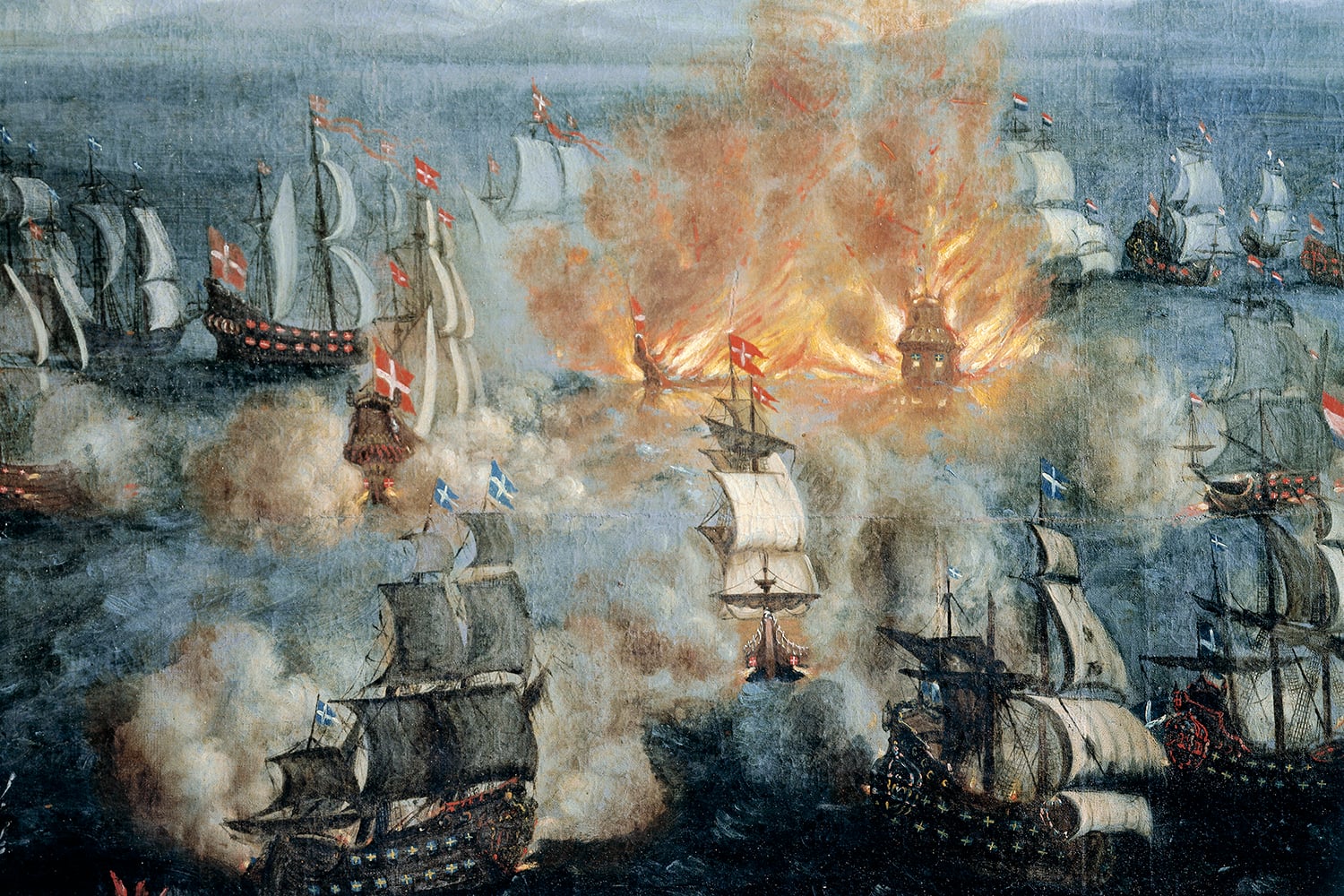
At time of writing, U.S. President Donald Trump’s haphazard attacks on Iran have killed 18 U.S. service members, an unknown number of Iranian civilians and military personnel, and cost tens of billions of dollars. Most importantly for everyone else on Earth, it has closed the Strait of Hormuz to international shipping. Approximately 90 percent of traded goods are shipped by sea. Disruptions caused by a war over vitally important naval choke points are not new, nor are their calamitous economic effects. Trump’s war has catalyzed a reversion to a period before Great Britain and the United States enforced the neutrality of major global waterways in the 19th and early 20th centuries, a deliberately manufactured situation that modern Americans inherited without remembering or understanding that it was artificial, and like everything artificial, needed to be maintained. At time of writing, U.S. President Donald Trump’s haphazard attacks on Iran have killed 18 U.S. service members, an unknown number of Iranian civilians and military personnel, and cost tens of billions of dollars. Most importantly for everyone else on Earth, it has closed the Strait of Hormuz to international shipping. Approximately 90 percent of traded goods are shipped by sea. Disruptions caused by a war over vitally important naval choke points are not new, nor are their calamitous economic effects. Trump’s war has catalyzed a reversion to a period before Great Britain and the United States enforced the neutrality of major global waterways in the 19th and early 20th centuries, a deliberately manufactured situation that modern Americans inherited without remembering or understanding that it was artificial, and like everything artificial, needed to be maintained. Trump’s grotesque actions do not represent the abdication of empire, as some Trump supporters from the far left and right hope, but its degeneration. Unless this failure is reversed, the world’s waterways will again become sites of brutal contention, as they have been historically. Consider two examples: the Dardanelles, between the eastern Mediterranean and the Black Sea; and the Oresund Sound into and out of the Baltic. One exemplifies the way control over geography can make even a weak power vital to international decision-making. The other provides an example of the financial rewards of control of a shipping choke point—which becomes unsettling when applied to Iran’s Islamic Revolutionary Guard Corps (IRGC) and its power over Hormuz. From 1453 and the final conquest of Constantinople (modern-day Istanbul), the Ottoman Empire controlled the entire Turkish Straits, the passage from the Mediterranean to the Black Sea including the Dardanelles and the Bosphorus. Since the Baltic exit to the open ocean was dominated by Denmark, Russia had for centuries bent toward an exit to the Mediterranean through the Turkish Straits. As the Ottoman Empire crumbled, control of this important waterway was a recurrent aim of warfare in the eastern Mediterranean: between Russia and everyone else. After the Napoleonic wars, control over the Turkish Straits swung back and forth, eventually culminating in the Crimean War, during which a European alliance propped up the Ottomans to deny Russia control of the Bosphorus. The Oresund connects the Baltic to the North Sea, which from the late Middle Ages onward was a vital nexus of shipping for a broad group of Northern European communities from Muscovy to England. (This contact is how Shakespeare knew enough about Russians for characters to disguise themselves as Muscovites in Love’s Labour’s Lost, for instance.) The Baltic trade was in vital but unsexy commodities like timber and wood products, hemp and flax, iron and copper, grain, beer, salt, and fish, as well as more visible luxury products like furs and amber—and after the adoption of gunpowder in Europe, firearms. From 1429, the sound was controlled by the Kalmar Union and then Denmark, and so were the lucrative sound tolls, where ships paid 1 percent to 2 percent of the cargo’s value for passage. (The closeness of this date to the fall of Constantinople is not a coincidence: Throughout Eurasia, the early modern period was characterized by the development of state power, including the ability to make war and extract revenue.) This money went not to the embryonic Danish government—at this time, the Rigsrad, or council—but to the king of Denmark as a personal asset. In 1625, control of this independent revenue, amounting to one-eighth of Danish state income, allowed Christian IV to intervene in the Thirty Years’ War without consulting his own council, a disastrous decision for Denmark. That raises an uncomfortable parallel in Iran: Is this money going to the Iranian government as such, or directly to the IRGC, a parallel armed force whose purpose is to maintain the theocracy? This purpose has enabled a substantial expansion of its remit: For instance, it is the IRGC, and not the regular Iranian armed forces, that controls the ballistic missiles. It is also a vast economic cartel. Even before 2026, the IRGC was already becoming stronger at the expense of other entities within the Iranian power structure, such as the clerisy. During the U.S. attacks this year, it has rapidly consolidated power. Independent revenue would reinforce revenue from its economic operations within Iranian society and give it more funding to finance war as well as support proxies like Hamas, Hezbollah, and Shiite militias in Iraq, without input from other Iranian decision-makers. This would bring Iran closer to what I believe is one probable decay state for the Islamic Revolution: instead of a cleric-dominated Islamic republic, an IRGC-led junta. The Turkish Straits, the Oresund, and other waterways were forced open to shipping and commerce during the 19th and early 20th centuries by the British Empire and the United States. In 1841, the London Straits Convention barred all warships from the Bosphorus, benefiting British naval power at Russia’s expense. Although dissatisfaction with the sound tolls had been brewing in Denmark itself throughout the early 19th century, the United States forced the issue when it refused to pay tolls in 1856; in response, Denmark convened a summit to establish the sound’s neutrality. The modern United States has inherited this imperial structure, which remains beneath the 1982 United Nations Convention on the Law of the Sea, which protects “innocent passage” within narrow waterways and coasts. Until this year, the United States securing international trade is how the world has functioned. Trump has thrown this away for zero gain—not even for pacifism’s sake. (In 2026 so far, he has bombed Iran, Somalia, the Caribbean and the Pacific, Iraq, Syria, Nigeria, and Venezuela.) A world order enforced by the United States was morally unpalatable for many people on the American left. But when isolationists imagined a world without U.S. hegemony, they envisioned a world order characterized by mutual restraint without considering who might enforce this situation. As we are now seeing, the alternative to some kind of enforcement of a consistent world order is not an acephalic, mutually respectful world, but recurrent, destructive wars. Within this more bellicose world, every single power bordering an important shipping channel is likely to remember it has a potential throat hold on the world economy, and eventually they will act accordingly. The Iranian-allied Houthis in Yemen are already attempting to contest the Bab el-Mandeb passage from the Arabian Sea to the Red Sea. If I were one of Russia’s enemies, I would be seriously contemplating the old significance of the Oresund and the Turkish Straits. If Finland and Estonia block the Gulf of Finland, Russia could not export oil through this routeor resupply Kaliningrad. In the Iran conflict in 2026, we are confronted with the same conclusion that T.R. Fehrenbach, infantry officer and author, reached regarding the Korean War: “Americans in 1950 rediscovered something that since Hiroshima they had forgotten: you may fly over a land forever; you may bomb it, atomize it, pulverize it and wipe it clean of life—but if you desire to defend it, protect it, and keep it for civilization, you must do this on the ground, the way the Roman legions did … [in] the mud.” What decides history is the geography of earth and water, and the human beings on it.
The Straits Are Not OK
Full Article
Original Source
Read the full article at Foreignpolicy →KhanList aggregates and links to publicly available news content. We do not host full articles from third-party sources. Always verify important information with original sources.