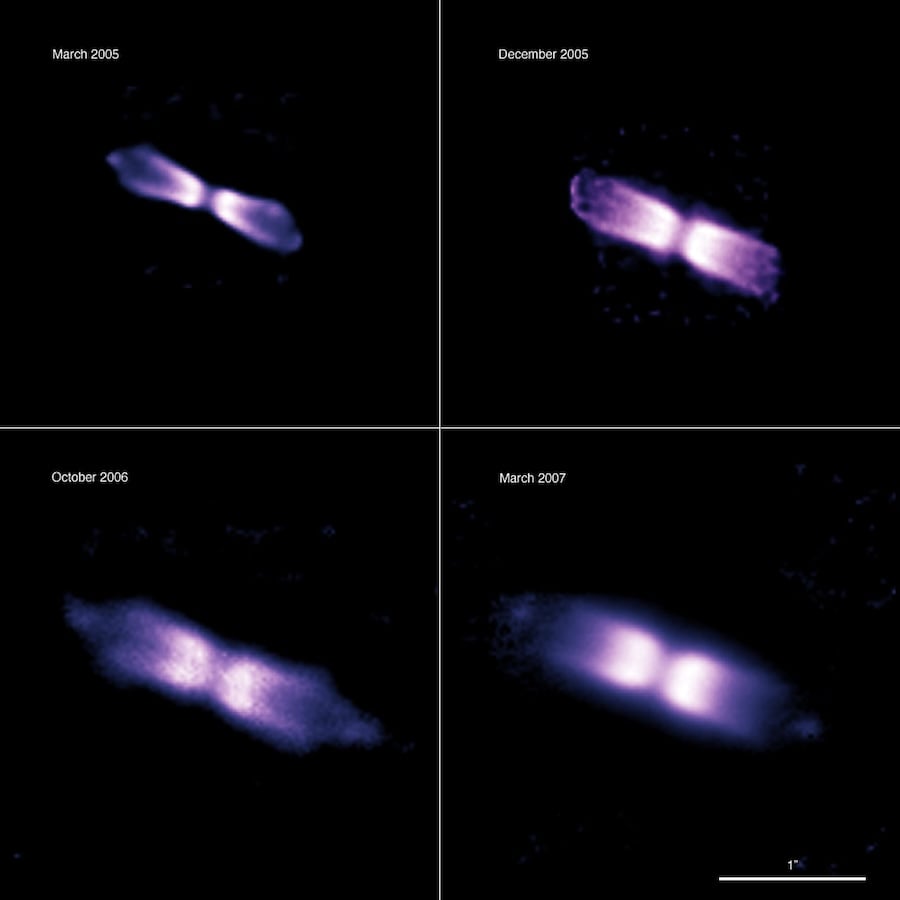
How do you solve a crime when the scene has been hidden for a quarter of a century? That’s been the problem with V445 Puppis. When it erupted in late 2000 it announced itself as something genuinely peculiar, a nova with no hydrogen in it. Ordinary novae are generally rich in hydrogen. A white dwarf, the hot dense remains left when a Sun like star dies, sits in orbit with a companion and slowly pulls gas off it. That stolen material piles up on the white dwarf's surface until the pressure and temperature at the bottom of the heap reach the point of no return, and the whole lot detonates in a runaway thermonuclear flash. It is a borrowed explosion, fuelled by hydrogen, and we see them all the time. Illustration of the standard arrangement of a white dwarf siphoning gas from a companion until the pile detonates. In V445 Puppis the same machinery is running on helium instead of hydrogen (Credit : NASA/CXC/M. Weiss) V445 Puppis did it without a trace of the stuff. It remains the only confirmed helium nova in the Milky Way, however, the eruption promptly hid the evidence. It launched a bipolar outflow stretching more than a trillion kilometres, and in doing so manufactured a thick disc of dust that obscured the system. For more than twenty years astronomers could watch the debris expanding but could not see what had produced it. The debris has since started to clear and John Mills, a researcher at the University of Warwick, has combined infrared data from the Very Large Telescope, Hubble imaging, two decades of spectroscopy from the Southern African Large Telescope and photometry from NASA's TESS to reveal the binary at last. It’s a white dwarf feeding on a helium star, a star stripped of its outer hydrogen envelope, most likely by the companion now robbing it. These are vanishingly rare objects with perhaps a few thousand among the hundreds of billions of stars in our Galaxy. The pair circle each other every 3.7 days, roughly twice as long as anyone had assumed, and the theft has already started up again. Then there are the embedded clumps of gas in the outflow, possibly rich in oxygen, moving at up to twelve million kilometres per hour. Mills suspects they were launched after the main outburst, but nothing like them has been seen in any nova anywhere. Supernova 1994D, lower left, briefly outshining the combined stars of its host galaxy. Type Ia explosions like this one are the yardstick that revealed cosmic acceleration and V445 Puppis may be showing us how one begins (Credit : NASA/ESA, The Hubble Key Project Team and The High-Z Supernova Search Team) Why should we care about a single star which is seemingly a little odd? Because repeated helium eruptions may be one of the roads that leads to a Type Ia supernova, and Type Ia supernovae are how we measure the universe. Their brightness is so reliable that we use them as standard candles, and they are the reason we know the expansion of the universe is accelerating. Whether helium novae really do end that way remains an open question. But we now have one clear laboratory in which to ask it, and a set of mysterious clumps of gas to explain along the way. Source : Astronomers discover super-bright quasar lenses
The Star That Exploded Without Hydrogen
Full Article
Original Source
Read the full article at Universetoday →KhanList aggregates and links to publicly available news content. We do not host full articles from third-party sources. Always verify important information with original sources.