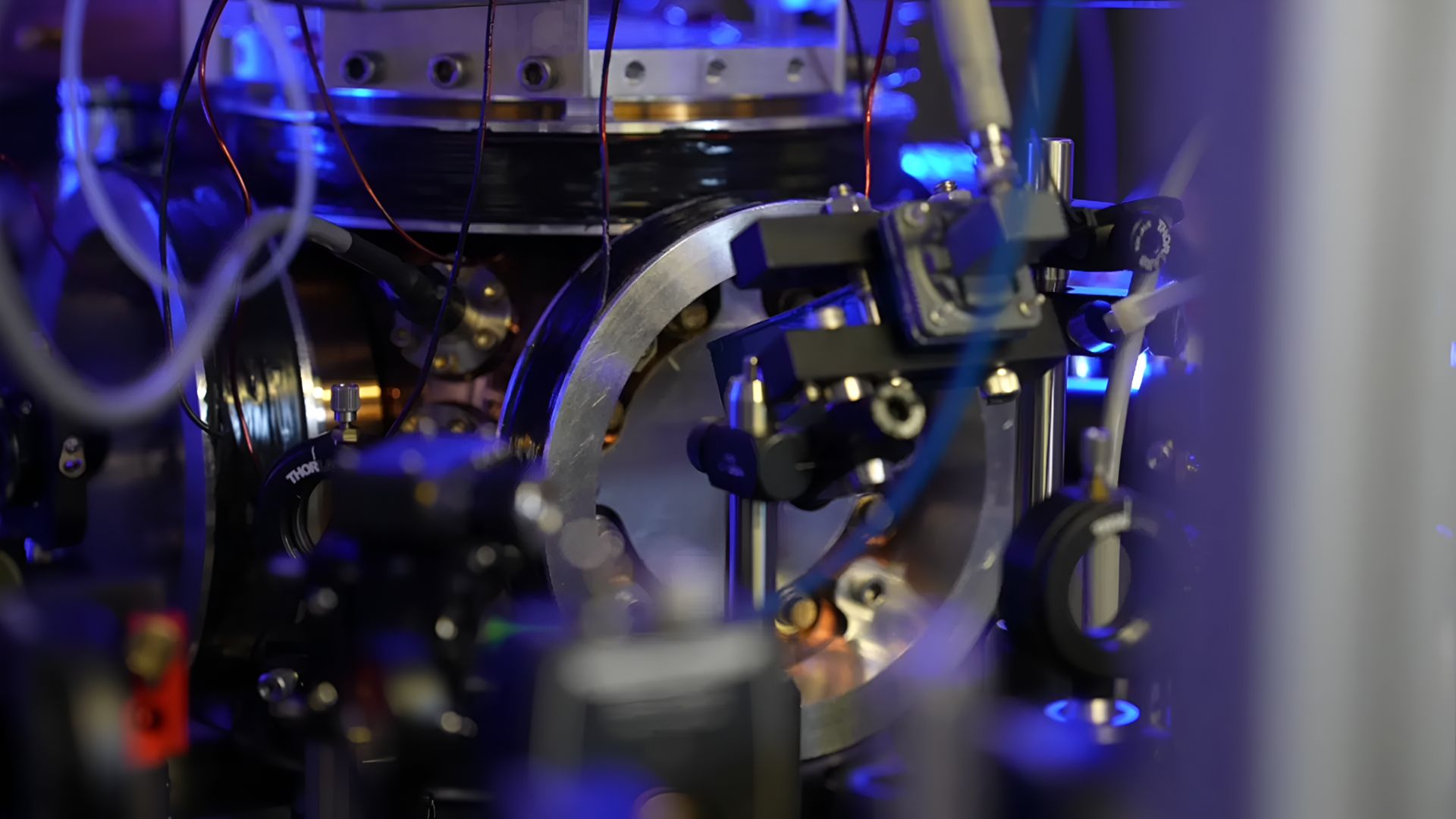
Scientists in the US have developed a novel way to control temperature inside a trapped-ion quantum simulator that recreates realistic thermal environments for studying quantum systems. Led by Guido Pagano, PhD, a physics and astronomy professor at Rice University in Houston, Texas, the research team developed a two-knob control system that independently regulates heating and cooling. The two independent controls make it possible to precisely tune the temperature of trapped ions and the rate at which they change. This could reportedly improve simulations of molecular processes such as electron transfer. It could additionally broaden the range of experiments with quantum simulators. “Electron transfer is a phenomenon that underpins many fundamental natural phenomena, for example breathing or photosynthesis,” Guido Pagano, PhD, a physics and astronomy professor at Rice University, noted. “This research was about trying to simulate a model of electron transfers by adding an additional knob, which is the temperature.” Precise thermal tuning For the study, the team studied molecular electron transfer using a trapped-ion quantum simulator. It works by confining ions in a vacuum by electromagnetic fields to mimic how electrons move between molecules. According to Pagano, until now, the simulator could be placed in only two basic environments: one that cooled the ions to their vibrational ground state, as well as another that continuously heated the system. The new approach introduces two independent knobs that overcome this limitation. “The vibrations of the ion relate to the temperature,” Pagano emphasized. “More vibrations means a higher temperature, while fewer vibrations means a cooler temperature.” The system uses vibrations to precisely set the ions’ temperature and control how quickly it changes. One control heats the ions by applying random electric-field signals that add vibrational energy. “You can think of it as random kicks to the crystal,” Visal So, PhD, the study’s first author, said. “Each kick provides vibrational energy, which essentially creates a heating effect on the ions in the study.” By controlling these kicks, the team can tune the system’s heating rate. In turn, the second control relies on a cooling laser that slows the ions’ vibrations, which reduces their temperature. The researchers can finely adjust the final temperature by balancing the two effects. Better quantum simulations Mingjian Zhu, a graduate student in physics and astronomy at Rice, revealed the system enables independent control over a thermal environment’s temperature and dissipation rate. “If we want to have a controlled temperature, we need a cooling and a heating process and this should be controlled independently,” Zhu explained. The new controls allow the simulator to reproduce thermal environments that are much closer to those found in real molecular systems. With the upgraded setup, the team examined how the temperature influences electron transfer. They revealed that increasing the temperature changed the efficiency of electron transfer. It, moreover, activated processes that were not observed when the ions remained in their lowest-energy ground state. Random electric field kicks, left, control the heating rate of the trapped ion, center. A cooling laser, left, controls the cooling rate.Credit: Rice University / Mario Norton The trapped-ion simulator allowed the team to directly observe how the electrons move from a donor site through a barrier to an acceptor site. The added thermal controls revealed how the temperature altered this behavior. “These new controls give us precise control over an ion’s thermal state, allowing us to place an ion into a specific state or interrogate an ion in an unknown state,” Pagano concluded in a press release. “With these, we can greatly increase the number and type of questions we can ask using the trapped-ions quantum simulator.” The study has been published in the journal Physic Review Letters. Recommended ArticlesGet the latest in engineering, tech, space & science - delivered daily to your inbox.Based in Skopje, North Macedonia. Her work has appeared in Daily Mail, Mirror, Daily Star, Yahoo, NationalWorld, Newsweek, Press Gazette and others. She covers stories on batteries, wind energy, sustainable shipping and new discoveries. When she's not chasing the next big science story, she's traveling, exploring new cultures, or enjoying good food with even better wine.
US quantum simulator mimics real-world temperatures with two independent controls
Full Article
Original Source
Read the full article at Interestingengineering →KhanList aggregates and links to publicly available news content. We do not host full articles from third-party sources. Always verify important information with original sources.