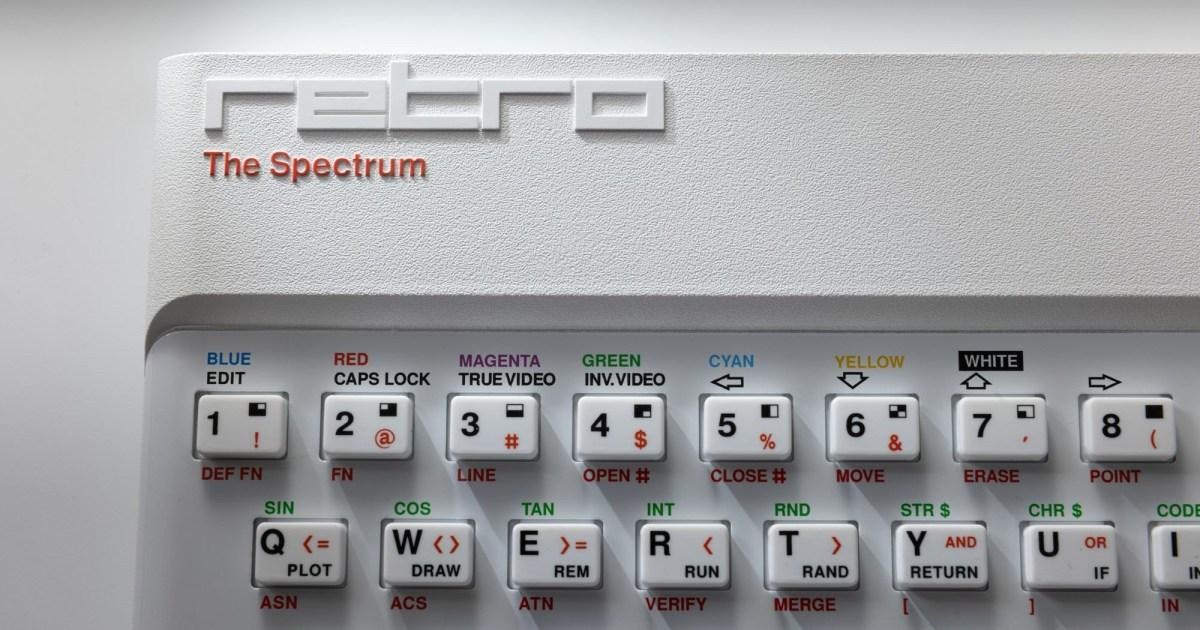
The Spectrum has seen a ghost (Tim Green DP) In 1980s Britain the ZX Spectrum and Commodore 64 were the most popular video game formats around and they’re making a comeback with new hardware and new games. In order to have enjoyed 8-bit computers such as the ZX Spectrum and Commodore 64 when they first came out, you’d have to be pushing 50 at this point. The same is true of the NES, which came out only a year later, in 1983, and yet somehow it doesn’t seem quite so ancient, no doubt because many of its most famous franchises are still continuing today, with new entries and careful preservation of the originals. That’s very much not the case for the Spectrum and C64 but there is still plenty of interest in the formats, at least in Europe. Earlier this year we talked to the creator of Spectrum classic Chuckie Egg, about the revival of the game on mobile, while hardware maker Retro Games recently announced new portable versions of the Commodore 64 and Spectrum, for release later this autumn. Their most recent product though is The Spectrum White Edition, a full-size recreation of the original Sinclair ZX Spectrum in white, a reference to a rumoured special edition from back in the 80s. We’ve had a chance to use the device ourselves, but we also got to talk to product designer and Retro Games CTO Chris Smith, for who the preservation of ancient computers and consoles is a personal passion. The Spectrum was originally released in its traditional black finish a few years ago but while the white version is functionally identical it does come with a number of enticing extras, most obviously 48 games that include genuine 8-bit classics such as Manic Miner, Skool Daze, The Great Escape, The Lords Of Midnight, Head Over Heels, and The Hobbit – games that were system sellers at the time but are now all but forgotten by mainstream gaming. As Smith makes clear in the interview, this isn’t a mini-console, in the style of the SNES and Mega Drive devices that were fashionable a few years ago, but a fully-functioning computer that looks and works exactly as the original did over 40 years ago. Although it can be used to emulate various different models of Spectrum, including the 16K version, the best-selling 48K, and the later 128K edition. Expert, exclusive gaming analysis Sign up to the GameCentral newsletter for a unique take on the week in gaming, alongside the latest reviews and more. Delivered to your inbox every Saturday morning. Any Spectrum game can be run on the device, since to all intents and purposes it is the original hardware, with the famous rubber keyboard recreated perfectly. You can use a bundled USB stick to access more games and there’s a white joystick that looks uncannily like the Competition Pro 5000, that was popular at the time. You also get an all-new copy of Crash magazine, the predominant source of gaming news and reviews at the time, long before the existence of the World Wide Web. Nostalgia in a box (Tim Green DP) The White Edition costs £129.00 but there’s also a Collector’s Edition that includes the white Spectrum, Crash, and the USB stick, but a different joystick that looks more like the QuickShot II, and a more modern style joypad. You also get a spiral-bound manual and a black and white printer. The Collector’s Edition costs £199.99, from the Retro Games website, which still seems surprisingly reasonable. Using the Spectrum itself, the recreation does have some modern conveniences, despite looking like it’s just fallen out of a Christmas stocking from 1983. Like a mini-console it comes with four save slots for each game, so you can attempt to compensate for the games’ extreme difficulty, by creating manual checkpoints for your progress or rewinding at any time. There’s also support for more colours than the original had and you can use the HDMI output to run the games at 720p and 50 or 60Hz. As far as Smith is concerned, though, the most important feature is that it doesn’t just play games. Instead you can use it to program in BASIC, just like the original machine, thereby turning it into an educational tool as well, especially for children. That’s certainly not something you’ll be able to say about any console, from the NES to the PlayStation 5, and it’s gratifying to know that the legend of the 8-bit home computers is still being kept alive today. GC: Can we just do some background on the company first. Are you profitable? I assume so as you seem to have been around for a while now. CS: Well, we pay staff now, so profits are lower. [laughs] Speaking for my business partners, I mean the three main partners in this are myself, Darren Melbourne, and Paul Andrews. We’ve all been into the retro gaming scene, or gaming industry, since the 80s. So Darren, from school really, got involved with very, sort of high-profile gaming companies that are around today. He’s done stuff with Team17… lots of companies. So he’s been around since the 80s, and that’s been a great advantage for us as a company because he’s been on the ground when companies folded that have had software titles for ZX Spectrum and Commodore 64, Amiga, MSX… all that kind of stuff. Because he’s been moving around the industry, he’s been able to keep tabs on where all the ownership has gone, etc., which has made him quite a quite a successful director of licensing. He works for Antstream, doing just that, and for Retro Games as well. Back in 2004, Darren was responsible, mostly in part, for the Commodore 64 on a joystick, the C64 Direct-to-TV, which he brought to market, which was designed by Jeri Ellsworth over in the States. And that was his first foray really into retro gaming products in a physical sense, because he’s done an awful lot of stuff on mobile gaming over SMS and all that kind of stuff – way back in the late 90s, early 2000s. Paul Andrews, he’s also a bit of a collector. He’s also been working a lot in the retro game sphere, as a collector and a reseller of machines and merchandise and all that kind of stuff. But he doesn’t anymore. He’s got a digital publishing business but has always kept himself in that. And myself, between my A-levels and going off to university to do electronics and computers, I wrote a game and had it picked up by a publisher, for the ZX Spectrum, and I was doing some work then, over the summer, for a company called Mikro-Gen. That was towards the end of the 80s and a lot of companies were folding in that time and unfortunately they went down and it coincided with me going to university anyway, so it wasn’t a kind of a great shake because I wasn’t planning that as a career. I graduated early, mid-90s, got a job, etc. Chris Smith is an 8-bit expert (Plaion) And then about 2007, I found up in the loft some circuit diagrams and things that I drew when I was about 15, because I always wanted to make my own computer. And I found these diagrams and looked at them and they weren’t right, but they weren’t terribly wrong. And I realised at the time, that when I was 15, all the sort of books you could find on building a computer, on putting a picture on a television screen, they were either really dumbed down books, that you could find in the library, or they were for post-grads, and I was neither. So I set about to design my own computer and I thought, ‘Tell you what I’m going to do. I’m going to reproduce the ZX Spectrum exactly. But from a timing accuracy point of view, because there have been lots of clones, but they didn’t run all the games. There were always some differences that the program code running on them wasn’t expecting. So I did that. That took me about six months and in doing that I realised there are a few things that I had discovered, but there was still a bit of conjecture as to how these aspects worked. And I thought the only way to know is to take apart the ZX Spectrum. Now, most of what Clive Sinclair did in the ZX Spectrum, which followed on from the ZX81, which followed on from the ZX80… they took the ZX80 and they put most of the code, most of the logic, into a single chip, which they had made by a company called Ferranti up in Manchester. And they did the same thing for the ZX Spectrum. So apart from the ROM code, that it runs when it boots up, and the memory and the colour circuit and the processor, everything else was in this custom chip, which you can’t see inside. So that’s why it was such a challenge for people to know exactly how these machines were made. So I was lucky enough to find somebody who, I think out of charity and out of a sense of actually being quite interested themselves to see what’s inside one of these chips, took one apart for me. It’s a company up in Stoke, called Datel, took it apart and photographed it under a microscope and set me all the images. GC: When was this, exactly? CS: This was early 2009. A bit of light reading (ZX Design and Media) GC: That sounds like a system on a chip, which I thought was a modern concept. CS: It is a system on a chip, it’s called a ULA. It hasn’t got a processor on it. It literally is all of these chips are on this big board – let’s just put all these logic gates… let’s just put them onto one chip. This is a big cost saving. So I ended up writing this book [holds up The ZX Spectrum ULA: How to Design a Microcomputer]. So because I wrote that book, I did some interviews, I did some panel talks around the 40th anniversary of the Spectrum and the original designer of the Spectrum electronics, Richard Altwasser, who lives down in Portishead – so just across the water from me – he couldn’t go. So he said, because I’d already met him and I interviewed him for the book, he said, ‘Get Chris.’ So myself, and Rick Dickinson who was the industrial designer – who Paul and myself then ended up becoming quite friendly with until he sadly passed away in 2016 – Paul and Rick Dickinson and I were doing these talks and lecture circuit type stuff around the anniversary of the Spectrum. So that was a real privilege to do that. And through doing that I crossed paths with Paul. Darren wanted to do another Commodore 64, but he wanted to do a proper unit. Paul said, ‘I’ve got just the man’ – me – and then the three of us came together, met up in London, and designed TheC64 Mini, basically. And then from that we got the C64 full size, and then the VIC-20, and then the Atari 400, the Amiga 1200, The Spectrum, The Spectrum White Edition…. And now, of course, The Spectrum Handheld and The C64 Handheld, which is a collaboration. So that’s basically the backstory. We are we were three men in a shed, but we all had a unique set of skills that, coming together, enabled us to do what we do. And what we do, which is different to everybody else in the space is, we’re not just recreating old retro products from just a gaming point of view. Our sort of interest is twofold. It’s bringing back these home computers, which were very different than.. because Nintendo did the SNES and the NES Minis they brought out and Sony had a stab at doing their classic one. GC: Yeah, that one wasn’t very good. CS: The reputation of it in the reviews was it wasn’t terribly well executed, that. They made a couple of mistakes with it, I feel. But they’re real sort of consoles. There’s no difference, really, between that and having the old, actual device, other than it’s got the games baked in it. Our products, our aim is to recreate the same experience you would have had back in 1983. So we want that same nostalgic feeling when you get it out of the box. The mini versions… they’re cute, as opposed to the full-size versions of things that we that we do. This is the first prototype of the Amiga 1200. [Shows what looks to be an actual Amiga 1200] This is so absolutely accurate that when you get it, you’re like… ‘Oh my god, I’m back!’ Down to the millimetre accuracy. But we supply them with games and things built-in, because a lot of people just want to play the games. But one of our USPs is we allow people to play the games they already own in a digital form, by putting in a USB stick. We don’t condone. People do what they do and even if we locked it all down, people would hack it and put side-load games and things in it. If you’re motivated enough and technical enough, you can do that. But we just leave it open, with some caveats, obviously. So if you legally own the game then you can play them on the device. And we offer the whole programming side of it as well, so the 1200 will come with Workbench and stuff. The Spectrum comes with a full programming environment. That’s actually owned by Comcast now. So that was impossible for us to get, actually, that that operating system ROM. So we had to we had to write our own compatible version of it. But of course, you know my history now, and the people I do know in that sphere, so uniquely placed to be able to undertake that piece of work. But it’s important because the ZX Spectrum. You’re familiar with the ZX Spectrum aren’t you? This is the usual colour of the Spectrum (Retro Games) GC: Well, yes, but I had a Commodore 64 as a kid. CS: [looks for a ZX Spectrum from behind his desk] We’ve got one down here. I have to look because they are so like the original. When I pick it up, I need to check what it says here to know whether it’s a real one or not. GC: You’re rattling through my questions here, without me having to say anything. Which is perfect, because I’ve got a terrible sore throat. CS: [laughs] GC: But why is it The Spectrum and TheC64? I thought these were licensed products? CS: So that’s a Comcast issue, because Sinclair sold the computer range to Amstrad. Amstrad, before it folded, or got consumed into Sky, was just making set-top boxes for Sky. So that was an obvious acquisition by Sky. And of course, Comcast bought Sky. So all the IP rights, like the ROM, the name ZX Spectrum, is now owned by Comcast. And that is an impenetrable legal… they’re not even going to think about getting the lawyers out of bed for less than $10,000, that kind of thing. So there’s no point because it’s not, it costs them so much to do all the legal due diligence. When we did the Commodore 64… so back in the day, did you call it the Commodore 64 or did you call it the C64? GC: I think I just called it the 64. CS: So when Commodore folded, it all got divvied up and sold off in different areas. GC: I knew all that was very complicated but I didn’t realise that the Spectrum stuff was as well, but someone explained the Amiga situation to me before and it was horrendous. CS: Well, we might have been able to do it, but we ended up calling our 64 TheC64, because a lot of people called it the C64 anyway. So we were leveraging that slang, the commonplace terminology for it, and people were automatically comfortable saying it because they were saying it anyway. So we had TheC64 Mini, then we did TheC64, which was the full size, and then we did The400. So you can see that the ‘The’ ended up becoming part of our branding. The Spectrum has never looked better (Tim Green DP) GC: Well, that answers my first question, which was whether the Spectrum was difficult hardware to replicate! CS: Well, I can tell you, actually, yes, it was really hard. I was sitting here on a Wednesday, on a video call to my colleagues out in China, and this was the second of two conversations we’d had. We’d already had an hour and a half/two hours the day before. It’s like 7 o’clock in the morning for me and about 3 o’clock in the afternoon for them. And I just said, ‘I’ll see you on Friday, basically.’ I just got on an airplane the next day, 13-hour flight over, and three hours travelling when I got to Hong Kong, to go and see them, because they were having all sorts of trouble. Yes, the Spectrum was really difficult to do from several aspects. It’s rubber keys and all that kind of stuff. They don’t make them like they used to, things have moved on. So they were trying to… when you’ve got a normal sort of game controller with a D-pad or a Fire TV remote control or television remote control, there’s a little rubber dome, which has got a little conductive bit underneath it. And when you press it, after a certain amount of force, it collapses and it makes the contact. And that’s the buttons you feel on the game controller. So they were using that process to make the keyboard, which seems sensible and logical, but it just wasn’t right. And they were used to making small areas, but now they’re making these massive mats, which were four keyboards that way and three this way. And in one corner of the mat, the space key would be really, really soft and over there it would be really stiff. They just couldn’t get any consistency out of it. So I just said to them, I said, ‘Look, Clive Sinclair did this on a shoestring 40 years ago. Surely in 2024 we can do this.’ They couldn’t argue with that, so we ended up finding a company that made rubber iPad keyboards, using modern tech. So, they had to modify their process slightly. But we ended up using that company and it’s brilliant! They’ve done it. The challenge is dealing with the guys out in China, because they don’t understand this. Manic Miner was the Super Mario Bros. of the Spectrum, kind of (Retro Games) GC: What do all these people, from Comcast lawyers to Chinese manufacturers, say when you try to explain what you’re doing? Because I assume, but I don’t know for a fact, that nobody outside Europe has a clue what the Spectrum is. And probably even most people in America have forgotten the 64. CS: So, there’s a bunch of people in America that know what the Spectrum is, well they… GC: Didn’t it get renamed as Timex-something? CS: So they all know it is a Timex… it went under two different names, it was the TC2048 or the TS2048. I think it was the TS Timex Sinclair. [Wikipedia suggests it was released in the US as the Timex Sinclair 2068 in 1983 and in some parts of Europe as the Timex Computer 2048 – GC] So it was a Spectrum with an extra graphic mode on it. So there are people, and a lot of expats, that know about it, but it’s not a massive market. The Spectrum was the UK, Portugal, Spain, Italy, and a bit in Sweden, bit in Germany, and Australia. And there’s another region which ships my mind right now that was a surprise and I hadn’t realised. So it’s mainly Europe. Massive in Spain, because Sinclair did a deal… in fact, the Spanish government had this thing around, back in the day, that computers in schools, that they were basically… they taxed any computer that wasn’t manufactured or designed in Spain. So Sinclair did a deal with a company in Spain to expand the 48K Spectrum into the 128K. So it was released in Spain first and then a couple of months later it was released in the UK. But because it came out in Spain, it originated in Spain, it didn’t fall foul of the tax. So, of course, Sinclair was really massive in Spain because of that reason, because everyone was buying it, because it was the cheapest official computer. There is a modern carousel interface to select games from (Retro Games) GC: With that quite limited sort of audience… everything you’re talking about sounds expensive. I don’t want to do your marketing for you, but the end result seems cheaper than I would have expected. Or maybe there are more people interested in it than I assumed? CS: So our choice of which machines to do is in part governed by how many we can sell. We are a company and I’m really fortunate to be doing something I love doing. I’m in my little lab here at home and that’s great. But at the same time, it’s my only source of income. I’ve worked for central government, the Digital Cabinet Office on Holden Road… doing some really high profile things. So to be doing this, it needs to be worth me doing. But it’s really enjoyable, obviously. So, part of what forms… which products we do is customer demand. And it’s not as black and white or as mathematical as how much money can we make, because we’ve got to cover our costs in doing it. We’re not hand to mouth, it is a business. And a lot of the public, they don’t understand what it takes to make a product and the complexities and all the little things that you need to think about. It’s the people who troll us on Facebook and say, ‘Just do this!’ or ‘Why is it this much? Why does it take so long?’ You have no idea. But also, the customer demand, the enthusiasm from the customers for a particular product, and for it to do particular things, is quite a motivating force as well. I do my team’s head in because I’m always banging the meeting-customer-needs-drum and making sure our products try to do 80% of what 80% of people want. We can’t do what everybody wants, but we try and do what 80% of people want. But out of that, we can’t do all of that either, because there are always going to be people… it’s a bell curve. There’s going to be people who are on the outlying end of things. And I’d have to say, up until today, we’ve done that really well, I think, and the reason for that is we are the customers. We do understand these products. We do listen to the customers. Not only do I know this product inside out because I designed it, I know the Spectrum inside out because I wrote the book, etc. So there’s such an inherent love that all the people on the team… I mean, one of our guys in his late 20 and the graphic designer – we’ve got an industrial designer now who’s doing a lot of the CAD stuff – he’s a couple of years out of university. So they don’t know this stuff, but they know gaming. They kind of represent that lower age group of people. A text adventure like The Hobbit must seem strange to young eyes (Retro Games) GC: You’re edging into the other question that I wanted to ask, about how much of a younger audience is there? Can you get younger people interested in this type of thing? What does that 25-year-old think when he sees the games that were being played in the early 80s? CS: He’s like, ‘Oh my god, they’re brutal.’ [laughs] They were hard. Because of course those games, back in that day, they were all based on the experiences and the vibe that you get going to the arcades. And they were cunningly designed, these games. They want you to be putting the 10 pences in. So they were difficult. You know, they had different phases and things, and so they were very well engineered to keep you putting money in these machines, so gamers today have got it easy, compared… so they really do appreciate the games. But there’s that bit which Eben [Upton], the guy behind the Raspberry Pi… his mission of having a computer that’s cheap enough to break, hence they’re like £25, but having a computer that’s literally a programming environment – that’s all you get. From an educational point of view, it’s taken its own path. But we’re finding that a lot of parents are buying these products because they remember them as kids, and letting their children play with them and spending – and this is where our products are different – spending a joyous amount of time with their children, learning how to program. You know, they’ve all got phones, everyone’s got a computer and is plugged into a computer but you’re so abstracted away from the computer bit, with Windows and stuff, you’re using applications, you’re not writing code, you don’t understand data structures and control loops and control structures and all that kind of stuff, but it’s everywhere. Everything you touch has got that going on inside it and it’s like back in the day, we used to be able to lift the bonnet of the car and tinker around with the engine. You can’t do that now, so much, because it’s all electronic and automated, but it’s that kind of thing. If kids today aren’t getting introduced to the programming side of stuff, then they’re not going to get excited and inspired by that and maybe take that as a career. I’m not saying it’s all going to go away, but with AI being there now as well, and that is professing to be able to code, it’s kind of a worry. But so many of our audience are buying these computers to experience them with their kids and the other thing is they’re not internet connected and everything on them is PEGI rated and USK and ESRB, and… I can’t remember the Australian one. So, it’s safe gaming as well. We’re about getting that environment right, getting that experience right, almost making them smell the same as they did when you opened them on Christmas Day in 1984. That kind of sensibility, it was a wondrous time. And there’s no reason why that wonder has to be any different for new people using these machines now, in 2026, other than computers now are really common. So you haven’t got that wonder but when you’re faced with a keyboard and it’s just got a blinking cursor and you’re like, ‘What do I do?’ And you start typing things and it responds, it’s magic to see kids doing that because where else do they do that? That’s all that I had when I was in the 80s. GC: So what is it with the white Spectrum? Like I said, I had a Commodore 64, so I didn’t hear anything about that. It was a rumour of a product that didn’t exist, or something? CS: So, the Timex factory up in Dundee; I mean, it wasn’t the millionth Spectrum, but in recognition of the millionth Spectrum to roll off the production line… all they did is, instead of painting the aluminium plate black, and then putting all the colour printing on it, they just left it aluminium. And then the black case, they just did in white. So the keys were the same colour, silver plate, and a white case. There’s a picture of Clive Sinclair holding it up. And in fact, there’s an interview with him on YouTube, where he talks about it. But it was one of a kind. People remember it as being all white and we frequently had requests, asking if we were going to do another production run – because it sold out, The Spectrum. I can’t remember how many units we made, but it was tens of thousands. It was a lot, and they sold out really quickly. So we thought, well, why don’t we do… Well, we had two ideas, really. We wanted to do a collector’s edition. We just thought, lots of people have bought the Spectrum and we’ve been asked by a lot by people, when we’ve been at events like the Crash event, etc., if we were going to do a special collector’s edition. That in part was because we did, for GAME Spain, we did a different cover, a different box artwork for it which had some iconic characters from some of the iconic Spanish games, for the Spectrum. And we’ve frequently been asked if we can make that available again, because it looks great. In fact, I’ve got a piece, I’m going to put it in a frame and put it on my wall because it’s really good. So there were lots of these ideas around doing a collector-y thing. The Spanish cover for The Spectrum (Retro Games) GC: So what is the Crash magazine? Is it new content or is it a reprint? CS: When we did the UK version, we had worked with the guys who have rebirthed Crash magazine – they do a Zzap!64 as well. We worked with them to produce a Crash magazine, which is good for them because they’re getting their magazine in front of lots of people, and it’s got reviews of all the games, I think, that are on the unit. And it’s got an article about isometric games, but that’s one of the things he wanted to highlight, because they really did come into their own on the Spectrum. I know the Commodore had some, and the Beeb [BBC Micro] had some, but they were fully done on the Spectrum, just because of the way the graphics worked. So, there’s a bit about isometric games because there’s Head Over Heels, Where Time Stood Still, The Great Escape… there’s several games. That’s going in the standard white edition and we’ve also got planned a collector’s edition, which is still a white one, but it’s got different things in it. GC: I saw that on the website. You’re obviously very interested, on a personal level, in the hardware and hardware in general. How interested are you in the software? How much of this is making sure these old British games are not forgotten? Because while NES and Atari games are constantly re-released, Spectrum games are not. CS: Part of this, of course, is digital archaeology. Because the guys that were designing the Spectrum, the Commodore 64, and all these things… they didn’t realise where on the evolutionary path of computers they were and the important design decisions and ideas that they were forming, how they led to the current AMD and Intel and ARM processors, and all that kind of stuff. So it wasn’t written down. They would just move on, because it was money-making most of the time. And that’s very much the same for the software side of things. They weren’t software companies, they weren’t games companies, these were bedroom coders. People like Kevin Toms, who did Football Manager. You had some outlying people ,like the Stamper brothers – who were Ultimate Play the Game, who then became Rare and then Microsoft bought them. And so the gaming market grew and some of these bedroom coders hired people, and they became the software companies that are today writing all of these high-flying, major multi-million pound studio games. So I think it’s important to show where it all started and try to remind people that it was the Spectrum and the ZX81 that started the global games industry, in a sense. Because most of the companies were in the UK and Spain/Europe, based on the Spectrum. The Collector’s Edition comes with a very retro printer (Retro Games) But going back to what I said earlier about that smell of getting it out of the box… I was very interested in electronics. My first degree is in computer science, my second degree is in microelectronics for my master’s degree. But I was never interested in playing games. I bought Crash magazine and I was fascinated, on a month-by-month basis, how the bar could be raised yet again – in terms of the technical things that they were doing, the colour, the gameplay. It was the wonder of how people could make this and do that. It was blowing my mind. And then before I’ve even come to terms with that, the next thing comes out and I’m like, ‘Whoa, how have they done that?’ So I really get the software side. And Jeff Minter, who’s a 45 minutes drive away, I remember a quote of his way back in the 80s, which was, ‘When you can write a game that has you coming back time and time and time again to try and beat it, and it’s in 5K of memory, that’s a game.’ So none of these special effects, none of all that kind of stuff. It’s about the gameplay and that’s still something that is really… GC: I make the point often in my reviews, that the idea of a game that looks great but doesn’t play that well is as old as gaming itself. CS: It is, and a lot of these games, the gameplay is unique and quirky and the only place you can get them is on this or on the Commodore 64. GC: So how much can these continue to be living formats? I don’t know if you saw, or perhaps you were even involved with it, but they announced a new Impossible Mission game. But it’s not a modern looking game, it’s a new C64 game. I know there is already a fan community that makes that sort of thing, but is it something you encourage, either personally or through the company? CS: Not just do we encourage it… when we brought out the Mini, it’s safe to say that we really did invigorate the Commodore 64 community that still exists. And there have been many, many titles… we know of people who are still actively coding on their 64s. They now use our machines because of HDMI, you can save on USB stick, and every time they power it on, they know it’s going to power on. Whereas there’s always that risk that it just goes pop when they’re using their original 64. It’s not like breaking out an emulator. An emulator is a very different experience, running on a laptop, etc., than it is using one of our products – because it works just like the original thing. We released this last year [shows box for TheC64 Mini – Black Edition] and it’s got 25 new indie games on it that have been written in the last 10 or 15 years. So, that community exists, and it’s even bigger now because of our products. So, the indie scene on the Spectrum is really big as well. There are lots of games, especially out of Russia. The Great Escape was another Speccy classic (Retro Games) GC: I was going to say earlier, when you’d forgotten one country, was it not Russia where it was quite big? CS: They didn’t officially have it, but they were very easy to clone. But they never got them quite right because they never knew what’s inside of the chip, like I was talking to you about earlier. But it was very big in Poland. GC: Oh, that’s interesting. I remember asking a Polish developer why Poland was such a big development centre, I wonder if that’s one of the reasons. CS: Maybe, but it’s huge in Poland. Take the 1200 for instance. The Amiga had The Settlers. It never had The Settlers 2, I think that came out on the PC. GC: No, but they released it like just last year. CS: They did! So that’s one of the feature games on TheA1200. We’ve been working with them to make sure it runs and all that that kind of stuff. But that conversation happened, of course, because people developing for the original platforms are starting to think, ‘Well, hang on a second. Tens of thousands of people are going to buy this product. So if I do my marketing, there’s now more than just doing it for the fun and showing it to a couple of your mates.’ There’s now a customer base out there. People for new games, potentially, which didn’t exist before because there weren’t new users of the computers. It’s a really weird thing. GC: So through you, the Spectrum may never die. CS: Well, it won’t die in my head, but yeah. [laugh] The Spectrum also has screen filters and border options (Retro Games) GC: I wrote recently about how the PlayStation 4 has died its second death. This year’s Call Of Duty is no longer coming out on it, so it’s right on the precipice of being a dead format. People will be nostalgic for it, because it’s a great console, but no one’s going to be programming new games for it on a replica in 40 years’ time. CS: No, it’s very difficult because you need the whole dev kit, etc. It’s a different world. GC: And no one would think of it because it’s not something it originally did either. CS: No, exactly. It was a different world and it was a different type of nostalgia. I mean… I remember going into WH Smith with my dad, and it would have been about 1981/82 and a guy was programming on the ZX81, on a vacuum-formed plinth with a black and white TV. He said to me, ‘Do you want a go?’ So I stood in front of it and he said, ‘Hello, what’s your name?’ And I typed in Christopher, hit the enter key, with a lot of help from the guy, and it said, ‘Hello Christopher, how are you?’ And I thought, whoa, how does it know my name? At that time, I had no experience of a computing device that had memory and recall. Generally, the public didn’t, and I was done there. I wanted that. And that’s why I’m sitting here. And people haven’t got that for the PlayStation 4, it’s not the same. This was a unique time, where it was like the Wild West. I don’t know how many computer companies there were in the UK alone producing computers, like hundreds. It was like the Wild West and there was no compatibility, no formats, etc. School… I mean, how many arguments did you have with your schoolmates about the Spectrum and the Commodore 64? GC: Let’s put it this way: I didn’t know anyone that had both. CS: [laughs] Brilliant. That’s worth tapping into, that nostalgia exists, those conversations still exist online or down the pub with people. People are still writing games for these platforms. And there’s a desire for modern hardware that will allow these individuals, for a brief moment a day or a week, to be 12 again. And that’s what we’re doing, basically. And it’s great that they’re able to see the joy and the wonder in their kids’ faces when they’re actually interacting with something. The Japanese Saturn was the most stylish (Wikipedia/Evan-Amos) GC: So where would you like to see yourself and the company in, say, five to 10 years? At some point you will have done every possible permutation of the Spectrum and the 64 and the other prominent home computer formats. But maybe you’d like to do something else? You could take a crack at the Sega Saturn or your own bespoke format, maybe, purely for indie games. CS: Yeah, it’s a really tricky one to answer because we never set out to do any of this. We set out to do an Indiegogo thing to do a new Commodore 64 and we went in a slightly different direction, we did the Mini in the end. And we were amazed at the response and at the community. Hence, we went on and did more Commodore 64 stuff and here we are about to do the 1200 and have just done the white Spectrum. So we’ve got a five-year plan; these things take a long time to actually develop. And of course, every year we’re thinking of new things. So we’ve always got a five year plan, because we need to budget and we need to resource and all that kind of stuff. But we’re trying to grow and we’re trying to do new things. So your point about doing our own sort of creations… there are lots of consoles that we haven’t done, or computers that we’ve not done yet, and they are potentially trickier to do than the ones we have done. The actual raw consoles are gonna to run out. It’s not going to become practical to do them in the same way, but maybe the type of product changes. So, a Sega Saturn, as you’ve mentioned, is a very different thing because… I’m trying to remember what it looks like now. GC: Bland. CS: Was it like a triangle-y shape? GC: It was a big black slab with a little dome on top. The Japanese one was different and looked nice but the Western version was pretty ugly. CS: Was it cartridge or CD based? GC: CD. It was supposed to be the ultimate 2D machine and then they suddenly realised that that was going to make them look outdated. So they threw a bunch of barely compatible chips on it and hoped for the best, which made it almost impossible to emulate – or at least that’s my understanding of it. CS: Yeah, so where are we gonna be in 10 years’ time? It’s just there are loads of consoles that we can do, but we’re being pulled in different direction. We’re successful in what we’re doing because the customers want this and nobody’s providing what we’re doing. So that’s where we need to continue going, really, and I don’t see it ending anytime soon. We are so busy, it’s like insane. GC: So your next product is the portable devices? CS: Yeah, it’s been a really interesting collaboration with Blaze on that. That’s their tech… they do the handhelds. They’ve been doing LCD based handhelds for ages. We know Blaze really well, because we’re in a very small field. We’re in retro gaming. So there are a few good players in the market. There’s us and Blaze and we coexist, we share resources sometimes and all that kind of stuff. They’re good guys. So, it was obvious to do, when they wanted to do a Spectrum or a C64, it was obvious we collaborated because we had all the licenses. And we’ve got a recognised brand, The Spectrum, TheC64. GC: That’s great. Well, thank you very much for your time. CS: Thank you, that was good. The Spectrum is not a console (Retro Games) Email gamecentral@metro.co.uk, leave a comment below, follow us on Twitter. To submit Inbox letters and Reader’s Features more easily, without the need to send an email, just use our Submit Stuff page here. For more stories like this, check our Gaming page. Arrow MORE: Wolverine on PS5 is considerably cheaper on disc than digital download Arrow MORE: Assassin’s Creed Odyssey has seen a surge in players due to Nolan film Arrow MORE: GTA 6 news coming very soon says insider as fans question summer marketing plans GameCentral Sign up for exclusive analysis, latest releases, and bonus community content.
The Spectrum White Edition interview: ‘it smells the same as Christmas Day 1984′
Full Article
Original Source
Read the full article at Metro →KhanList aggregates and links to publicly available news content. We do not host full articles from third-party sources. Always verify important information with original sources.