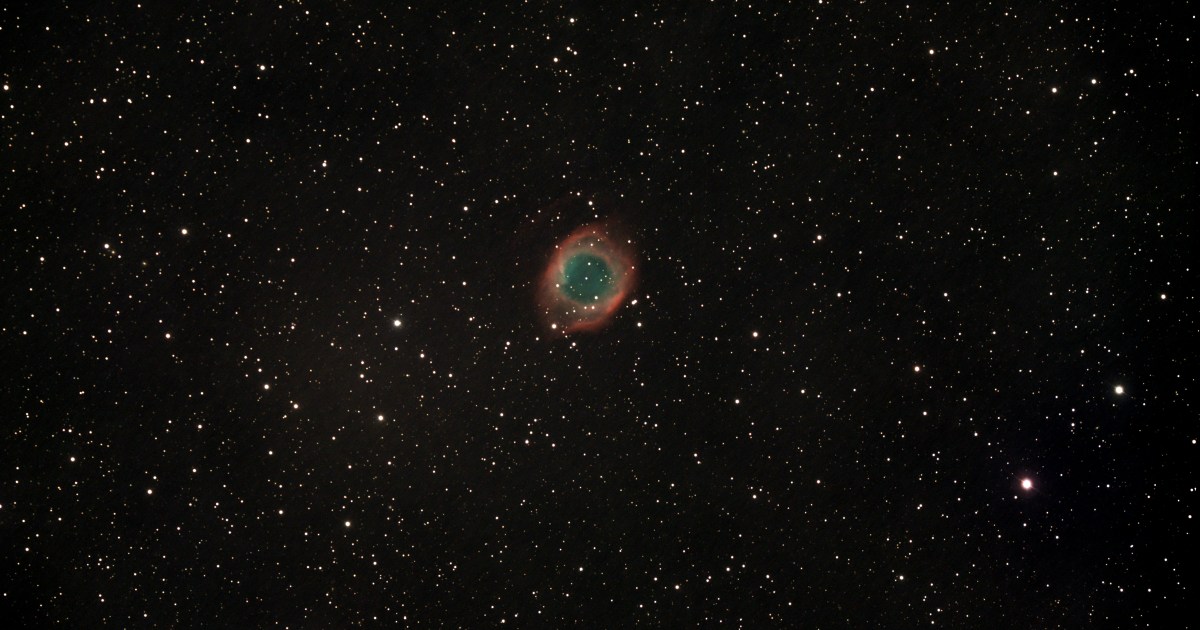
Floating in the constellation Aquarius, the Helix Nebula is a bright, ring-shaped planetary nebula formed by a dying star. | Published: August 19, 2026 The Helix Nebula is a lovely ring-shaped planetary in the constellation Aquarius, visible after moonset on August 19. Credit: Stephen Rahn (Flickr, CC0 1.0) Looking for a sky event this week? Check out our full Sky This Week column. August 18: Stars and sparklers First Quarter Moon occurs at 10:46 p.m. EDT. The Moon is up nearly all evening, not setting until after 11 P.M. local daylight time, so our viewing options are a bit more limited, with only a short dark window. But if you’re willing to stay up late, you’re in luck: NGC 7293, the Helix Nebula, is highest around 1 A.M. local daylight time, when it stands some 30° above the southern horizon. It is also cataloged as Caldwell 63. Located in Aquarius, the Helix is a lovely circular planetary nebula generated as well as lit up by the dying star at its center. Although it is 8th magnitude — quite bright for a planetary — its inner portion covers some 16’ of sky, making it one of the larger planetary nebulae we know. It also means that (like the Fireworks Galaxy yesterday) its light is spread out over a larger area, making its overall surface brightness low. But that doesn’t mean it can’t be seen — in fact, it can still be caught in binoculars or a small scope. On a very dark night (and if you have very good eyesight), you may even be able to see it without any optical aid! It’s in a patch of sky in southwestern Aquarius devoid of bright stars, but you can hop some 7.8° southwest of 3rd-magnitude Skat (Delta [δ] Aquarii) to find it. For a fainter but closer signpost, use 5th-magnitude Upsilon (υ) Aqr — it’s just 1.2° west of this star. If you’ve got a large scope, screw in a nebula filter to bring out more detail, including brightness variations along the edges of its ring. Sunrise: 6:15 A.M.Sunset: 7:51 P.M.Moonrise: 1:52 P.M.Moonset: 11:11 P.M.Moon Phase: First Quarter*Times for sunrise, sunset, moonrise, and moonset are given in local time from 40° N 90° W. The Moon’s illumination is given at 10 P.M. local time from the same location. Alison Klesman is senior editor of Astronomy magazine. She holds a Ph.D. in astronomy and has studied a variety of topics, from minor planets to supermassive black holes.
The Sky Today on Wednesday, August 19: The Helix Nebula
Full Article
Original Source
Read the full article at Astronomy →KhanList aggregates and links to publicly available news content. We do not host full articles from third-party sources. Always verify important information with original sources.